
(Coincidentally enough, I watched Aaye Din Bahaar Ke some weeks back, just after I’d posted my review of Phool aur Patthar. Back then I’d not known that we would be mourning the passing of Dharmendra so soon after. Consider this a tribute).
When I watched Phool aur Patthar some weeks back, I was reminded of the many fairly entertaining films Dharmendra worked in through the mid- and late-1960s. Not all of them were good (some, like Chandan ka Palna, were terrible), but quite a lot of them had at least good songs, a fair deal of entertainment value, and an undeniably handsome male lead to make them worth at least a one-time watch. Some of these (like Aankhen, arguably my favourite Dharmendra film) I’ve reviewed already; there are several others.
Here’s one. I last watched Aaye Din Bahaar Ke perhaps about 20-odd years ago, and actually remembered a fair bit of it. That I didn’t mind watching it again, even though the film is far from perfect, says a lot for it.
The story begins in Darjeeling, where Ravi (Dharmendra) lives with his widowed mother (Sulochana Latkar). Ravi is devoted to his mother: so much so that when Ma is doing her pooja, he tells her, “You may worship your gods, but I will worship only you.” She has devoted her life to looking after Ravi, educating him, etc, which is why this somewhat OTT sentiment.

Ravi is a college student and is looking for ways to earn some money on the side; one of his professors manages to arrange for him to tutor a girl named Kanchan (Asha Parekh). What Ravi doesn’t realize is that he has already met Kanchan—they had a run-in the other day by the riverbank, where Ravi and his friend Anmol Ratan (what a name; Rajendra Nath) were fishing when a fish Ravi had caught landed on Kanchan and there was an uproar: angry shrieking on her part [and Asha Parekh could be seriously shrill when given the chance] and flippant teasing on his.
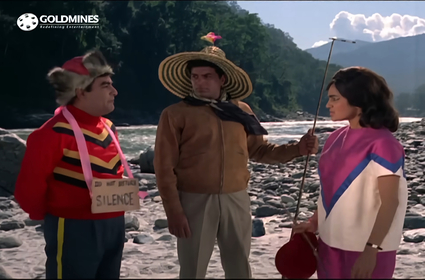
As it happens, when Ravi goes for his new tutoring assignment, he’s combed his hair down and is wearing a rather sombre outfit quite different from his usual leisurewear . This is why, when Kanchan’s father (Raj Mehra) introduces him to Kanchan and Kanchan subsequently comes close to throwing a fit [and him out of the house with it], Ravi is able to think on his feet and tell her—convincingly enough—that he’s the level-headed, sensible one of two twins: she must have met his frivolous brat of a brother, Prakash. [This sounds like it might have inspired Golmaal, though of course this trope of a man pretending to be two diametrically different men, for the benefit of his ladylove, is an old one: see Paying Guest, for instance].
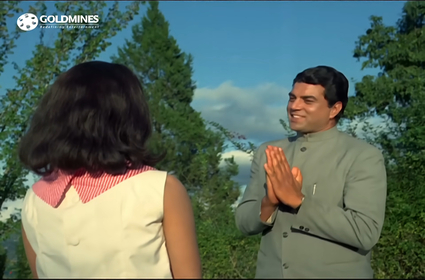
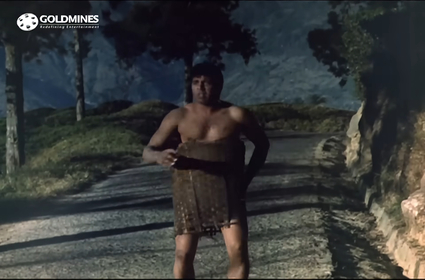
To cut a long story short, much mayhem ensues, as Ravi tries to pretend to be two men, and Kanchan falls more and more in love with ‘Ravi’ while wanting to make sure ‘Prakash’ gets his just deserts. Of course, the farce doesn’t last long, and when she discovers the truth, Kanchan teaches Ravi a lesson. He ends up traipsing through the chilly Darjeeling air clad only in a wicker basket [in the aftermath of this song]…
… and gets a fever, which brings a worried Kanchan rushing to him. And romance blossoms.
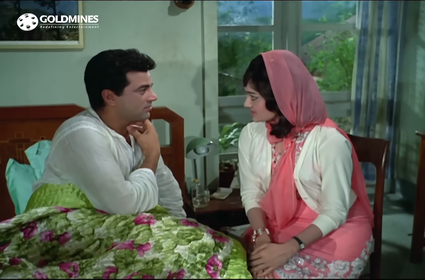
Everything is tickety-boo. They’re singing songs, mooning about the tea gardens, and—with the blessings of Kanchan’s parents and Ravi’s very grateful mother—now preparing to get married. At the engagement party, people have come from far and wide, among them an old auntie of Kanchan’s (Leela Misra). As soon as this old lady is introduced to Ravi’s mother, she looks puzzled, and then shocked. This woman is Jamuna Devi, right? And she belongs to Ambala, right? And she became an unwed mother, and fled town to avoid the shame…!
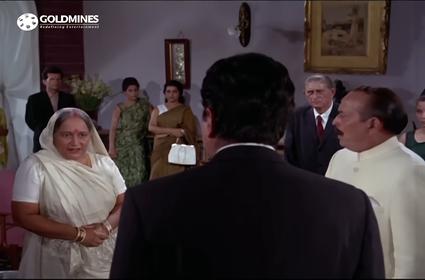
The horror and humiliation of it all is too much for Ravi.
He barely stops to say goodbye to Kanchan; then, taking his mother home, he raves and rants at her, screaming that he wished he’d never been born. He decides he must go to Ambala to find his father. [This, mind you, from a man who doesn’t know his father’s name and hasn’t seen even one photograph of him, though Jamuna actually keeps a portrait photo of the two of them—Ravi’s father played by Balraj Sahni—in her Ramayana].
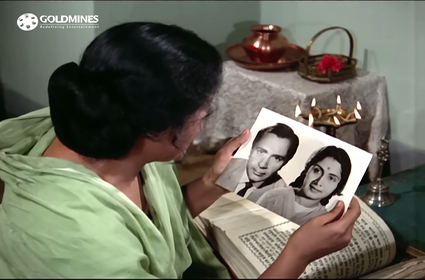
Having heaped invective on his mother, Ravi leaves. Ma, distraught, runs out into the street (where a storm has just begun), running through wind and rain after Ravi, calling for him, but he’s gone.
Ravi washes up in Ambala, where he’s busy drowning his sorrows in drink when a fellow tippler takes pity on him and drags him off to a kotha. Here, the tawaif is in the middle of her dance when her baby starts crying from an adjacent room. She ignores it at first, but increasingly upset by her child’s distress, begs to be excused so that she can feed her baby. Ravi is understanding but the other man starts abusing the woman: “a woman who probably doesn’t even know the name of her baby’s father”—
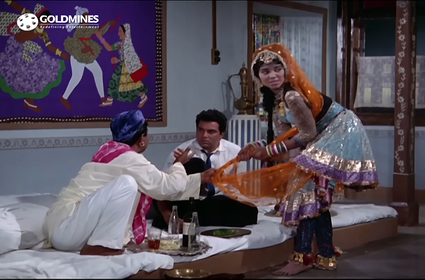
This, of course, infuriates Ravi, who immediately beats the man up, badly enough to get arrested and hauled up in court. And who should the presiding judge be but a man who, in the course of a courtroom conversation with Ravi, discovers that Ravi’s mother is called Jamuna Devi and that she used to live in Ambala.
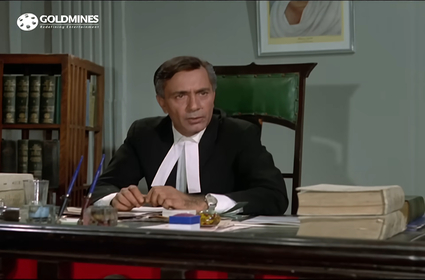
Being the upright judge he is, he sentences Ravi to jail, but then comes and bails him out too [this is the last we hear of Ravi’s sentence. Bail, as far as I know, is not a substitute for a prison term; just a guarantee that the accused will not vanish. Not in this film]. He tells Ravi that surely Ravi has mistaken his mother; that there must be more to this, etc etc. He will personally accompany Ravi back to Darjeeling to find out the truth from Jamuna. [We, having had a ringside view—a glimpse of that photo in the Ramayana—can guess at the truth, but Ravi doesn’t even suspect].
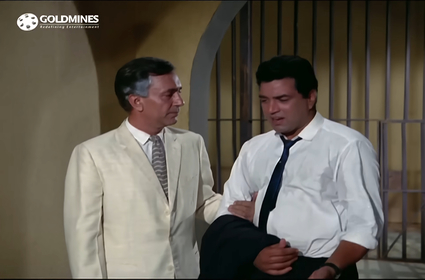
The two men travel to Darjeeling. There, when he gets to his home, Ravi hears devastating news from a neighbour: Jamuna had run out in his wake that day and had ended up jumping into the river. She is dead. Ravi’s sorrow is mixed with anger; his mother is still to blame, as far as he’s concerned.
The neighbour, however, seems to have been Jamuna’s confidant. She tells Ravi that Jamuna was blameless; her only sin was to trust the man who let her down—after having married her secretly in a temple, because she was poor and his parents opposed the match.He promised to fetch Jamuna to live with him, but he disappeared and a pregnant Jamuna, unable to face his betrayal, came away to Darjeeling. She was absolutely chaste.
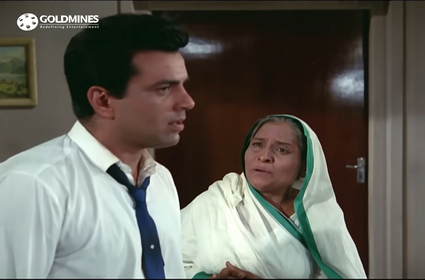
This revelation serves to restore Jamuna’s status in Ravi’s eyes, but he now has it in for that unseen, unnamed, unknown father who ditched him and his mother, leaving them to face the consequences of his cowardice. Ravi is determined to track the man down and have his revenge.
Before he goes off again to Ambala, though, Ravi calls on Kanchan. When he gets to her home, he finds that it’s being decorated, and there’s much hustle and bustle. The old servant directing operations outside tells him that Kanchan is getting married soon.
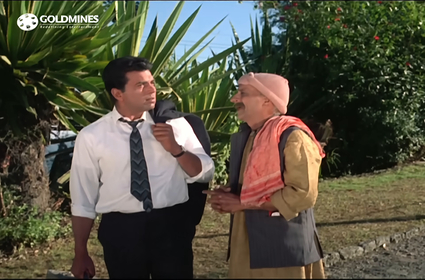
Disillusioned and grumpy, Ravi goes off in a huff [a huffy Ravi leaving someone after a misunderstanding is a common scenario in this film, and more so, without listening to any explanations]. Meanwhile, the servant has told Kanchan what had happened, and Kanchan is very upset: the servant knows she doesn’t want this wedding; she is being forced into it.
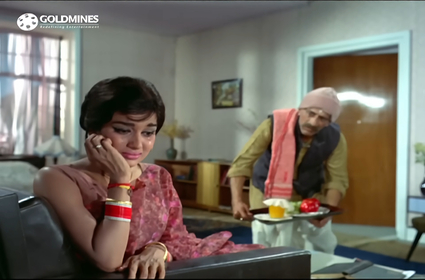
She runs after Ravi, but he’s already taken the train to Ambala.
… So Kanchan heads there too. And sets about wandering through the streets of Ambala, in search of Ravi [why do people in Hindi cinema do this? Isn’t it a chancy, time-consuming and foolish way of trying to find someone? Why not go to the police {in this case, given Ravi now has a criminal record, it might actually be a good way of finding him}]. Kanchan doesn’t find him, but in the process—while running in the middle of a road, inviting an accident—she gets hit by a passing car.
The nurse (Nazima), Rachna, who attends to her is a generous sort. When she discovers that Kanchan is running a fever and is all alone in this city, Rachna immediately offers to play host. Kanchan should stay with her; she’s lonely, and she would love to have a ‘sister’ around. Kanchan agrees, and soon these two are thick as thieves. Kanchan tells Rachna all about her quest to find her beloved (whom, of course, she never gets around to naming, even to a dear friend) …
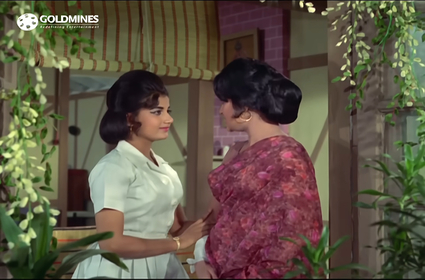
If you’ve seen even a dozen commercially hit Hindi films of the 60s, you will be able to guess how complicated and rife with coincidences this is going to get.
What I liked about this film:
The songs, written by Anand Bakshi and composed by Laxmikant-Pyarelal. There are some melodious ones here, among my favourites being Suno sajna papihe ki (ke aaye din bahaar ke); Khat likh de; Ae kaash kisi deewaane ko; and Mere dushman tu mere dosti ko tarse. This, actually, was the first time I really paid attention to the lyrics of Mere dushman tu meri dosti ko tarse—and was quite impressed with the ingenuity of the curses Anand Bakshi weaves into those lyrics. As a song of bitterness flung at one’s nemesis, this would be breathtakingly nasty; as a song addressed in public to someone one only suspects of underhand work, it is simply very rude and unfair.
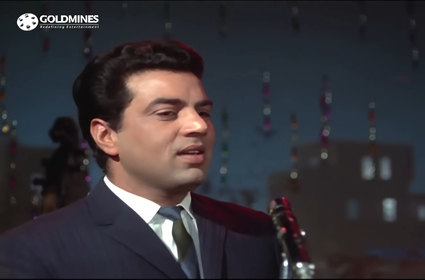
Overall, the film is not horrendous—and the initial bit, the romantic comedy revolving around the Ravi-Kanchan-‘Prakash’ angle, is entertaining enough. Both Dharmendra and Asha Parekh are good at this sort of frothy fluff, and there are pretty vistas, hummable songs, and a generally good-looking lead pair.
What I didn’t like:
The melodrama. (I was going to write ‘the predictable script’ and ‘the numerous coincidences’, but I realize that in Hindi films of this type, this was par for the course and one should take it in one’s stride; Sachin Bhowmick—who wrote the story and screenplay for Aaye Din Bahaar Ke—was only keeping up with the trend). Melodrama, too, is to be expected. But the problem here is that both Dharmendra and Asha Parekh play characters who go through much stress, and that none too gracefully. There is much weeping and wide eyes and quivering lips on both sides, and director Raghunath Jhalani isn’t able to rope it in.
And, the irritating presence of Rajendra Nath. (He is tolerable in some films, but this isn’t one of them. Here he is unnecessary, and silly. What’s with that suit, too?!)
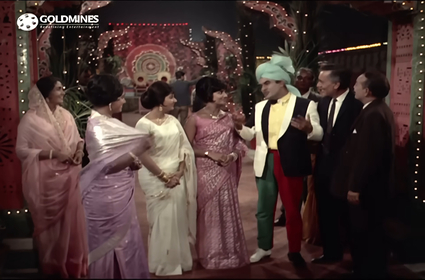
Rather like Phool aur Patthar, Aaye Din Bahaar Ke isn’t an awful film, but it’s not great either. By virtue of a fairly ebullient first half-hour or so, plus better songs, I would rate this higher than Phool aur Patthar.
 Dustedoff
nice review. Timely. Good movie too.
LikeLiked by 1 person
Thank you for reading, and for the appreciation. Glad you enjoyed it.
LikeLike
Nice review of a film I have seen and given it a miss everytime there was an opportunity. Apart from the generally agreeable songs and lovely locale (what more do you need when you have Kashmir / Darjeeling / the Himachal as the background), these three/four lettered films from J Om Prakash – the Aaps, the Aayes, or the Aans – bore me no end.
Btw, there is no way this could have inspired Gol Maal, as it was directly based on Kanamachi, a Bengali story by Sailesh Dey which was later made into a film. What happened to the original —how that film was basically lost forever—is an interesting story. I wrote about it in the Basu Chatterji book, so you can check the relevant chapter for the details.
LikeLiked by 1 person
I find the Aap/Aan/Aaye business, when it has Rajendra Kumar as the male lead, quite avoidable barring the songs. But this one I liked. It’s silly, yes, and thoroughly predictable, but personally, I find it entertaining. Comfort watch, that’s what I’d call it.
I didn’t really think that this might have inspired Golmaal, but wouldn’t you agree that the coincidence is quite marked? One man pretending to be two diametrically opposite brothers, and teaching a girl while pretending to be the good guy?
LikeLiked by 1 person
When Rajendra Kr is the lead I do not care who directed the film. I’d have let it fend for itself even if Satyajit Ray were behind the camera :). That said, having Dharmendra on screen does make a film more watchable, even though I’m not particularly fond of him as an actor. He’s still fine, even in his kutte-kamine avatar.
I actually prefer Dharmendra in his black-and-white films like Bandini, Shola Aur Shabnam, and Anupama.
As for inspiration, Kanamachi (1961) might have influenced both GolMaal and ADBK. Early 1960s Bengali cinema was widely watched—especially by producers and directors in Bombay—so cross-inspiration was very common at the time.
LikeLiked by 1 person
If Rajendra Kumar is the lead, I honestly don’t care who directed the film—I’d have let it fend for itself even if Satyajit Ray were behind the camera! That said, having Dharmendra on screen does make a film more watchable, even though I’m not particularly fond of him as an actor. He’s still fine, even in his kutte-kamine avatar.
I actually prefer Dharmendra in his black-and-white films like Bandini, Shola Aur Shabnam, and Anupama.
As for inspiration, Kanamachi (1961) might have influenced both Golmaal and ADBK. Early 1960s Bengali cinema was widely watched—especially by producers and directors in Bombay—so cross-inspiration was very common at the time.
LikeLiked by 1 person
“I actually prefer Dharmendra in his black-and-white films like Bandini, Shola Aur Shabnam, and Anupama.”
Yes, I agree. There’s an earnestness about him in those films – a sort of restraint – that I like a lot. Still, at least he didn’t let his success go to his head the way people like Dev Anand and Rajesh Khanna did! (Both of those irritate me no end in their somewhat later movies, when the mannerisms overtook the acting).
Thank you for telling me about Kanamachi. I’ll try to see if I can get hold of a subtitled copy.
LikeLike
You wont get a copy of Kanamachi. It is no longer there. The first reel (one that contains the title) was lost in transit. And that was the only copy available. (Check my Basu da book, it is mentioned)
Even I have not seen Kanamachi; have heard stories from my father and his generation. Wish I had seen it :)
LikeLike
Oh, that’s sad. :-( I would have liked to watch it. Such a shame.
LikeLike
I love this movie. There is a good bit of weeping and wailing but still.. no one dies and circumstances are the only villains. Oh to watch Dharmendra flaring his nose at some hapless girl. And to watch him coyly refer to Balraj Sahni and Achala Sachdev as ‘Pitaji’ and ‘Maa’. Suddenly the poor, near orphan has a rich and influential daddy! Pretty Nazima as the nurse and friend just when Asha is destitute. Dharmendra finding his Dad asap! Thoda filmi misunderstanding, Asha picking up the baby because she wants to drive Dharmendra into Nazima’s arms.. ooo.. No one makes movies like this anymore.
LikeLiked by 1 person
Ava, I giggled my way through your comment, it is so delightful – and so true! Yes, it’s a silly film, and quite predictable, and terribly melodramatic, but total paisa vasool and good entertainment. I wouldn’t even call this a film ‘that’s so bad it’s good’, as they say, because I don’t think it’s that bad after all – but it’s good. And yes, I agree: nobody makes movies like this anymore.
LikeLiked by 1 person
Coincidentally, a few days prior to Dharmendra’s demise, I had reviewed this film. I am in complete agreement with your assessment and analysis. Songs are the best thing in this movie. Thanks for the good review Madhulikaji.
LikeLiked by 1 person
Yes, indeed, Jitendraji. I remember reading your review. The songs are certainly top-class in this film.
LikeLiked by 1 person
Hi Madhu
Thanks for the review! Hopefully you will be able to review a couple of other Dharmendra movies – Anupama and Satyakaam.
Thanks
Nishi
LikeLiked by 1 person
Thank you, Nishi! And yes, indeed – I do need to review those films. It’s been donkey’s years since I saw them, so this is probably an appropriate time to revisit them.
LikeLike
Nazima had passed away this year itself. Since in this movie, she has an important role, please say something about her performance too.
LikeLiked by 1 person
I had forgotten that she passed away this year itself. I think her role here is pretty much the sort of role she ended up playing in A-grade films like this (of course in B-grade films where she starred – like Baadal, with Sanjeev Kumar – she got to be heroine). In films like this (or Manchali, another one that comes to mind) Nazima was the sweet and pretty girl-next-door type. Not a rival at all for the heroine, but more a good friend. In this film, I ended up feeling rather sorry for her, because it’s just her bad luck that she ends up being the third wheel in the Ravi-Kanchan relationship. Nazima’s acting was good: she made me sympathise with her.
LikeLiked by 1 person
Thank you for the detailed and informative response. I have been an admirer of Nazima. If you haven’t seen Adhikar (1971), then please see it whenever possible for you. It’s an A grade movie with Nazima in a strong role (parallel to Nanda).
LikeLiked by 1 person
No, I haven’t seen Adhikar. Thank you for the recommendation – I’ll add it to my watchlist.
LikeLiked by 1 person
Ma’am, Pardon for correction, but it’s mourning not moaning (it would have an altogether different meaning). Love your posts always.
LikeLike
Oh God. How did I do this?! Of course I know the difference.
Thank you for pointing that out. Off to correct it.
LikeLike
Fret not, it happens. (Again) loved your post.
LikeLiked by 1 person
Thank you.
LikeLike
Nice hommage to Dharmendra, dear Madhu.
I remember the movie mostly for its songs. Thanks for reminding me of its plot as well.
LikeLiked by 1 person
Thank you for reading, Harvey. I’m glad you liked this.
LikeLike
Madhuji,
There were so many of these movies about orphans and adoption and swapping of kids in the yesteryears. What made them watchable were the songs and perhaps the hills in which they were picturised. In most of them, the last scene is a courtroom one where things suddenly fall in place.
Anita
LikeLiked by 1 person
Yes. One could go on and on about the number of films that feature lost-and-found children, swapped children, and more. Always with many coincidences thrown in!
LikeLike
Madhu, rewriting (or trying to – my brain doesn’t work quite well these days) my comment which WordPress decided to swallow for reasons known only to itself:
I’d watched this movie a couple of weeks ago, and thoroughly enjoyed it, melodrama and all. :) Though, poor Dharam can’t cry for toffee. I just wished the heroine was someone else, though.
LikeLiked by 1 person
Dharam can’t cry for toffee
LoL! That he can’t – there’s that curled and quivering upper lip, that’s all. I was watching Madhumati the other day, and was actually thinking “How well Dilip Kumar cries”! But then DK was DK. :-)
While I don’t particularly dislike Asha Parekh, I agree that another actress might have been more suited for this role. She has a tendency to go overboard with the melodrama.
LikeLike
I knew that Suno Sajna was from this movie but not that Mere Dushman is also from this one. Oh my God, what a horribly bitter, vengeful and just plain cruel song that is. One of my all-time hated songs! How can someone who even for a moment loved anyone wish such horrible curses upon them!!
LikeLiked by 1 person
Yes, it’s such a nasty song! Even if you’re convinced somebody treated you badly and betrayed your love, that’s just plain rude. The curses he flings at her are vile – if I were in her place, I would have dropped him like a hot potato.
LikeLiked by 1 person
Absolutely!
LikeLike