Prisoner of Golconda (1954)

Aka Golconda ka Qaidi: a film made both in Hindi as well as English, though I’ve only seen the English version, not the Hindi, which I couldn’t find anywhere, despite much searching.

Prem Nath directed and starred in Prisoner of Golconda, which also starred his wife Bina Rai and his younger brother Rajendra Nath (whose debut this was, going by the film’s credits). I don’t remember now how I happened to stumble upon the film on YouTube, but I was immediately intrigued; Indian films in English from that era always have that effect on me. What’s more, on a web page, I saw it mentioned (as it turned out, incorrectly) that Prisoner of Golconda was a fantasy. This, I decided, was a film that might merit watching, since the last Prem Nath-starrer fantasy I saw, Aab-e-Hayat, was a thorough entertainer.

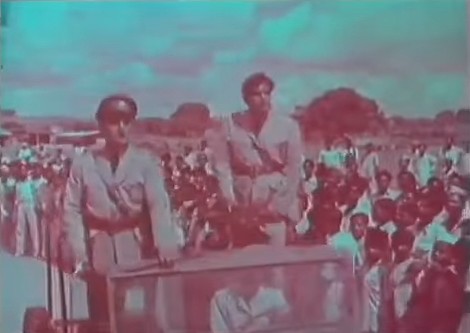
But no, Prisoner of Golconda is no fantasy at all. This is a patriotic film, a story set in the early 1940s, and Prem Shankar (Prem Nath) is a police officer, an ASP, who comes to the rescue of a besieged police station where the local officer, Zorawar Singh (Hiralal) has found himself surrounded by a crowd of irate locals. These people, full of anger for the high-handed ways of the British government (and, naturally enough, seeing in the police the embodiment of that colonial government) have been on the rampage. They have already set fire to a post office and are now getting ready to destroy the police station as well.
Continue reading

Aaye Din Bahaar Ke (1966)

(Coincidentally enough, I watched Aaye Din Bahaar Ke some weeks back, just after I’d posted my review of Phool aur Patthar. Back then I’d not known that we would be mourning the passing of Dharmendra so soon after. Consider this a tribute).

When I watched Phool aur Patthar some weeks back, I was reminded of the many fairly entertaining films Dharmendra worked in through the mid- and late-1960s. Not all of them were good (some, like Chandan ka Palna, were terrible), but quite a lot of them had at least good songs, a fair deal of entertainment value, and an undeniably handsome male lead to make them worth at least a one-time watch. Some of these (like Aankhen, arguably my favourite Dharmendra film) I’ve reviewed already; there are several others.

Here’s one. I last watched Aaye Din Bahaar Ke perhaps about 20-odd years ago, and actually remembered a fair bit of it. That I didn’t mind watching it again, even though the film is far from perfect, says a lot for it.

The story begins in Darjeeling, where Ravi (Dharmendra) lives with his widowed mother (Sulochana Latkar). Ravi is devoted to his mother: so much so that when Ma is doing her pooja, he tells her, “You may worship your gods, but I will worship only you.” She has devoted her life to looking after Ravi, educating him, etc, which is why this somewhat OTT sentiment.

Continue reading

Ghazal (1964)

Those who frequent this blog have probably figured out by now that I have a soft spot (a very soft spot) for Muslim socials. So much so that I will watch just about any Muslim social out there, even if it features people who aren’t among my favourites. Even if it has a fairly regressive theme, and even if I end up not agreeing with half the things in the film. So, when I come across a Muslim social that stars some of my favourite actors (Sunil Dutt? Meena Kumari? Rehman? Prithviraj Kapoor? Rajendra Nath? Check, check, check), has lyrics by my favourite lyricist (Sahir Ludhianvi), and had its songs composed by one of my favourite music directors (Madan Mohan—and how appropriate, too, for a film called Ghazal to be scored by the Ghazalon ka Shahzaada): to not watch this would be a crime, I thought.

Meena Kumari and Sunil Dutt in Ghazal Continue reading

An Evening in Paris (1967)

…and a day or two in Beirut (plus an afternoon in the Lebanese countryside, masquerading as provincial France). A couple of days in Switzerland, and a grey afternoon at the Niagara Falls. Lots of Paris, of course, from the Eiffel Tower and the Champs Elysées, to the bateau mouche and pretty little cafés.

And Sharmila Tagore. And Shammi Kapoor. And pretty mad masala.

What with reading about Amar Akbar Anthony (and thinking over the lost-and-found trope), I ended up thinking, too, about An Evening in Paris, which is a good enough example of the genre. In this one, Sharmila Tagore is the one who plays the character(s) who’re lost: twin sisters, separated as children, thanks to a villain. They grow up unaware of each other’s existence, and in classic Hindi film style—ranging from Anhonee to Sharmeelee—with one sister good and the other bad, or at least not-so-good.

Sharmila Tagore as Deepa and Suzie in An Evening in Paris Continue reading

Love in Bombay (2013)

Or 1971, if you go by the year the film was made, not the year the film was released. Or 1974, which was when the censor certificate dates from.

I came to know of Love in Bombay a few months back, when a newspaper article mentioned that Joy Mukherji’s sons were finally going to be releasing this film. I forgot about it until I discovered that it had finally been released this last Friday—and then I was in a quandary. To see or not to see, as I put it. Various friends urged me on: Harvey, for instance, said that with Agha Jani Kashmiri having revised the script, it may be pretty good. Beth said that she’d heard the costumes were good. Sidharth Bhatia suggested that the presence of Joy Mukherji and Kishore Kumar might be one reason to watch.

Kishore Kumar, Narendra Nath, and Joy Mukherji in Love in Bombay Continue reading