
This was not the post I had been intending to publish today; I had a film review lined up. But then, just the other day, I heard of this new exhibition that’s currently on display in Delhi, and I was … Continue reading

This was not the post I had been intending to publish today; I had a film review lined up. But then, just the other day, I heard of this new exhibition that’s currently on display in Delhi, and I was … Continue reading
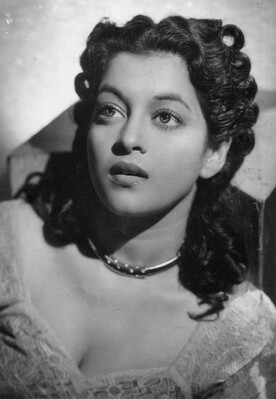
Nalini Jaywant is one of those actresses about whom I’ve changed my opinion over the course of my watching of her films. I remember, as a child (which includes my early teens, which was a peak period when it came to Hindi film viewing), not especially liking her. I was a callow youngster, and as shallow as I was callow. To me women like Madhubala or Meena Kumari were the ultimate in beauty: Nalini Jaywant, with her heavy-lidded eyes and her pouting mouth, didn’t strike me as beautiful. Also, even if I put aside the purely superficial aspect of her looks, there was the fact that I didn’t think her a good actress. I found her voice affected and thin, nothing to write home about.
Thank goodness I grew up. Grew up, widened my horizons, and realized that there are different kinds of beauty. Realized, too, that one shouldn’t pass judgment on the worth of an actor without having watched a wide-ish spectrum of their work. Nalini Jaywant, when I had watched Munimji, seemed just another effervescent filmi female, no more than arm candy; it was through Shikast and Kaala Paani, through Hum Sab Chor Hain and Railway Platform (and many more), that I discovered just how versatile she could be. Goofy, flirtatious, tragic, long-suffering, feisty… Nalini Jaywant aced so many roles, brought so many of her characters vividly to life.
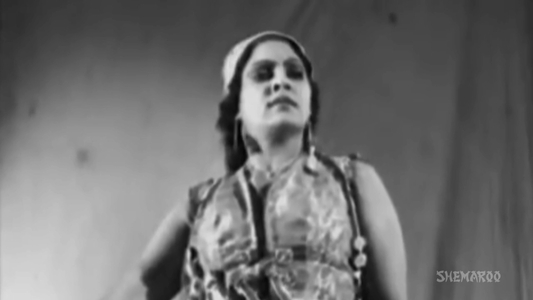
This is a film I first heard about many years ago, when Memsaab reviewed it on her blog. It’s been in the back of my mind to watch it sometime, but it kept getting put on the back burner. Then, some months back, when I was watching Baaz (1953) as part of my tribute on Guru Dutt’s 100th birth anniversary, I was reminded of Amar Jyoti. If Geeta Bali’s woman pirate in Baaz seemed a surprisingly progressive character for 1953, Durga Khote’s pirate queen Saudamini, playing the lead in V Shantaram’s Amar Jyoti in 1936, was even more progressive.
This is a film that’s been on my radar for a long time—in fact, from when I first read about it on Memsaab’s wonderful but now sadly defunct blog. As those who have read my Muzaffar Jang books might know, I find certain sections of Mughal history (especially around the reigns of Akbar, Jahangir and Shahjahan) fascinating. So rich, so interesting, a period of such efflorescence, in different ways. Spirituality; art; architecture; beauty in myriad forms. Among the greatest examples of the Mughal contributions to culture is the exquisitely beautiful Taj Mahal, ‘a teardrop on the cheek of time’, as Rabindranath Tagore put it.
The Taj has been the subject of numerous films over the year (the latest one seems to be controversial enough to have run into trouble). Arguably the most famous film on the subject is the 1963 version, starring Beena Rai and Pradeep Kumar and directed by M Sadiq; there have been more recent ones, including a 2005 one named Taj Mahal: An Eternal Love Story, supposedly the most expensive Hindi film of its time.
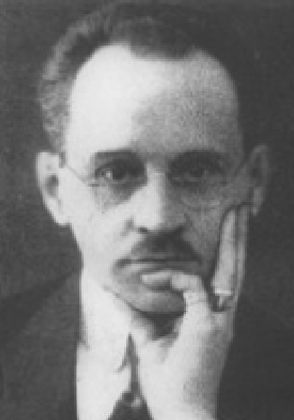
Long before all of these was this silent film, directed by the Bavarian film-maker Franz Osten and produced by Himanshu Rai (who also played the titular role in the film). Himanshu Rai’s interest in cinema had led him to visit Germany, where he had spent some time with the Emelka film production company, exploring ways of getting German collaboration to produce an Indian film. When Rai returned to India, he brought with him one of Emelka’s best directors, Osten, as well as several of their top technicians. Osten went on to direct 16 films in India over the years, of which the second was this one, a story about how the Taj came to be built.
 Dustedoff