
This was a film I watched by way of tribute to Nalini Jaywant earlier this year. I had initially not planned to review it, but there were several points about Raahi that I found unusual enough to make me decide it needed to be documented.
I first heard about Raahi on Anitaji’s blog, where she mentioned that it was based on Mulk Raj Anand’s novel Two Leaves and a Bud—which is where one of the songs of the film, Ek kali aur do pattiyaan, draws its inspiration. Anitaji had included this song in a list of songs picturized in tea gardens, and it intrigued me. The story, set in a tea garden where friction between the workers and a heartless, predictably colonial (money-minded, racist, contemptuous) management causes problems, sounded like something that might merit watching.
Raahi begins on a country road in Assam in 1945. A Britisher (S Michael) going by in a jeep loses his temper at Ramesh (Dev Anand), who’s walking in the middle of the road.
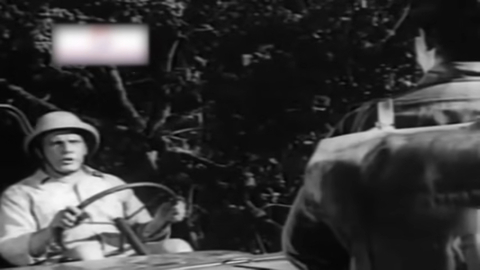
A conversation ensues. Ramesh explains that he is an ex-soldier, unemployed and looking for a job. All he knows is to shoot, to kill, and to obey orders. This last bit seems to resonate with the Englishman, a man named Walker, who manages a tea plantation owned by a Mr MacDonald. Walker needs a supervisor, and decides Ramesh will be a good fit for the job.
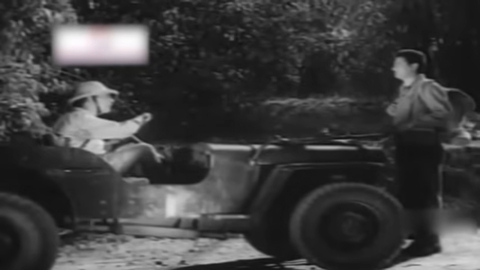
Ramesh accepts with alacrity, hops into the jeep, and goes to Walker’s tea plantation. Here, he is introduced to the clerical staff Kaalu (David) and Shashi Bhushan (Rashid Khan), both of whom are pretty good at boot-licking. Walker hands Ramesh a whip and tells him it’s going to be his job to get the workers to work. That’s what they’re paid for, but they’re always slacking off, always finding excuses to not work or to go slow. Whip, use the whip.
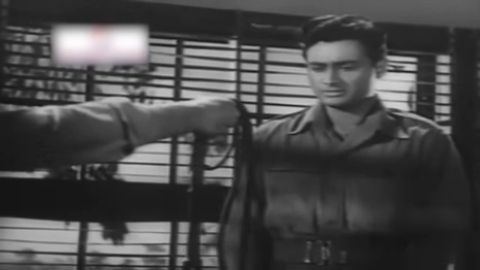
Ramesh is used to taking orders, and has no qualms about obeying this particular order. He’s soon swinging the whip at the workers, at anybody who seems to be taking it easy.
This, of course, makes him an unpopular man, but Ramesh doesn’t care. He doesn’t even bat an eyelid when he (given a small cabin to stay in, at the end of the workers’ settlement) walks through the settlement to his home and everybody along the way turns away or falls silent. The hostility is obvious, but Ramesh remains aloof and uncaring.
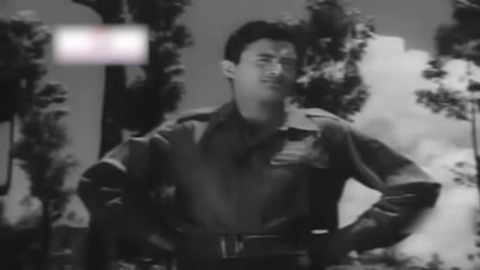
None of the other workers have the courage to snap back at Ramesh for his brutal wielding of the whip. One day, however, he swings the whip on Ganga (Nalini Jaywant) when he sees her sitting down among the tea bushes. Ganga snaps back at him and tells him that she was removing a thorn from her foot.
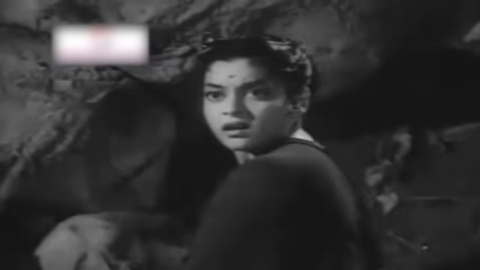
Shortly after, Ganga has further cause to stand up to Ramesh. Another tea-picker, a widow named Chanda (Achla Sachdev), has to bring her baby with her to the tea garden because she has nowhere to leave the infant. The baby is left on the ground near the bushes, and one day, a snake slithers up and bites the child. Chanda screams, and everybody abandons work and races to see what is happening.
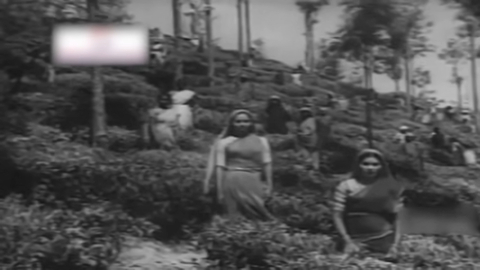
Ramesh, without waiting to check on the reason for this sudden disruption, starts shouting and swinging the whip—which is when an irate Ganga stands up, the baby in her arms, to tell Ramesh where he gets off. For once, there is indecision in Ramesh’s eyes: he realizes that in his zeal to follow Walker’s orders, he’s being inhuman. He backs off.
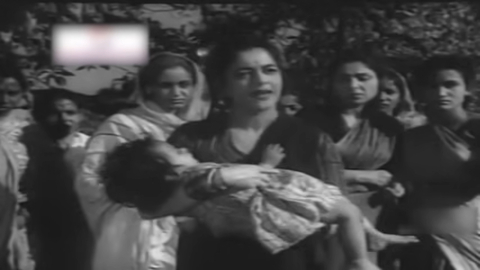
Chanda’s baby is taken to the local doctor, a Britisher named Dr Thomas (Balraj Sahni). Dr Thomas is a good, kind man who is sympathetic to the plight of the workers. He examines the baby, does what he can, but is distressed at his ultimately futile efforts to really do anything. Because of poverty, the baby is already weak and none too healthy; the chances of its survival are slim.
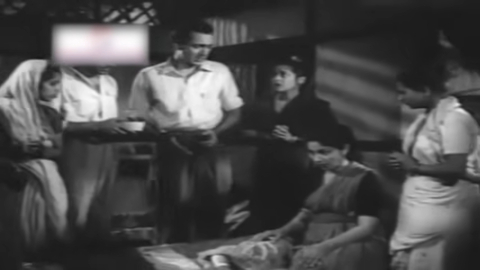
Sure enough, the baby dies, and poor Chanda loses her mind. Since she lives in the settlement, very close to Ramesh, he sees her, and hears her, as she swings her baby’s empty cradle and sings a lullaby to it. It’s an unsettling episode…
… and helps to make Ramesh a somewhat more human character. So much so that when he next meets Ganga—in the jungle, while a tiger hunt (organized for MacDonald and Walker) is in progress—Ganga senses the change in Ramesh and ends up being more comfortable in his presence than before. When the tiger, chased by the beaters, comes into the area where Ramesh and Ganga are walking, Ramesh saves Ganga by hauling her up into a tree.
It’s not as if they fall in love immediately, but there’s a definite easing in the tension, a relaxation of their opinion of each other. There’s even some good-humoured banter, which carries forward into other encounters. Finally, Ganga and Ramesh do confess their love to each other.
But several things happen in the meantime which lead to the climax. For one, Ganga’s father Hari (Manmohan Krishna) is dragged off to be a beater in the afore-mentioned tiger hunt, and in the course of the hunt, he has an accident which leads to one leg having to be amputated. He cannot work now, and he develops a yearning to go back home to his village. He’s had enough of kow-towing to the British.
Then, there’s the arrival of Walker’s sister, Sylvia (Kate Sethi). Sylvia has come to India from England, and is quite intrigued by all the colourful exoticness she sees around her. For Sylvia, this is a strange and intriguing new world, and that too a world where her brother (and, of course, the British per se) are king. A world that bows to them.
The stage is set for that world to collapse. Or will it?
Mulk Raj Anand’s Two Leaves and a Bud was published in 1937, when Independence, or even the hope of it, was still a pipe dream. I haven’t read the book, but if Raahi is a (even relatively faithful) copy of the book, it must have been a brave book, to not flinch from showing people like Walker in a bad light. Of course, by the time Raahi was made, we were well and truly independent and there was no chance of getting into trouble for depicting the British in a none-too-flattering way.
What I liked about this film:
Even though I’ve mentioned (see above) the fact that Raahi does depict the British in a poor light, this is by no means a jingoistic film. There are four Britishers in this film: Walker and his sister Sylvia; MacDonald, and Dr Thomas—but there’s only one man who is really villainous. Walker, who is the quintessential ‘cruel planter’, the man who has no qualms about treating the workers like slaves, and generally regards Indians with contempt. His boss, MacDonald, comes across as somewhat lackadaisical, not really bothered this way or that, and only occasionally showing a spark of harshness.
Sylvia Walker, though she is the one because of whom the story spirals into the climax, is not really a harsh woman, only (and that is perhaps natural) one who loses her cool when frazzled and acts impulsively. She comes across as a person with a conscience, and not scared of speaking up when she thinks it’s needed.
It is Dr Thomas who is the nicest, a man with a heart and a soul, a man who feels for the workers and does whatever he can to help. Balraj Sahni does a good job of portraying this character, and he actually manages to look quite believably British. Also, this is a man who has made an attempt (unlike Walker) to actually polish his Hindi, so he doesn’t speak the broken Hindi of Walker or Sylvia; yet there’s an inflexion in his pronunciation that isn’t that of a native speaker. Good acting, as I’d expect of Balraj Sahni.
Actually, it’s the actors and actresses in Raahi that I especially want to mention. Achla Sachdev, a mere 31 years or so, is young but puts in a very powerful performance as the anguished Chanda. Nalini Jaywant is feisty, hot-headed; and Dev Anand’s Ramesh has the earnestness he brought to many of his early roles.
A quick word about Kate Sethi, an Englishwoman married to an Indian Army officer. Kate worked in at least two films in Bombay, this one and Anand Bhawan (1953). I liked her in Raahi: Sylvia is an interesting character, and of course I applaud the fact that director KA Abbas took the trouble to find an Englishwoman to play this role rather than (as in a lot of later films) bunging a blonde wig onto an Indian actress and getting her to speak her lines in broken Hindi. Because Kate’s English, her Hindi, meagre as it is, is very real for the character.
And yes, I also liked the way the story plays out. The slow and incremental change that takes place in Ramesh’s character, the gradual shedding of the persona he carries forward from his days in the army which have conditioned him to obey the British. There’s a sort of organic progression here, as well as in Ramesh’s relationship with Ganga (and, by extension, some of the other workers, whom he begins to see in a different light), which holds together well.
A last word, too, in praise of the music: composed by Anil Biswas, and with lyrics by Prem Dhawan. Among my favourite songs here are Holi khele Nandlala Biraj mein (is this the earliest filmi iteration of this much-loved song?); Chanda so gaya; Ek kali aur do pattiyaan; and the hard-hitting Zulam dhaale tu sitam dhaale.
The cast is good, as is the story, the direction, and the music. Not so good, however (unlike films like Pyaasa, for instance) that I would watch just for the entire experience. This is ultimately a grim, sad film that I found a little too depressing to want to watch again.
Note:
Raahi was apparently a big hit in the USSR. Just as Raj Kapoor became extremely popular there after Awara, so too, did Dev Anand in the wake of Raahi. This article offers some interesting insights into the popularity of Raahi and Dev in the Soviet Union.
 Dustedoff