Raahi (1952)

This was a film I watched by way of tribute to Nalini Jaywant earlier this year. I had initially not planned to review it, but there were several points about Raahi that I found unusual enough to make me decide it needed to be documented.

I first heard about Raahi on Anitaji’s blog, where she mentioned that it was based on Mulk Raj Anand’s novel Two Leaves and a Bud—which is where one of the songs of the film, Ek kali aur do pattiyaan, draws its inspiration. Anitaji had included this song in a list of songs picturized in tea gardens, and it intrigued me. The story, set in a tea garden where friction between the workers and a heartless, predictably colonial (money-minded, racist, contemptuous) management causes problems, sounded like something that might merit watching.

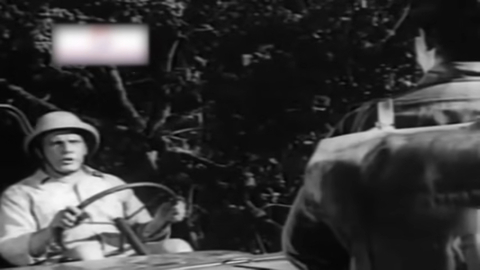
Raahi begins on a country road in Assam in 1945. A Britisher (S Michael) going by in a jeep loses his temper at Ramesh (Dev Anand), who’s walking in the middle of the road.
Continue reading

Dharti ke Laal (1946)

Balraj Sahni devotes several pages of his autobiography to one of his first films, KA Abbas’s directorial debut, Dharti ke Laal (1946). Here, among other behind-the-scenes reminiscences, is an anecdote which especially struck me.

A scene of the film depicts the death of one of its characters, an old peasant who has come to Calcutta to escape the famine in the countryside. In his dying delirium, the old man ‘sees’ the ready crop, fields of rice waiting to be harvested. Around him, his friends and family hover, as the man’s eyes open wide in joy and then, suddenly, he keels over.

It’s a dramatic scene, and was envisioned as taking place under a street lamp, with the light shining on the dying man’s face in his moment of delirium. The set was ready, but somebody had blundered, and the bulb that was supposed to shed its light on the character refused to light up. Abbas, Sahni, Shombhu Mitra (who played the role of the dying peasant), the cameraman and the rest of the crew were in a flap, when a mazdoor—a labourer—suggested an alternative: let the light be provided not by a street lamp, but by the headlights of an approaching car, shining on the dying man’s face. And, as the car moves away, its tail lights should provide the last glow before the man finally dies.

Continue reading