
Aka The Immortal Song, a Marathi film directed by V Shantaram, about the Marathi poet Honaji Sayaji Shilarkhane (1754-1844).
Given that Indian cinema (and not Hindi cinema, but several other regional film industries as well) have always focussed heavily on songs, it’s hardly a surprise that films based on the lives of singers and/or poets have been made time and again. In Hindi, there’s been everything from Meera to Mirza Ghalib to Kavi Kalidas; in Gujarati, I’ve seen Kalapi, about Sursinhji Takhtasinhji Gohil ‘Kalapi’. And then there’s this, about Honaji.
The story begins in Saswad, where Honaji ‘Hona’ (Panditrao Nagarkar) lives with his mother Vithabai (Lalita Pawar) and his wife (?). This is not actually their home; they used to live in Pune with Hona’s uncle. However, the uncle was part of a tamasha troupe, and Vithabai found that a potential bad influence on Hona. She didn’t want him to get corrupted, so she shifted the family to Saswad, where Hona now spends his time being a cowherd.
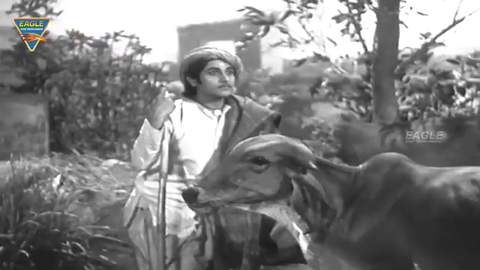
… but, in reality, he spends more time composing and singing songs. It all begins when Hona is sitting outside a temple and listening to the Shastriji who is describing to a group of devotees the raas-leela of Krishna. Hona is so enraptured, he envisions the scene before his eyes and bursts into song.
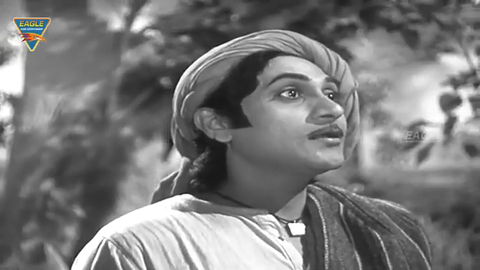
That’s all very well for the budding poet/singer, but not so much for the irate neighbours. Hona’s cows go wandering into other people’s fields, and there is much anger as a result. Things go out of hand, and Vithabai has to hear so much rancour directed at Hona that she decides it’s best for the family to move back to Pune.
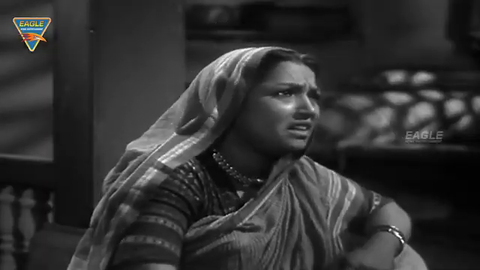
So Hona, his wife, mother and their cow head back to Pune. Vithabai is not happy about the shift, because now that they’re back with their relatives, there’s all that raucous tamasha stuff happening all around them. Hona’s uncle is quite sarcastic about it too, pulling Hona’s leg and trying to get him to come along with him and his troupe: they are off to Shaniwarwada, to perform for Peshwa Bajirao.
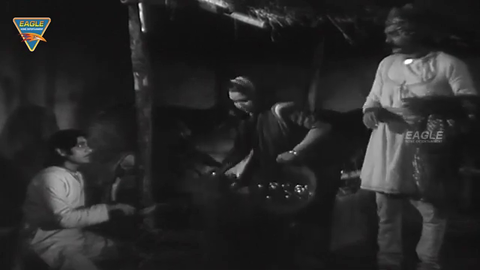
Hona and his mother are headed to Shaniwarwada anyway, but not to entertain the Peshwa; they have been appointed to supply milk to the Peshwa’s household. On the way there, Hona begins to sing, and the Peshwa’s wife (?) is so entranced by his song, she comes downstairs and blesses Hona for singing something so beautiful, such a relief from that awful tamasha!
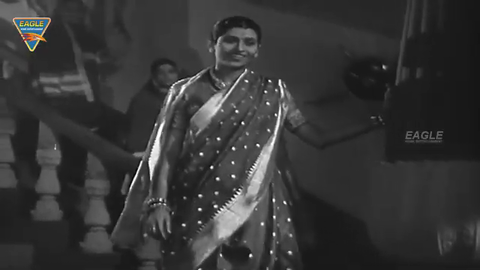
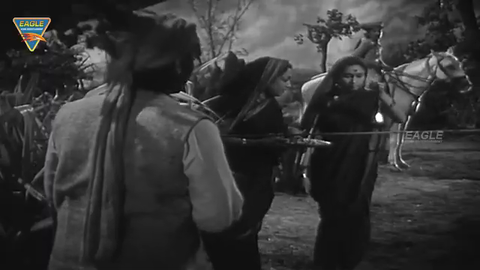
What’s more, she is so impressed with Hona’s song, she bestows a gift: Hona and his mother are to walk out into the countryside, accompanied by her servitors, one of them carrying a lamp. As long as the lamp continues to burn, the distance they have covered will all be theirs. Hona and Vithabai do as instructed, the Peshwa household’s soldiers and a maidservant (carrying a lamp and shielding it with her sari’s aanchal) walking beside them while Hona sings. For quite a while; by the time the flame finally fizzles out, Hona has acquired quite a sizeable chunk of land.
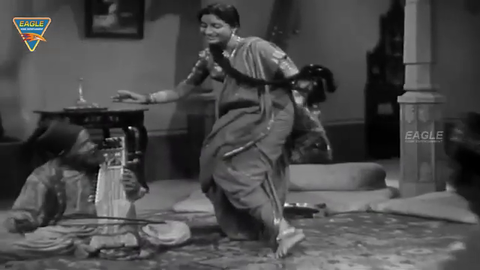
Hona need not worry about earning a living anymore; but a dear friend of his, Bala (Bhalchandra Pendharkar) is taking an interest in Hona’s singing. Bala, in fact, has gotten acquainted with a local dancer-and-singer named Gunvati (Sandhya, in her debut role) who lives and performs at Baavankhani. When we are introduced to her, Gunvati is singing a classical tune, and has realized that this has no takers. The patrons want sizzling songs, the ribald lavanis for which Baavankhani is famous (or infamous, really). And Gunvati has no wish to sing lavanis, even though her mother Jamuna (Amina) knows that’s where the money is and is egging her on to jump onto the bandwagon.
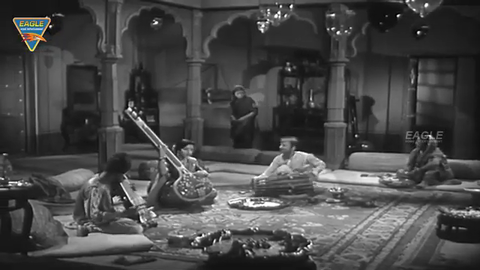
Bala meets Gunvati and tells her about Hona, and about his beautiful songs. He even manages to get Hona to sing one of his songs while walking in the vicinity of Baavankhani, so that Gunvati can hear Hona’s song for herself. Gunvati is entranced; this song bridges the beauty of classical music with the joie de vivre, the energy, of lavani brilliantly.
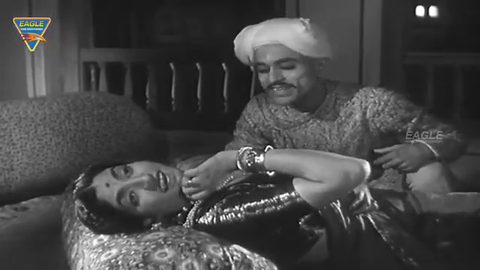
Encouraged by Bala, Gunvati sets out to learn Hona’s songs. She meets him ‘accidentally’, pretending to have fallen down in the area where Hona is ostensibly grazing his cows. Hona comes to her rescue, and (Hona being Hona, needing no excuse to burst into song) soon begins to sing. Gunvati joins in his song…
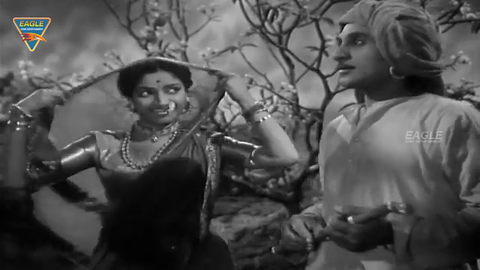
… and takes that song back to Baavankhani with her. Hona’s song, Hona’s words and talent and music, which had entranced the Peshwa’s wife, which his mother regards as a prayer—offered up to the clientele of Baavankhani.
And all this happening in tumultuous times. The British East India Company has its factors and officials at Pune, keeping tabs on all that’s going on, not just in Pune but around as well. Also, at the same time, enmity has sprung up between the Peshwa and the Holkars of Indore. Vithoji Rao Holkar, the youngest brother of the ruler, Yashwantrao Holkar, has been killed by the Peshwa, and Yashwantrao Holkar has sworn to have his revenge.
With this in mind, Yashwantrao Holkar sends a couple of his men as spies, recruits (to employ traitors who will help them out in Pune) as well as borrowers of funds.
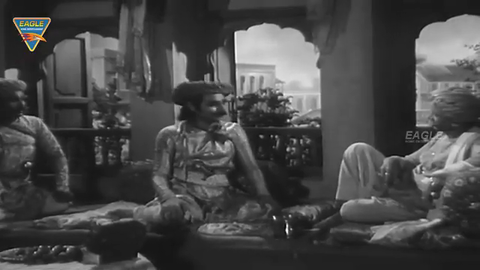
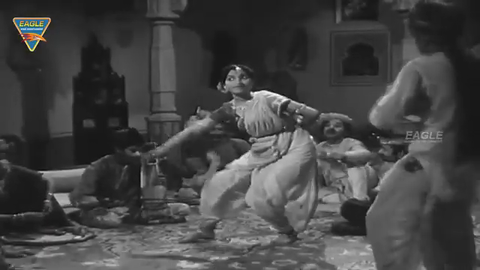
These men arrive in Pune, begin to make their plans by borrowing money, talking to people—and, in their leisure time, going to Baavankhani to see and hear Gunvati singing.
With a screenplay by Vishram Bedekar and music by Vasant Desai, Amar Bhoopali proved a great hit, marrying as it did several themes that resonated with audiences: poetry, of course; devotion (Hona’s first, and most commonly sung composition in the film is the lovely bhajan Ghanshyam sundara shridhara); and, finally, patriotism, the love for one’s land. V Shantaram was to use these motifs in other films as well (most notably in Navrang, 1959); but this film, just eight years before Navrang, was also able to work in the personality of one of Maharashtra’s best-loved poets of the era, and that made it even more appealing.
Honaji is much loved in Maharashtra, especially as a poet who contributed vastly to the creation of lavani music; his association with his friend Bala (who sang his songs) resulted in them being together known as ‘Honaji Bala’, a nomenclature so widely used that some people seem to think them a single person.
What I liked about this film:
The music. Vasant Desai was an excellent choice as music director for Amar Bhoopali, and each song (sung by Panditrao Nagarkar, Lata Mangeshkar, and Asha Bhonsle) is a gem. My favourites are Ghanshyam sundara shridhara; Saanga mukund kuni ha paahila; and Tujya preetiche dukh mala daau nako re, but really, there wasn’t a single song here I didn’t like.
And, the overall experience. Yes, Sandhya’s acting was somewhat theatrical (this is a constant complaint when it comes to my appreciation of Sandhya: fabulous dancer, not so great actor); but other than that, there was really very little here that I didn’t like. And even then, Sandhya’s dancing makes up for her acting. She’s so good.
Plus, the visuals. I love the way Sandhya and Jamuna move, the way the frames are composed when Sandhya is in them: this was almost like watching one of Raja Ravi Varma’s paintings brought to life.
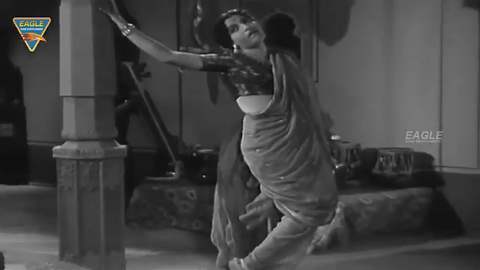
But, one closing thought: why do scriptwriters find it essential to assign a romantic muse to a real-life poet? And that too one whom he isn’t married to? Mirza Ghalib, in the film, had Moti Begum; here Honaji and Gunvati fall in love, though he continues to be married to his wife. Is there an underlying idea that a poet must have a forbidden love? (Though Navrang’s Divakar is probably an outlier in that respect: his muse is his wife, though she doesn’t know it: was that conventional relationship the result of a fictitious poet, rather than a real-life one? Who knows?).
At any rate, a good film, and one I enjoyed a good deal.


I enjoyed this write-up, Madhu. I have actually watched this film even though I couldn’t find English subtitles, because I knew it featured Sandhya’s famous debut, and I had also heard praise for Lata’s singing in this. I knew some basics about the plot, but it was good to see it spelled out clearly. I also appreciate that you agree that Sandhya – at least as a dancer – was so good!
LikeLiked by 1 person
I was lucky to be able to find a subtitles file for this film, Richard. Of course it meant I then had to download the video from YouTube in order to be able to play it with the subs, but it was worth it. I enjoyed it a lot. :-) Also, I didn’t mind Sandhya’s acting here as much as in some other films of hers. Perhaps it was the milieu? Perhaps she was a little more contained in her debut? I don’t know. Still a little too theatrical for my taste, but anyhow.
LikeLiked by 1 person
I tried to leave a comment, but it is not going through; not sure why.
This is a new test comment.
LikeLike
Your first comment went into the spam folder, I don’t know why. I retrieved it from there, but then realized that you’d posted your comment again (thank you!).
LikeLike
OK, so now trying again.
Great to read this post! I’m a Maharashtrian, and I grew up in Bombay hearing so much about this movie though I never saw it. But\ the songs blared out from our kitchen-counter radio almost every day! Ghanshyam sundara was used in an \ ad campaign by Maharashtra times. And latapata latapata was the canonical lavani song I knew off even be\ fore I heard the songs of Pinjra. I remember seeing its picturisation on TV in a Marathi version of Chaa\ yageet. The concept of classical music having a place in popular was so alien to me – while in school, I\ detested classical music as slow and boring. It took quite a while for my father and sister to educate \ me about many popular songs being based on classical ragas :-)
LikeLiked by 1 person
I can completely relate to your recollection of not being drawn to classical music and regarding it as slow and boring. It’s taken me some time to get to the point where I am able to appreciate it, but now I am very happy to come across a film like this, which really celebrates classical music.
LikeLike
I liked Amar Bhopali a lot, when I watched it decades ago on DD. From the songs I particularly liked lat pat lat pat. What I noticed from your screenshots is that Honaji often has that faraway look; like the lady at the ball says about Eliza Doolittle in My Fair Lady (1964).
LikeLiked by 1 person
I had forgotten about that quote from My Fair Lady, but I agree completely! He does have that faraway look. :-D
Thank you for reading, Harvey.
LikeLike
I watched this a long time ago – on DD, actually. And my grandfather, who does not understand a word of Hindi, let alone Marathi, watched it with me. Of course, sub-titles helped enormously, since I didn’t know any Marathi then, either. The songs were fabulous. But then Vasant Desai was such a wonderful composer. And both Lata and Asha sounded a tad different when they were singing in their mother tongue.
Thank you for bringing this film back to mind, Madhu. I’d forgotten much of it, and your review really brought it alive.
LikeLiked by 1 person
Thank you for reading, Anu. The songs are such a vital part of the film, actually, that I think one could enjoy the film for them without maybe understanding too much of what was happening (says someone who refuses to watch an alien-language film without subtitles!) I agree with you re: Lata and Asha singing in Marathi: there is a certain je ne sais quoi…
LikeLike