
When I was compiling my list of Raj Kumar songs last week, it occurred to me that there are several major films of his that I haven’t reviewed yet. Dil Apna aur Preet Paraayi, for instance, which stars one of my favourite actresses, and features one of my favourite songs. A film I watched many years ago and remember only in a fairly rudimentary way. Time for a rewatch, I decided.
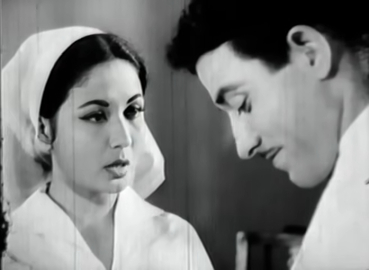
The story begins with the arrival, at a hospital, of Karuna (Meena Kumari), who has just completed her training as a nurse and has come here for an interview. In her conversation with Dr Malhotra (Kumar?), Karuna explains—in response to a question—that her father had been a renowned doctor back in Himachal (she belongs to a village near Kullu), but he had a weakness for alcohol. The death of a patient on the operating table because of Karuna’s father’s alcohol-fuelled negligence resulted in such a feeling of guilt that he drove his car off a cliff. Karuna’s mother lost her mind because of the grief of bereavement and went down the same cliff.
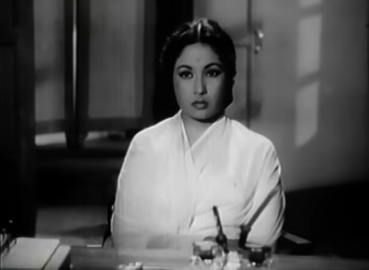
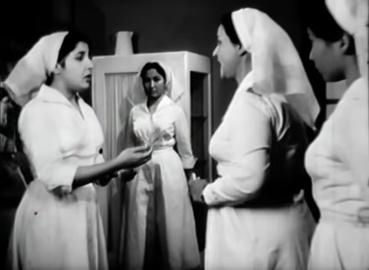
Karuna joins the nursing staff from that day on, and quickly makes friends the other nurses. The Matron (Ruby Myers/Sulochana) is, at least on the outside, a strict disciplinarian, but the other nurses, including Sheela (Shammi), know that she is actually not quite such a harridan.
Among the patients, too, Karuna soon makes herself popular. Girdhari (Om Prakash) has stomach cancer but is invariably effervescent, talkative, ebullient. On the other hand there is Nathu (?), who is abrasive and unco-operative, refusing to take his medicine and throwing tantrums (as well as said medicine) when Karuna, on duty in the general ward, tries to get him to swallow it down.
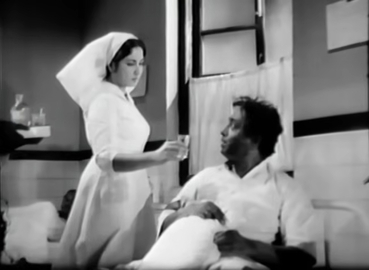
Nathu’s fit of anger is noticed by Dr Susheel Verma (Raj Kumar), whom Karuna met in the OT on her first day, when Dr Verma operated on Girdhari. He’s a good surgeon, and it was obvious that Karuna, returning the watch he had forgotten beside the washbasin while washing up, was a little self-conscious in his presence. Now, watching Karuna deal with Nathu—firmly but kindly getting him to take his medicine—Dr Verma is impressed.
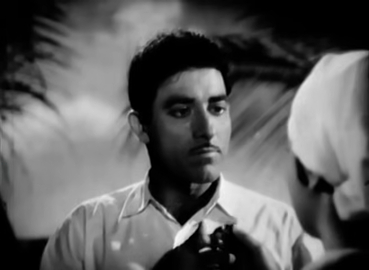
Later still, as he talks to her, one day running into her at the seaside, or chatting over a cup of coffee from the nurses’ station after an operation, Dr Verma and Karuna get to know each other a little better. She’s quiet, he’s a little awkward, so neither of them actually admits how they feel about each other.
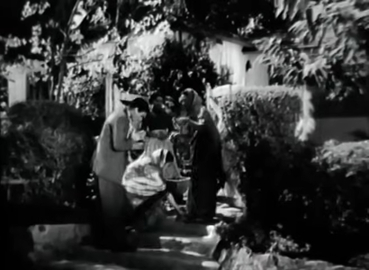
In the meantime, Karuna has also, all coincidentally, met Dr Verma’s widowed mother (Pratima Devi) and his teenaged drama queen sister Munni (Naaz). Munni had one day been in the park and had gotten slightly hurt in a mishap; her loud wailing and dramatics had attracted the attention of Karuna, who had also been in the park at the time. Karuna had attended to Munni and helped her back home, which is how she made the acquaintance of Dr Verma’s family. Both his mother and Munni like Karuna a lot, and Karuna starts visiting them often, massaging Mrs Verma’s painful foot, having tea with them, and chatting.
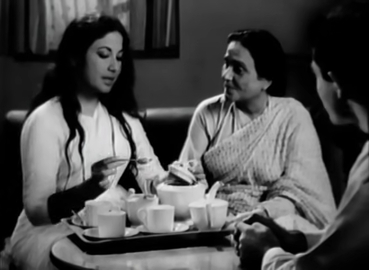
The unspoken feeling between Karuna and Dr Verma does not seem to have made any impression on Mrs Verma, at any rate; because one day she insists that Susheel and Munni accompany her to Srinagar to look up a family friend of theirs, Lala Basant Rai. The Vermas have much to be grateful to Lalaji for; after Susheel’s father’s death, he was the one who financed Susheel’s further education, even sending him abroad to study medicine.
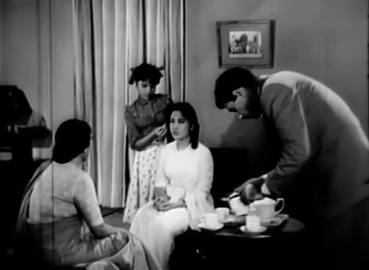
So the family goes to Srinagar, and there Dr Verma realizes that this was all a ploy to get him to Srinagar. Lala Basant Rai is perfectly well, but the fact is that his daughter Kusum (Nadira) has returned after completing her studies abroad, and now Lalaji and Mrs Verma, who have decided on their own to get Susheel and Verma married, are pushing for the wedding to take place. Susheel, for whom this is a bolt out of the blue, tries to push back, but his mother (like so many Hindi film parents) resorts to emotional blackmail. He should know how obliged they are to Lalaji; she has given her word, and if he refuses, she will kill herself.
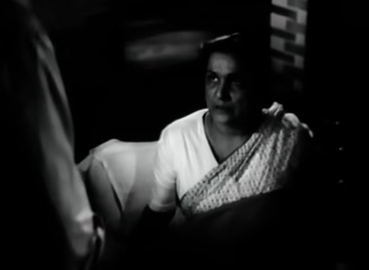
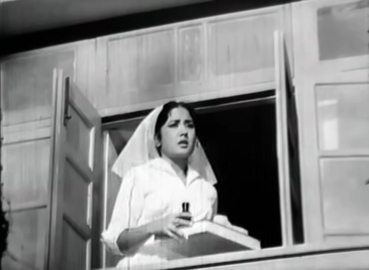
Thus it is that a few days later, when Karuna is out on the balcony of the hospital, she sees the Vermas returning to their home next day. The car stops, the mother and son and Munni get out—and so does a heavily made-up Kusum, saree pallu over her head. Karuna is surprised, curious; but when Mrs Verma hurries into the house and emerges with a thali, welcoming Kusum in, and Kusum and Dr Verma bend to touch her feet… Karuna realizes what has happened, and is devastated.
It might have been all well if Kusum had settled in well and Dr Verma was obviously happy with her; but this doesn’t happen. Kusum is the quintessential spoilt daughter of a very wealthy man; and like all such women in Hindi cinema, she is not just spoilt but also selfish and unscrupulous and too proud of her wealth.
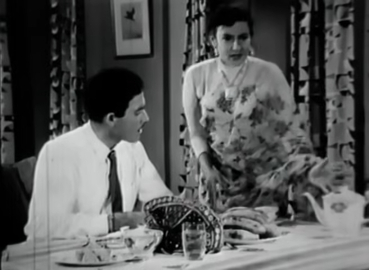
Within days of moving into the doctors’ quarters, Kusum, of her own accord, changes all the furniture and the curtains. When Dr Verma asks her about this, she tells him that she bought it with her own money; when he tells her—still gently, not accusingly—that all this fancy décor is a far cry from the décor of the other quarters and that it’s not quite in keeping with his (humble) status, Kusum throws a tantrum, tearing down the curtains and shrieking until her distressed mother-in-law makes her sit down and have her tea.
But this is only the start. It doesn’t take long for self-centred Kusum to realize that her husband is a very dedicated doctor, and that that means he gets called away every now and then, even at odd hours, to attend to patients. At times, for instance, when Kusum would much rather be partying at the club or watching a movie.
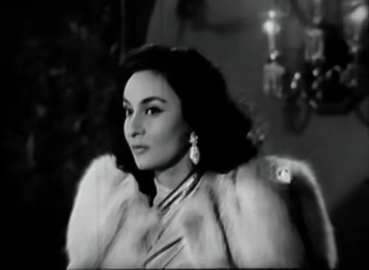
… and, of course, all the while Karuna, looking on from the sidelines, is seeing the man she loves with another woman.
Over the years I’ve been blogging, several people have reminded me that this is one film I haven’t reviewed. It had been so long since I watched it, too, that I’d forgotten the finer details of it, but I did remember that it wasn’t that fabulous a film.
Now I realize why that memory remained.
What I didn’t like about this film:
The cardboard, uni-dimensional character of Kusum. There is nothing nice about this woman. Nothing which redeems her, nothing which struck me as relatable. In fact, almost from the beginning—when she throws that tantrum and pulls down the curtains—I began thinking “this woman has mental health issues”, and that was a notion which simply went on resurfacing as the story progressed. Kusum’s character (especially given that she’s married to a doctor and the milieu is that of a hospital) cried out to have the spotlight shown on what sort of complex could plague someone who otherwise seemed to have it all. But no; we are given a cardboard cut-out Kusum, a Kusum so evil and nasty, that she comes across as hard to believe.
Then, there are the others: all the Vermas, actually, every one of them annoying in their own way. Munni’s whiney, over-the-top wailing and complaining is annoying from the first, and her mother’s insistence on Susheel marrying Kusum out of obligation is the sort of thing I detest. Why parents in Hindi cinema behaved like this, and then went scot-free after wrecking their offspring’s lives, I will never know.
… and there’s the said offspring. The intention may be to paint Dr Verma as the strong, silent kind, but he comes across merely as the weak-willed, spineless sort who will let others ride rough-shod over him just because. Why couldn’t he tell his mother that he was already attracted to someone else? Or that this was his life they were discussing. Or whatever—but then, of course, there wouldn’t have been a story.
But then, what I did like:
Meena Kumari as Karuna. While she is kind and gentle (though steely, too, when it comes to enforcing discipline with patients like Nathu or Girdhari), Karuna comes across as a woman of character. When she realizes that she, Dr Verma and a jealous Kusum are forming a triangle, she makes it clear, even to Dr Verma himself, that things are no longer the same. For example, after a late-night operation, when Dr Verma asks if she will get him a cup of coffee, Karuna does so. The scene is the same as in the earlier instance, long before he was married, when they stood comfortably together and had coffee…
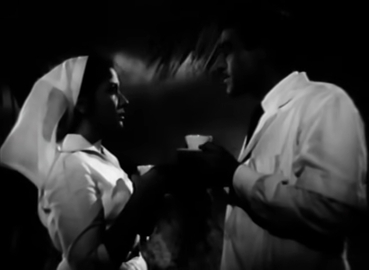
Now, it’s only him drinking. He asks her about her cup, and she says no, she won’t have coffee.
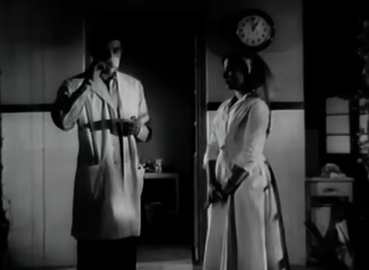
And on one momentous occasion, when Kusum has been guilty of deceit (and only Karuna knows that), Karuna tries to hedge and deflect Dr Verma’s questions: she doesn’t want to tell tales, even if that tale is the truth.
A good character, and very well-portrayed. Meena Kumari manages to say so much with just her eyes. And, since she has very little dialogue, the expressiveness of her eyes, her face, even her walk—speaks volumes.
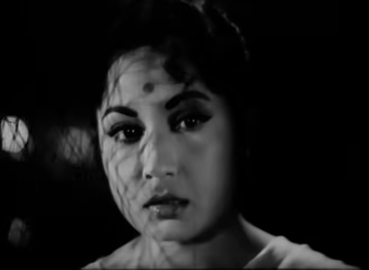
(Talking of her walk, why do all the nurses in Dil Apna Aur Preet Paraayi wear heels while on duty?)
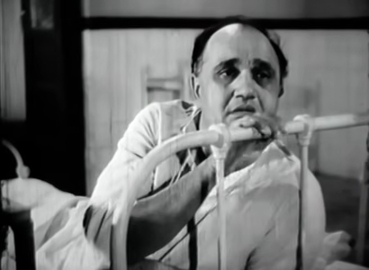
Then, there’s Om Prakash as the patient Girdhari. This is one of his better roles: a man who tries to remain upbeat, even silly, but whose façade of insouciance slips now and then when he comes face to face with his looming mortality. Om Prakash was a good actor but I think he ended up playing a fairly one-note, buffoonish comic in far too many films; here he gets a chance to show some of his acting skills.
Plus, of course: Ajeeb daastaan hai yeh. Shankar-Jaikishan’s music and Shailendra and Hasrat Jaipuri’s lyrics make this a very good score, with memorable songs like Jaane kahaan gayi, Sheesha-e-dil itna na uchhaalo and Ooi itni badi mehfil (though very obviously lifted from Harry Belafonte’s Banana boat song)—but the standout song here is the exquisite Ajeeb daastaan hai yeh, where everything comes together seamlessly to create a classic. Whether it’s Lata’s rendition, the tune, the orchestration, the sections of the backdrop that are sung by the chorus, or Shailendra’s lyrics: each element is just right.
Despite all its shortcomings when it comes to characters, at least this is a largely entertaining film, for me the best of all that Kishore Sahu directed.
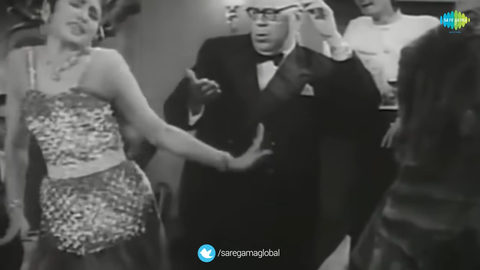
Little bit of trivia: Sidharth Bhatia tells me that in Ooi itni badi mehfil mein, the bespectacled, partly bald man who appears at about the 0:33 point is Josef Wirsching, the Bombay Talkies cameraman who filmed Dil Apna Aur Preet Paraayi, as well as other films like Mahal and Pakeezah.


Even the Ajeeb Daastaan song is a copy. Original song is My Lips are Sealed by Jim Reeves.
LikeLiked by 2 people
Yes. But unlike Ooi itni badi mehfil mein (which is an out-and-out copy, very easily recognizable) the ‘distance’ between My lips are sealed and Ajeeb daastaan hai yeh is far wider – the latter is a much more evolved tune, and the arrangement is superb.
LikeLiked by 1 person
So finally you’ve reviewed this classic. I had seen it first on Doordarshan long long back. Meena Kumari’s characterisation, her acting, Kishore Sahu’s direction and SJ’s music are its pluses. Among its songs, you’ve not mentioned the title track which is also very good. Your review is very good and assesses it perfectly. It was remade as Armaan (2003) casting Anil Kapoor, Gracy Singh and Preity Zinta in principal roles and Preity Zinta delivered a far better performance than Nadira in the negative role.
LikeLiked by 1 person
I hadn’t known it was remade. I like all three – Gracy Singh, Preity Zinta and Anil Kapoor – so will try and see if I can find Armaan online.
Thank you for reading, Jitendraji.
LikeLiked by 1 person
Yes. ARMAAN was a quite well made film and I did enjoy it more than Dil Apna…
LikeLiked by 2 people
Loved Meena K in this film (and in many others) and disliked everybody else. But the only part that made me laugh out loud is
*SPOILER* (for those of you who haven’t yet watched the film)
When Nadira drives off the road with MK and Rajkumar leaps to the rescue, he stops ‘rescuing’ once he’s gotten hold of MK. And I’m thinking to myself, “Attaboy!” and “Poor Nadira!” all at once. :)
LikeLiked by 1 person
Heh! Yes, that struck me too. So “Jisko nikaalna thha, nikaal liya. Ab jo ho so ho.” ;-)
LikeLike
It’s an engaging film to watch despite of typical characterization of Nadira and Dr. Verma’s mother. Your review makes me want to rewatch it.
Pray how do you expect Kusum to have any redeeming quality? By Hindi cinema standards at that time, unless you are wet mop & doormat combined, you could not be a good wife. And certainly not if you were Nadira – wealthy, educated abroad and fond of parties.
Parents were firmly put on pedestal, more so, if they had raised off-springs single‑handedly like Dr. Verma’s mother. Since they were not allowed to be human, they could do no wrong, induce no harm.
Though, it did make sense for RK to save MK rather than N—for the greater good of society. Here me out – Again by those very standards, love (before or during marriage) was generally considered an anathema. To love an individual above family, relations, friends, or society was seen as shameful. Sacrificing personal affection—if there had ever been any for N—was glorified so long as it served whims of someone, anyone.
So why bother saving a spouse which was already deemed socially unacceptable, when shining epitome of sacrificing womanhood was lingering on sidelines?
MK might have discouraged further mess but she never really moved on. But then again, we would have no movie, had she actually moved on.
LikeLiked by 1 person
Heh! I enjoyed your comment thoroughly. Such an interesting tongue-in-cheek analysis of the film’s knotty love triangle.
To add to the bit at the end: if MK’s character had moved on, she wouldn’t have been the Sati Savitri who deserves the hero at the end. A ‘good woman’ is the one who goes on pining and loving her man even if he is no longer her man. This longsuffering, all-sacrificing, always-loving attitude is what gets her the right to be rescued while others simply drown.
LikeLike
Madhu ji,
One of them has to clear the way. But , I wonder why they did not turn it into a tragedy in keeping with the times by killing both or MK instead.
Anita
LikeLiked by 1 person
Killing MK would make it a horror story. ;-) And for it to qualify as a tragedy (in the way Hindi cinema interpreted it) would mean killing off MK and RK! But I think by this time there were far fewer outright romantic tragedies of the kind that Dilip Kumar acted in through the late 40s and through the 50s – of the Mela, Shaheed, etc style.
LikeLike
I first saw Dil apna aur preet paraai in school ( in the school). For some reason I missed the reason why RajKumar married Nadira if he didn’t like her, and spent so many years puzzling over it. Had she blackmailed him somehow over something? I did not remember much of the film except a few of the hospital scenes. A few days ago YouTube algorithm threw it up and I watched with some trepidation, anticipating weep fests or self sacrifices. I was pleasantly surprised. Of course, the points you make about the characterization of Nadira is correct, but I not only got to know the reason for Rajkumar marrying Nadira, but also realised that at that point of time although he was attracted to or perhaps liking Meena kumari, they had not declared their feelings, or perhaps his preferring her was not very clear to his own self. And Meena Kumari is so good in it. And her character is so dignified and competent and not weepy at all. I liked the film, though if course, I must admit I fast forwarded through some of Nadira’s tantrums and through one song.
LikeLiked by 1 person
Thank you for sharing what you felt about the film. Yes, I guess the fact that he hadn’t actually expressed his feelings for MK (and perhaps was not absolutely clear about it himself) makes it more plausible that he gave in to his mother and married Nadira.
I did watch through all of it, including her childish tantrums – but which song did you fast-forward? I’m curious.
LikeLike
Sorry for being late with the reply. I had to think it over and re-watch that segment. I realised that what I had fast forwarded through was not an actual song but the prelude / introduction to ” andaaz mera mastana”. The songs of the film are all lovely.
LikeLiked by 1 person
No worries. Thank you for telling me. And yes, all the songs are lovely!
LikeLike
I find myself in agreement with your review, especially the likes and dislikes, the latter being one of the reasons I am not so fond of the movie, I much prefer an Ardhangini or an Aarti over this (better storyline and atleast the antagonist women characters have their reasons and redeeming arcs). Meena Kumari’s performance is however brilliant as always.
Now although everyone’s favorite song from the movie obviously is Ajeeb Dastaan Hai Yeh, which ofcourse is an evergeen heartbreak song; however, as an MK fan, mine is Sheesha E Dil Itna Na Ucchalo, coz it is such a rare sight from her 60s filmography to see her have so much fun in a girly song, the melody and lyrics too are wonderful.
Interesting bits of trivia about the film: On the radio programme Jaimala in the late 1960s, Meena Kumari revealed that the original climax wasn’t supposed to have her character and Nadira’s character confront each other. She strongly felt that it was essential for both women to face the truth, and insisted that the scene be included, despite the director, writer and producers initially disagreeing with her as they felt two women could not face each other. Eventually, they agreed to her version of the ending. I do wonder what the original climax was supposed to be!
Did you know that Sheesha-e-Dil Itna Na Uchhalo was actually meant to be banned by All India Radio for its supposedly suggestive lyrics? Thanks to a clerical mix-up, the ban sticker was mistakenly pasted on the other side of the record, resulting in Ajeeb Dastaan Hai Yeh being banned from the airwaves instead for several years!
There’s also a blink n miss appearance of the infamous Mr Baqar Ali (Mr Amrohi’s assistant) as the doctor who compliments Rajkumar’s character in the 1st surgery scene.
LikeLiked by 1 person
Thank you for that very interesting anecdote about Ajeeb daastaan hai yeh being mistakenly banned instead of Sheesha-e-dil itna na uchhalo! I had no idea, or even about Baqar Ali appearing onscreen. Someone had mentioned that bit about there having been talk of an alternate ending, but even they didn’t know what it might have been.
Incidentally, I also like Sheesha-e-dil itna na uchhaalo – lovely song. After Ajeeb daastaan hai yeh, that’s my favourite from this film. Meena Kumari does look so happy and carefree and girlish in that.
LikeLike
Although the story is what might appear in a Mills & Boon paperback, the film is raised a notch or two by Kishore Shahu’s direction and Josef Wirsching’s camera. All the three main actors are good. Kumari Naaz is the only one who gets really on my nerves. I wish we had more such an ensemble and subtle acting in Hindi films.
It is one of the rare Hindi movies, which gets better on a second watch, despite some melodramatic scenes like the rain scene, which made me snigger.
LikeLiked by 1 person
Yes, I agree about the subtle acting (barring Naaz!): I have recently finished watching another Hindi film from the same period as this, and was bemoaning the lack of subtlety there. Will post a review one of these days. :-)
LikeLike