
Years ago, while going through Dean Martin’s filmography (I went through a phase of being obsessed with his work), I stumbled upon Bells Are Ringing. I saw it for Dean, and while I liked him in it, I was bowled over by his co-star, Judy Holliday. Why hadn’t I even heard of her before? Why hadn’t anyone told me about her? How come she isn’t better-known?
Since then, whenever I’ve heard of a Judy Holliday film, I’ve hurried off to see if it’s available online. This is the latest: a delightful rom-com, starring Judy Holliday opposite Jack Lemmon in his first big role, about a young woman who wants to make a name for herself. Literally.
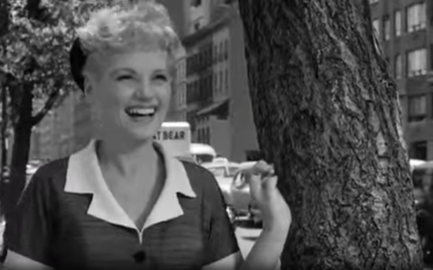
The story begins in New York’s Central Park, where Gladys Glover (Judy Holliday) is wandering around, in her stockinged feet, tossing peanuts to pigeons. She sits down next to some random man and because he’s irritable and passes snide remarks about her feeding the pigeons, walking barefoot, etc, Gladys snaps back at him, giving as good as she gets.
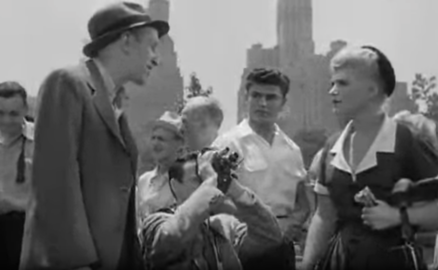
Gladys doesn’t realize that all of this is being recorded on film by a man who’s a maker of documentaries, Pete Sheppard (Jack Lemmon). Pete is in the process of making a film about Central Park. He introduces himself to Gladys, and they get talking. Gladys reveals that till a little while ago, she was a model, modelling girdles. But she put on 3/4” around her waist, and because of that she’s been thrown out of her job. Gladys is thoroughly miffed.
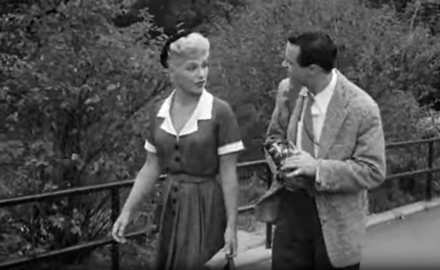
Also, as they walk through the park, Gladya confides in him: she wants so much to be famous, to make a name for herself. That would be the best thing ever.
Pete is more than a little taken aback, moreover since she doesn’t seem to have any idea (or any plan) about what career she might follow, what path to that dazzling fame. She just wants to be famous.
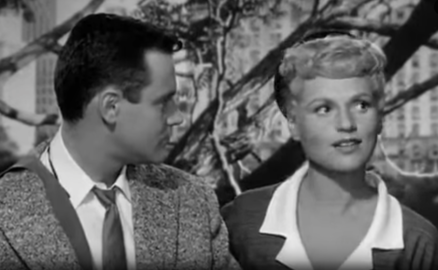
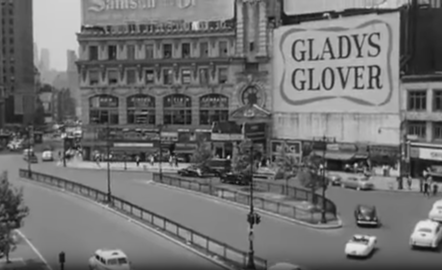
Later, when they’ve both gone their own ways, Gladys has a moment of serendipity. Looking across the street at Columbus Circle, she sees a billboard with a name and an address. Gazing dreamily at the sign, all Gladys can see is her own name there, shining bright. Big, bold letters, looming above the rest of the world.
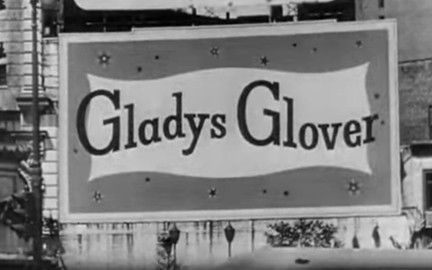
Others might just have snapped back out of that reverie and gone on their way; not Gladys. She sees the name and address on the signboard (of some Horace Pffeifer) and goes off there (it turns out Horace is not a person, after all, but a company which rents out these signs). There, she meets the employee in charge of renting out the signs, and asks him about the Columbus Circle sign. It costs $200 a month, he tells her, and it has to be rented for a minimum of three months at a time.
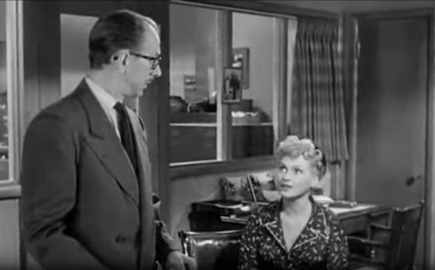
The man is flabbergasted when Gladys calmly hands over the money (she has brought along all her savings, a thousand dollars). She will rent the sign. The man cannot fathom why this odd woman wants the sign—only to put up her name—but gives in. After all, she’s paying hard cash.
And so the sign is Gladys’s, and she immediately has her name painted on it.
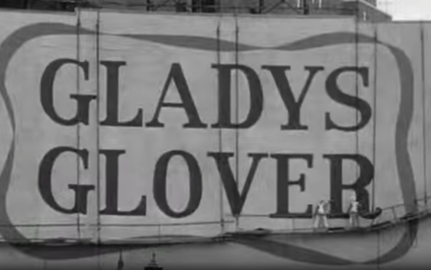
Meanwhile, Pete Sheppard (who had taken Gladys’s address when he parted from her at Central Park, telling her that he would show her the documentary when it was ready) has rented a room in the boarding house where Gladys lives. No, it’s not coincidence; Gladys, nuts though she is, has appealed to him, and he’s followed her here. He settles in and says hello again.
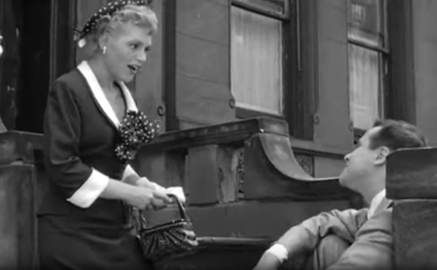
Gladys is very happy to see a familiar face. Not just familiar, but someone who already knows about her ambition to make a name for herself. Pete will be able to appreciate this: the view from her room window.
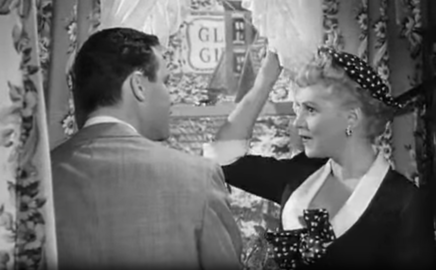
But Pete is unable to wrap his head around this. Why on Earth has Gladys spent her hard-earned money on something so worthless? What good will it possibly do? How does it even help her get famous, if that’s her aim in life? He’s mad at her for being so ditzy, and Gladys is mad right back at him for judging her. She has got the sign, and she will enjoy her name up there for the next three months. So there.
However, it’s not quite such smooth sailing. Because a wealthy businessman named Evan Adams III (Peter Lawford) is out to pull the rug from under Gladys’s feet. Adams heads a family-run soap company, and Adams Soaps has used the Columbus Circle billboard for their advertisements since forever. Now he turns up at the Horace Pffeifer company wanting to know why he can’t get it this time, and being pretty aggressive about it.
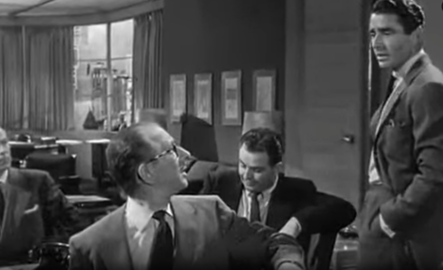
A meeting is called, and Gladys is invited. Adams offers her a large sum of money in return for her relinquishing the sign. $500? But Gladys staunchly refuses, and then walks out. She will not give up that sign.
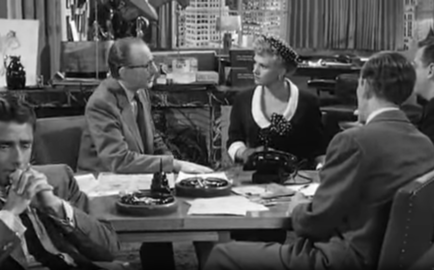
Adams, a determined man, decides to woo Gladys, while at the same time trying to find other means of getting her to agree. His courtship (such as it is) is noticed by Pete, who is even more livid, though naturally he doesn’t tell Gladys. To her, he’s still just a friend. A good friend, one with whom she spends time, sings, wanders through town, showing him the sights…
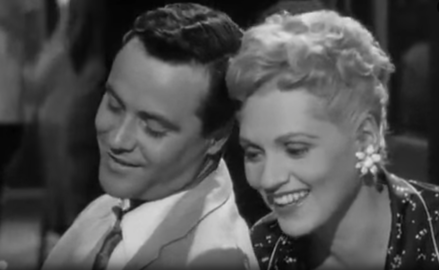
Finally, Adams makes Gladys a proposal that she likes. In exchange for the Columbus Circle sign, she can get six other signs, scattered in prime locations across New York City. Gladys, ever on the lookout for anything that will broadcast her name far and wide, sees an opportunity, and agrees.
Before you know it, signs across the city are proclaiming Gladys Glover’s name, and New Yorkers are beginning to wonder who this mysterious woman is.
One night, shopping with Pete by her side, Gladys has to give her name for an order she places at Macy’s, and the saleswoman at the counter pricks up her ears. Gladys Glover? The Gladys Glover, the woman whose name is on all the billboards? She calls out to other people around, and soon everybody is clustering round, asking for Gladys’s autograph.
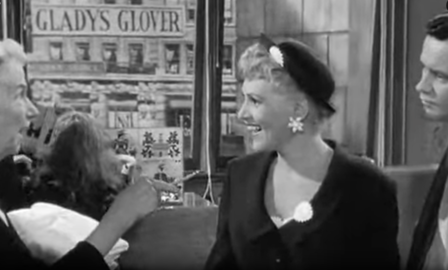
Just like that, Gladys has actually become famous. But what next?
It Should Happen to You is a comedy, but there’s a deeper truth to it: that hollow fame, fame that rests on no achievement, no real reason for the fame, has no value. It’s a message conveyed lightly and with humour, so that it never really interferes with the entertainment quotient of the film.
What I liked about this film:
Pretty much everything: the pace, the storyline, the dialogues, the gentle wit. This isn’t the laugh-out loud sort of humour that Jack Lemmon later became known for (and which, truth to tell, sometimes really gets my goat); there is very little slapstick here, and the humour lies a good deal in the situations and the dialogues…
And, most significantly, in the leading lady. Judy Holliday is so absolutely brilliant. Her expressions, her dialogue delivery, her body language. Gladys Glover is an interesting character, and Judy plays her superbly. Pete Sheppard, at one point, trying to knock some sense into her, tells her that somebody’s making her out to be a ‘goofball’, and it made me think: is Gladys really quite so goofy and dim-witted? Or just very naïve, very uninhibited? Most other people, even if they did wish for their names to be up there, highly visible, wouldn’t act on that impulse. Gladys does, because there is an honesty to her, a clear-eyed acceptance of what should be, and how it should be.
Such a likeable character, and portrayed so very well.
What I didn’t like:
Something very minor, which didn’t actually impact my enjoyment of this film. Why did Evan Adams III pursue Gladys? Initially, it seems apparent that he’s after her so that he can sweet-talk her into giving back the Columbus Circle sign space. But even once he’s got that, he still doesn’t give up the chase. Why? Is he so madly in love (lust?) that he cannot help himself?
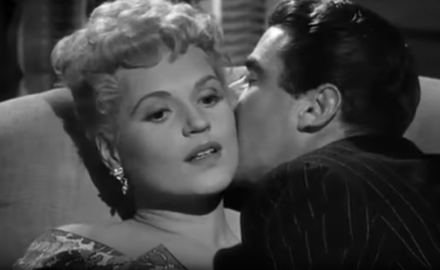
But that is, as I said, a minor irritant. Watch this film for the rest of it, and especially for Judy Holliday.
A copy of It Should Happen to You is available here, at ok.ru.

