Deep Jwele Jaai (1959)

It’s sad that, over the past year or so, barely a month has passed without my having to post a tribute to yet another film personality who’s passed on. Last month, with Eleanor Parker, Joan Fontaine and Peter O’Toole passing away within days of each other, I thought it couldn’t get worse. And I hoped that 2014 would be better.

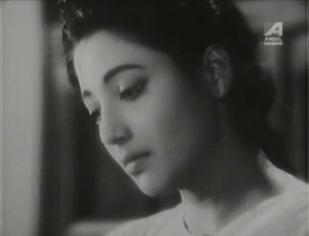
But, alas. We say goodbye to yet another luminary of the film world. This time, the beautiful and very talented (not to mention wildly popular) Suchitra Sen (April 6, 1931-January 17, 2014), who made a mark in Hindi cinema even in the few films she acted in (Bombai ka Babu, Devdas, Mamta and Aandhi being the best-known), but ruled Bengali cinema.

Suchitra Sen Continue reading

Oliver! (1968)

People who’ve been frequenting this blog for the past couple of years probably know by now that there’s one annual tradition I follow on Dusted Off: every year, on my birthday—which is today, January 8—I post a review of a film featuring someone born on the same date as me. I’ve reviewed films featuring well-known stars born on January 8: Nanda, Elvis Presley, Fearless Nadia—and some lesser-known but also good ones, like José Ferrer and Kerwin Matthews.

This year, I’m wishing a happy birthday to Ron Moody (born January 8, 1924), the British actor whose first film appearance was back in 1958, and who’s acted all the way up to (according to IMDB) 2010. To celebrate Mr Moody’s 90th birthday, I’ll be reviewing the film that won him a Golden Globe, as well as an Oscar nomination—Oliver!, the musical adaptation of Charles Dickens’s Oliver Twist, aka The Parish Boy’s Progress.

Ron Moody as Fagin in Oliver! Continue reading

Les Quatre Cents Coups (1959)

This is the 400th post on this blog.

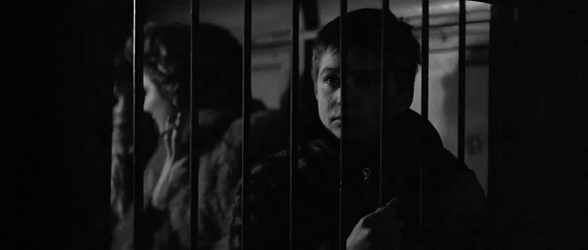
And, what with my penchant for honouring precedents, I couldn’t pass up this opportunity to watch a film that has that number—400—in its title. Les Quatre Cents Coups (known in English as The Four Hundred Blows, though the actual translation would be closer to ‘the four hundred dirty tricks’) was directed by François Truffaut, one of the most prominent pioneers of French New Wave cinema. It was Truffaut’s first full-length feature film, a work that not only won much critical acclaim, but also led Truffaut to make a series of sequels featuring the same lead character…

…who is, in Les Quatre Cents Coups, the twelve-year old Antoine Doinel (Jean-Pierre Léaud).

Jean-Pierre Léaud as Antoine Doinel in Les Quatre Cents Coups
Continue reading

Gojira (1954)

Aka Godzilla.

I was in the mood for watching something different. This film seemed to fit the bill: the first old Japanese film I’ve seen that wasn’t directed by Akira Kurosawa, and the first monster movie I’ve reviewed on this blog.

Godzilla (1998, the Hollywood version) was a film I didn’t watch for many years after its release, despite the fact that some Indian TV channel or the other was always showing it. Then, I happened to go on a monster movie binge, and ended up watching it. (More, later in this post, about what I thought of it). Importantly, Godzilla encouraged me to look out for the original Japanese film.

Gojira rips Tokyo apart Continue reading

Andha Naal (1954)

Last week, chatting with a group of friends (equally mad about old cinema) on Facebook, I was stumped by a quiz question posted by one of them. Which was the first Indian language feature film to be made without any songs? Most of us who attempted to answer that question could only think of Hindi films, and the earliest Hindi non-songs film we came up with was Kanoon (1960). That wasn’t the answer—the correct answer was the Tamil film Andha Naal (That Day), made six years before Kanoon, and (like Kanoon) blending suspense—in the form of a murder mystery—with weighty issues about society and politics.

[Edited to add: According to blog reader and blogger AK, of Songs of Yore, the correct answer to that question is actually the 1937 Wadia Movietone film Naujawan].

Andha Naal, the first Indian language film with no songs Continue reading

Plein Soleil (1960)

I’ve spent the past month—and more—focussing solely on Indian cinema. Time for a change, I thought.
This, therefore. Director René Clément’s Plein Soleil (literally, ‘Full Sun’, but known as Purple Noon) is a French adaptation of Patricia Highsmith’s The Talented Mr Ripley, and was the first major film of Alain Delon, who really does dominate the film. In more ways than one.

Alain Delon in Plein Soleil

Continue reading

Chaowa-Pawa (1959)

Serendipity: noun. plural: serendipities. The faculty of making fortunate discoveries by accident; the occurrence of such a discovery. Coined by Horace Walpole in 1754, based on a fairy tale called The Three Princes of Serendib (‘Serendib’ being present-day Sri Lanka)—the three princes in question often making such lucky discoveries.

And what does this have to do with Chaowa-Pawa (‘To Want and To Have’)? Simply that, while I had set about watching this film because I really, really like the lead pair—Uttam Kumar and Suchitra Sen—I realized, within the first half hour of the film, that it was a remake of one of my favourite old Hindi films, Chori-Chori (which, as many of you would know, was a remake of It Happened One Night). Serendipity? Absolutely.

Uttam Kumar and Suchitra Sen in Chaowa-Pawa

Continue reading

Pathala Bhairavi (1951)

When I’d decided to dedicate this month to regional Indian cinema, I’d also decided that I wouldn’t restrict myself to only the grim, stark ‘real’ films that win awards (Chemmeen, as you will see over the next few films, was an exception rather than the norm). After all, it’s not only the films which win awards that are remembered and loved. There are also films that may not be award-winning material, but are enjoyable and prove to be hugely popular.

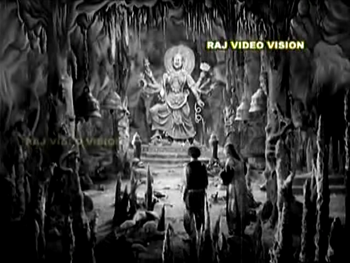
Pathala Bhairavi—originally in Telugu, also dubbed in Hindi and Tamil—was one of these.  Although the research I’ve done doesn’t seem to indicate any awards won, this film was a superhit, which ran to packed houses for weeks on end. It was also the only South Indian film to be selected for screening at the first International Film Festival in Bombay in 1952. And—this was what made me want to see it—it was a fantasy film, one of my favourite genres.

The cave of Pathala Bhairavi

Continue reading

Chemmeen (1965)

When I first began searching the Net to find landmark regional films to review for this special ‘100 years of Indian cinema’ celebration, Chemmeen was one name that cropped up again and again. It sounded impressive. This was one of the first Malayalam films to be made in colour; more importantly, in won the President’s Gold Medal for Best Feature Film at the National Film Awards in 1965. It was screened at both the Cannes and the Chicago Film Festivals, and was greeted with much critical acclaim (not to mention commercial success)—it was even released, dubbed, in Hindi as Chemmeen Lehren, and in English as The Anger of the Sea.

All it needed was for me to discover that the music director of this film was an old favourite (Salil Choudhary) and that Manna Dey sang in it, and my mind was made up: I had to watch Chemmeen.

Madhu and Sheela in Chemmeen

Continue reading

The Night of the Generals (1967)

As a young teenager, I went through a phase when I watched a lot of war movies. And when I say ‘a lot’, I mean a lot: everything from Operation Daybreak and Operation Crossbow to The Guns of Navarone, Where Eagles Dare, Escape to Victory, Von Ryan’s Express—and this one.  I remember The Night of the Generals as being an offbeat war film, because it didn’t have the drama and high adventure of most of the other war films I saw during that period. Instead, it was an unusual film, in that it was shown from the point of view of the Germans—and it combined suspense with war.

The three generals

Continue reading