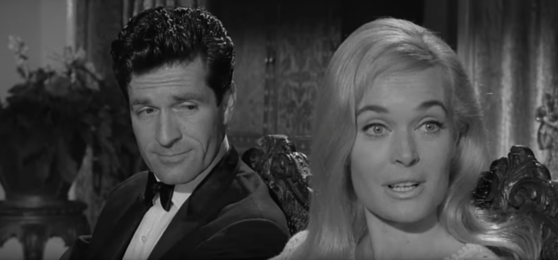
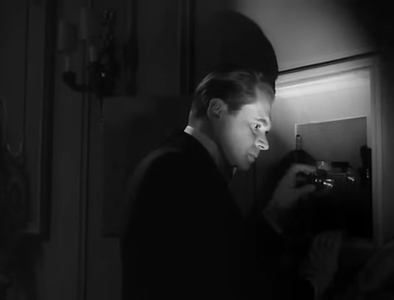
Sapphire (1959)

Not even half an hour into this 1959 British film, directed by Basil Dearden, and I was wondering: “Why isn’t this one better-known? How come I hadn’t heard of it before?”

Having finished watching Sapphire, I think I know the answers to those questions. It’s not as if Sapphire is an obscure film; in Britain, in knowledgeable film circles, it’s probably fairly well-respected, given that it won the BAFTA Award for Best Film in 1960. But here in India, while British cinema of earlier years (Hitchcock’s early cinema, the films of Laurence Olivier and Leslie Howard in the 30s and 40s, for instance) were the stuff of my childhood film-watching—thanks to Doordarshan, which would air the great classics—by the 1950s and 60s, the cinema that seemed to be most popular was Hollywood. I am not talking of what English-language films were actually screened in India back then; I am talking of the 50s and 60s English-language films that were aired by Doordarshan in the 1980s and early 90s, when much of my film-watching was on TV.

Anyway, better late than never, I guess. I finally watched Sapphire (because of a serendipitous discovery on YouTube; the film is available here). And this, I can safely say, is one of the more unusual noir films I’ve seen. While it is a solid police procedural, a whodunnit revolving round a murdered woman, it is, too, a comment on society, on norms, what is right and what is wrong.

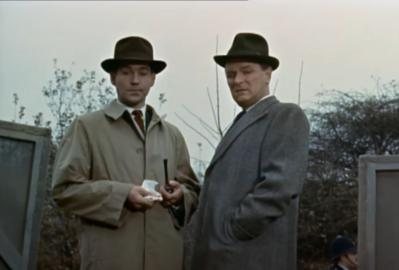
The story begins on Hamstead Heath, where two little children, playing with their ball, tumble onto the body of a young woman (Yvonne Buckingham) who’s been stabbed to death. The police are called in, and Chief Inspector Bob Hazard (Nigel Patrick) comes with his team to examine the scene of crime. The young woman’s body is taken away for autopsy.
Continue reading

Beyond This Place (1959)

Given that I reviewed Raj Khosla’s 1958 film Kaala Paani—based on AJ Cronin’s novel Beyond This Place—last month, I thought it appropriate to also watch and review an English-language adaptation of the same book. And, as always happens when I do something of the sort, to compare the two, see what they do with the same source material. Here, I must point out that that I haven’t read Cronin’s novel, so I cannot say how much Beyond This Place (directed by Jack Cardiff and with a screenplay by Ken Taylor) resembled Cronin’s book.

But, to begin at the beginning.

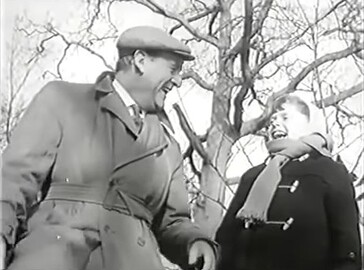
As the credits roll, we see a man, Patrick Mathry (Bernard Lee) and a boy, Patrick’s son Paul (Vincent Winter) running through the woods, laughing and obviously happy in each other’s company.

Continue reading

Ten Little Indians (1965)

I was reminded of this film the other day, because I was lecturing at a Delhi college on historical detective fiction, and ended up mentioning And Then There Were None/Ten Little Indians (no, it’s not historical detective fiction, but I wanted to check how many people in the audience had read this book). The novel, first published in 1939, is Agatha Christie’s most popular book (also, the world’s top-selling mystery book), and one which Christie described as being the most difficult one to write. It has been adapted to screen multiple times, in different languages (in Hindi, as Gumnaam, which sadly did not credit Christie even though the film was very obviously based on the book).

I have reviewed—many years ago—an earlier film adaptation, And Then There Were None (1945), directed by René Clair, and I’ve reviewed Gumnaam too, but decided it was high time I watched a later version. This one, directed by George Pollock.

Ten Little Indians gets off to a flying start, the credits rolling as eight guests arrive by train at a snowy, deserted-looking railway station. They proceed, first by horse-drawn carts and then by cable car, up to a grand (but forbidding-looking) mansion situated high up on a rocky, lonely mountain. There, they are met by a couple of servants: Grohmann (Mario Adorf) and his wife (Marianne Hoppe).

The Grohmanns show the guests to their rooms. None of these guests have ever met each other, though from the curious looks some of them bestow on the others, it’s obvious they’re at least interested. The American Hugh Lombard (Hugh O’Brian) and the host’s newly-appointed secretary, Ann Clyde (Shirley Eaton) seem, for instance, to like what they see.

Continue reading

Characters with Books: In English-language cinema

Six years ago, to commemorate World Book Day, I published a post about characters in Hindi cinema shown with books (not necessarily reading books, but sometimes even just holding a book). My main criterion there was that the book should be identifiable, and (preferably) a real book, not just a fictitious prop bunged into the film. The idea was to celebrate books, even in cinema. After all, the connection between books and cinema goes far beyond the fact that books are often adapted to the screen. Both the page and the screen are media used to tell a story; both can entertain, both can provoke thought, both can be incendiary. And just as characters in books may watch films, characters in films may read books. To underline their own personalities and interests, by way of making an oblique reference to a thematic element of the film itself, or simply to have something to do.

This year around, with World Book Day coming up again (today in the UK, for much of the rest of the world on April 23), I decided it was high time to do another iteration of that ‘characters with books’ idea. This time, it’s characters in English-language cinema: mostly either Hollywood or British cinema. As for my earlier post, the criterion here is that the book should be identifiable: its title should be readable. Also, preferably, it should be a real book, not a fictitious one. And, of course, as for all my posts on this blog, these are all from pre-70s films that I’ve watched.

Continue reading

Sleeping Car to Trieste (1948)

This little-known British film was recommended to me by YouTube, and given that I am a fan of train films (The Lady Vanishes is a favourite, as are Murder on the Orient Express and North-West Frontier), I decided I had to watch.

The story starts off with a bang (actually, almost literally: there’s a fatal gunshot in the very first scene). In an unnamed embassy in Paris, a party is in progress, when one of the guests, a Captain Zurta (Albert Lieven) slips out of the ballroom, makes his way to one of the more secluded rooms in the embassy, and having broken into a safe there, purloins a diary. He is caught red-handed by a footman who enters just then.

Continue reading

Great Expectations (1946)

Charles Dickens was one of those authors whose books, I think, might be very difficult to adapt to cinema. Most of his works have a plethora of characters, and characters, too, who are described in great detail: people who play an important part in the proceedings. The books are long and involved, and there’s a style to them that would be more suited, I’ve always thought, to a television series rather than a film.

But every now and then, there comes along a fine adaptation of a Dickens novel that manages to retain the essence of the original, and translate it effectively to screen. Adapted for the screen (along with several other people) by David Lean, and directed by him, Great Expectations was a film I’d approached with some trepidation, wondering how it would work as a film.

The story begins with orphaned Philip Pirrip ‘Pip’ (Tony Wager) running along near the marshes that border the village he lives in. Pip’s parents died years ago, and Pip has been brought up by his very hot-tempered, sharp-tongued sister, Mrs Joe Gargery (Freda Jackson) and her husband, the blacksmith (Bernard Miles). What Mrs Gargery lacks by way of human kindness, Joe makes up for: he’s a sweet, gentle, wise man, who is very fond of Pip.

Continue reading

The Ladykillers (1955)

Long-time readers of this blog probably know by now that I have a soft spot for suspense films, heist films, comedies, and—where these genres sometimes meet—films about bumbling crooks. The funny heist film, so to say, where everything goes wrong. Some months back, when I watched Gambit (which I enjoyed very much), a subsequent search for funny heist films threw up another suggestion that I’d heard of before: The Ladykillers. Like Gambit, this too starred Herbert Lom, an actor I like, and because I was fresh from watching Gambit, I thought why not give this one a try too.

The Ladykillers begins with the lady in question: sweet, somewhat scatter-brained old lady Mrs Wilberforce (Katie Johnson), who emerges from her house at the end of a lane and walks down the street nearby. Everybody around seems to know and like Mrs Wilberforce: people greet her, and when she reaches her destination—the local police station—the cops are indulgent. Mrs Wilberforce has come to clarify that her friend, another elderly lady who had informed the police station about spotting a spaceship, was actually misinformed… Mrs Wilberforce’s explanation is detailed and apologetic, and her earnestness shines through bright and clear.

Continue reading

Spring in Park Lane (1948)

PG Wodehouse is one of my top favourite writers. I’ve read most of his books, and I’ve explored some of his intersections with cinema: the films he was involved in, and the films that were based on his books. Of the latter, I’ve realized again and again, there seem to be very few that do anything close to justice to Wodehouse’s inimitable blend of humour. Some of the shorter TV films (like Heavy Weather, starring Peter O’Toole as the eccentric Lord Emsworth) or TV series like Jeeves and Bertie are good (though Jeeves and Bertie, after a few good episodes, went off the rails).

But now and then I come across a film that has nothing to do with Wodehouse, but seems somewhat like a homage. With the same light-hearted charm of the master, the same frothy humour that never fails to appeal to me.

As in Spring in Park Lane

The film begins with Judy Howard (Anna Neagle) ringing the doorbell of her home in London, only to have the door opened by a complete stranger (Michael Wilding). Judy is surprised, and the conversation that ensues has both her and the man quite baffled. It’s only with a little perseverance, and some help from the butler Perkins (GH Mulcaster), who comes rushing up from below stairs, for the fog to clear. This man, Richard, is the new footman.

Continue reading

Gambit (1966)

I have a soft spot for heist movies.

And Shirley MacLaine.

And Michael Caine.

And movies about inept crooks.

Which, given that they all come together in Gambit, made this a film I had to watch.

Gambit begins in Hong Kong, where Harry Dean (Michael Caine) surreptitiously follows a woman through the streets of Hong Kong. He watches until she goes into a night club.

Later, we see the woman in action, as she (Shirley MacLaine) dances at the club. Harry takes a seat beside his friend and associate Emile (John Abbott) and they watch the woman, Emile with a surprised but approving look on his face. Yes, she will be the perfect fit.

Continue reading

The Reluctant Widow (1950)

Based on a novel by Georgette Heyer.

Georgette Heyer is one of my favourite authors, and when, the other day I discovered that one of Heyer’s books had been made into a film, I managed to find a copy on YouTube. Though the hard-coded Greek subtitles on this copy are a little distracting, at least I was able to watch The Reluctant Widow, aka The Inheritance.

The film begins on a night in the English countryside. Elinor Rochdale (Jean Kent), who has just gotten off a stage coach, is hailed by a groom with a carriage, asking her if she has come in answer to the advertisement? Elinor says yes, so she gets into the coach and is taken to (as she assumes) the home of Mrs Macclesfield, who has employed Elinor as a governess for her young son. Elinor, once wealthy, is in sadly reduced circumstances since the death of her father, and with nowhere to go and no other means of keeping body and soul together, has chosen to work.

Continue reading