Aladdin aur Jaadui Chiraagh (1952)

Some weeks back, when I reviewed Police (1958), the thought that had stayed in my mind regarding Madhubala’s character—and her acting—in that film and otherwise, in the larger context of her career, was that she got sadly stereotyped. Too many people, film-makers most of all, ended up slotting her as the ravishingly beautiful woman who need only be cast for the fact that she could light up a screen like few others could. Her acting ability (which was actually very good) got overlooked far too often.

Something similar, though in a different way, happened to Meena Kumari. In Meena Kumari’s case, the ‘Tragedy Queen’ label got affixed fairly early in the actress’s career and branded her forever as the Main Chup Rahoongi type: the weepy, self-sacrificing, stoic Bhartiya naari. Despite films like Kohinoor, Azaad, Majhli Didi, Tamasha and Bandish, most people today associate Meena Kumari with ‘serious’ roles.

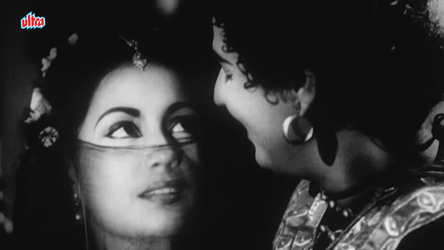
So, this film, which starred Meena Kumari in one of her lighter roles.
Continue reading

Zabak (1961)

Zabak is a film I’ve been wanting to watch for a while, mostly for Shyama. I like Shyama a lot, and as far as I know, this is one of the rare colour films in which she acted as a lead. Plus, given my penchant for raja-rani films, I thought this might be worth a try.

Zabak (Mahipal) is the son of a healer and hamaam owner named Hassan Shah Isfahani (?). Hassan Shah is much acclaimed as a man who knows his medicine, and everybody around, from the Haakim (the Lord) of Isfahan to the man in the street, comes to him for relief from a variety of ailments. Zabak is a happy-go-lucky sort, spending his time joking around town, and romancing Zainab (Shyama), the daughter of the Lord of Isfahan.

Continue reading

Sadhu aur Shaitan (1968)

Cinema looking at itself is not an uncommon feature; there have been several notable films, both in India (Kaagaz ke Phool, Sone ki Chidiya) as well as abroad (Cinema Paradiso, 8½, The Bad and the Beautiful, etc), which are about cinema and film-making. But this film, relatively obscure, really should be part of the annals, simply because of its sheer devotion to Hindi cinema. Not because it’s about film-making, not because there is even (as in Solvaan Saal), a single scene on the sets of a film. But because it celebrates Hindi cinema in so many ways, on so many levels.

Sadhu aur Shaitan begins by introducing us to the eponymous ‘sadhu’ of the story: Sadhuram (Om Prakash), a widower who lives with his two children Ganesh (Master Shahid) and Munni (Baby Fauzia), and the maid Ramdeyi (Dulari) who looks after home and the children. Sadhuram is a somewhat excessively ‘good and righteous’ man, the living image of piety (all a little over the top as far as I’m concerned, but at least he isn’t stuffy about his righteousness).

Continue reading