Kabuliwala (1957)

This is a film I’ve been meaning to watch for a long time now—ever since someone told me that the 1961 Balraj Sahni Kabuliwala (in Hindi) wasn’t a patch on the Bengali version, directed by Tapan Sinha and starring Chhabi Biswas as the eponymous Afghan. I was reminded of it again last year when, for Tapan Sinha’s birth centenary celebrations, Anu (from Conversations over Chai) wrote this wonderful review of the film.

Then, some time back, I began reading 100 Indian Stories (edited by AJ Thomas, published by Aleph Book Company, 2025)—and one of the very first stories in the collection was Rabindranath Tagore’s classic The Kabuliwala.

I figured it was about time I watched Tapan Sinha’s take on the story.

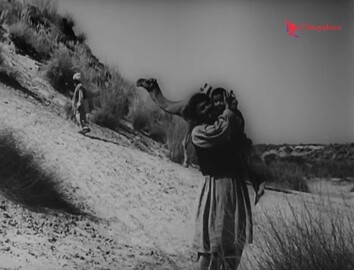
The story begins with scenes (no dialogue, only somewhat sonorous singing in what seems to be Pashto) in rural Afghanistan. Peaks loom high above the valley, a train of camels moves rhythmically along a narrow mountain, and we see Rahmat (Chhabi Biswas) hard at work, but taking out time now and then to play with his little daughter, whom he’s obviously deeply devoted to.
Continue reading

A two-film Tapan Sinha article

… not on this blog, but here, on Learning and Creativity’s Silhouette e-magazine.

Highly acclaimed director Tapan Sinha was born on 2nd October, 1924, in Kolkata, and at the height of his career, was considered one of a quartet of top Bengali directors, along with Satyajit Ray, Mrinal Sen, and Ritwik Ghatak. He was to make some very fine Hindi films too (including Ek Doctor ki Maut and Sagina—the latter a remake of his own Bengali work, Sagina Mahato), but it was in the realm of Bengali cinema that Tapan Sinha made a special mark, with poignant, insightful films like Kabuliwala (which, by the way, Anu from Conversations Over Chai has written about, exquisitely, here).

Khaniker Atithi, made by Tapan Sinha in 1956, was remade by him 16 years later in Hindi as Zindagi Zindagi. The two films are basically the same story, but it’s the details that make all the difference. You get a glimpse of how Sinha’s mind worked, how he tailored his film to suit two different eras, two sets of audiences with probably very different expectations from cinema.

The editors at Silhouette had asked me to contribute a piece on any of Tapan Sinha’s films for their Tapan Sinha centenary celebrations, and I’m grateful to them for giving me this opportunity: I got to see two very interesting films, always a thing of joy.

Click here to read the article.  

Jhinder Bondi (1961)

Considering I’ve recently reviewed two Hindi swashbucklers (Baadal and Baadal), both obviously—in one case even with credit accorded—inspired by European sources, I thought it appropriate to continue in the genre for another film. Also a swashbuckler, also inspired by a work from European literature. The Bengali film Jhinder Bondi (‘The Prisoner of Jhind’), based on Anthony Hope’s classic The Prisoner of Zenda (and the novel which Saradindu Bandyopadhyay—of Byomkesh  Bakshi fame—based on The Prisoner of Zenda).

Continue reading