
I had first watched this film many, many years ago, probably as a young teen. It had been aired on Doordarshan, back in the good old days when our family used to watch pretty much every film that was shown (including some seriously grotty ones like Fauji).
I remembered little of Jaal: Mala Sinha and Biswajeet, yes; and that it was a suspense thriller set in a spooky mansion beside the sea. That was all.
While I don’t like Biswajeet, and the music of Jaal (by Laxmikant-Pyarelal) is forgettable enough to not want to watch it for the songs, I decided I should give this one another try. At least find out what it’s about.
The story begins on a stormy night at sea. A small boat is tossed about on the waves, and we catch glimpses of the lone man on board: Sunder Singh (Sujit Kumar) as he tries to control his vessel. In the distance can be seen (like the boat and the waves, looking patently artificial) a lighthouse. Sunder, however, cannot make it safely to shore; his boat crashes against the rocks and explodes in a great burst of fire.
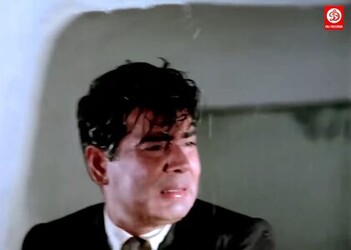

Next morning, a cop arrives and interrogates the lighthouse-keeper. He tells the inspector (Jagdish Raj) that he saw the boat capsize; but no corpse has washed up, nothing. The inspector (without having made any further investigations, not even tried to send a diver down to examine the boat or anything) now drives off to a nearby mansion.

Here he breaks the news to the lady who owns the place (Nirupa Roy). As we later discover, this woman is Sunder’s aunt; she had brought him here after the death of his parents, and she has pretty much devoted her entire life to Sunder. His death (at least, as assumed by the inspector) comes as a real shock to Aunty.

She eventually manages to make a telephone call, though, to inform a man (Niranjan Sharma). This man’s daughter, Sheila (Mala Sinha) had been engaged to Sunder, so they need to know as well. Sheila’s father is equally shaken by the news of Sunder’s death and takes to his bed.

Sheila is a famous dancer, and has been out with friends-cum-fellow dancers all this while. When she goes to check on her father, she finds that he isn’t just feeling under the weather. He gives her the news of Sunder’s death, and in the course of the conversation, we are told that Sunder and Sheila had never even met each other. Sunder’s Aunty and Sheila’s long-dead mother had been the best of friends, and (following in the footsteps of countless female friends in Hindi cinema) had pledged their respective wards to each other.
Sheila is upset, but before she can get around to expressing too much of her anguish, Daddy has a heart attack and dies.
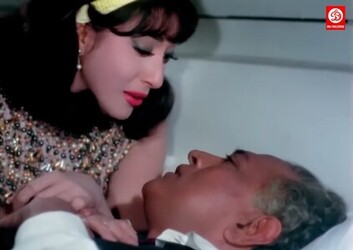
Sheila’s grief over her father’s death is (naturally, given that she never really knew Sunder) much more than for her dead fiancé. She is still trying to come to terms with the fact that she is now all alone in the world, when Aunty turns up. She commiserates, and she tells Sheila that now that both of them are alone in the world, both grieving for those who have departed this world, it would be best for Sheila to come and stay with her, at the seaside mansion.
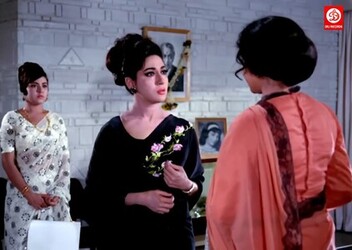
Sheila agrees and goes off with Aunty. At the mansion, there seems to be only one servant in evidence, a man who acts as chauffeur, butler, porter, everything. Michael (Tarun Bose) is taciturn and somewhat menacing, but Sheila ignores him. What she finds more disturbing is the fact that the revolving light from the lighthouse nearby keeps lighting up her room every few seconds, shining eerily through the coloured glass of the window and lighting up the huge portrait of Sunder that hangs on the wall. It’s all very disconcerting, and not exactly conducive to a good night’s sleep.
And then someone starts singing.

This, it turns out, is Shankar (Biswajeet), who is Aunty’s tenant and lives in an adjoining annexe to the mansion. Shankar likes going out every night in his boat to fish and sings while he’s at it.
Sheila ends up meeting him by chance soon after: she is playing catch with Aunty’s dog, and the ball having gone into Shankar’s cottage, she follows—only to find that there hangs, in his room, a painting of her!
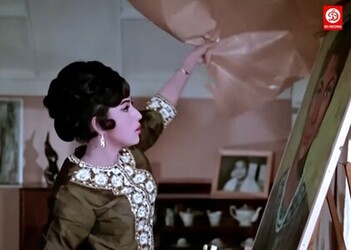
Sheila bumps into Shankar right after, and when she questions him about the painting, he explains that he’s an amateur artist, and he’s seen plenty of photos of her in newspapers etc: she’s a very famous dancer, after all. Sheila, though she initially pretends to be rather affronted that some random man has painted her portrait without her permission, it’s soon obvious that she isn’t just flattered by this tribute, she finds Shankar pretty interesting too.

It doesn’t take long for romance to blossom here, and we soon have Sheila and Sunder running about on the beach and around, singing songs and pledging eternal love.
Which, to me, seems quite natural. Sheila, after all, never knew Sunder. While it must have been a bit of a shock to suddenly find herself fiancé-less, the fact that there was never any real love must play a major part in her being able to get over her grief at his death fairly easily and quickly.

Not so with Aunty, however. Over time, Sheila realizes that there is something a little off about Aunty. At first, it’s just that Aunty keeps remembering every small thing about Sunder: how she used to knit a sweater for him every year, how he would go out in his boat come rain or sun, how he would sit in this very chair where Sheila is now sitting (this spooks Sheila out quite a bit).

But then, as time passes, Sheila begins to realize that there’s more to it than just Aunty’s grief at this bereavement. Aunty firmly believes that Sunder is coming back. He’s only gone for a while, and when he returns, he will come back not just to Aunty but to Sheila, the bride who must wait for him.
Sheila, of course, finds this all most ridiculous. She usually plays along, letting Aunty indulge in some of these whims and fancies, but every now and then, Sheila speaks up, telling Aunty that she’s imagining things, Sunder isn’t returning. Aunty tries to be patient and to work Sheila around to her way of thinking, but when she sees Sheila and Shankar together, Aunty loses her cool and gives Sheila a talking-to.
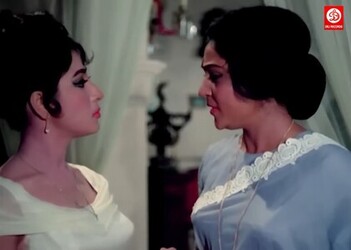
This might have gone on—looniness on Aunty’s side, rebellion on Sheila’s—until one night, when Sheila opens the door to find Sunder outside, his face half-burned.
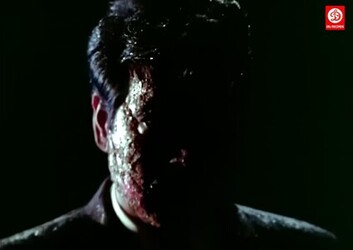
Sheila screams and faints, and so she doesn’t know that it is Michael who discovers her there, and who informs Aunty. It is Aunty who soothes Sheila when Sheila comes to, still panicked.
But this is just the start of it. Sunder, face all puckered up and scarred, keeps turning up more and more frequently, until Sheila is seeing him all over the mansion, blocking her path wherever she turns. Is Aunty right after all? Or is Sheila losing her mind?
What I liked about this film:
The basic premise of the film, about a woman slowly beginning to wonder if the eccentricity (as she sees it) of someone else is actually based on a truth that, bizarre though it may seem, has some substance to it. Initially, it appears (both to Sheila and to the audience) that Aunty is merely missing Sunder terribly, and has been unable to come to terms with her grief. It doesn’t take long to realize that there’s more to Aunty’s behaviour than a sense of bereavement—and then, when Sheila starts seeing that apparition, seemingly Sunder back from the dead, it becomes even more intriguing.
Some of the songs, especially the (oft repeated) Akela hoon main humsafar dhoondhta hoon, are good. Not standout good, not an important reason to watch the film, but anyway.
What I didn’t like:
The way the film falls apart in the last 20 minutes or so. Up to a point, even past the halfway mark, the suspense builds up fairly well. Later, it begins to become obvious (especially to someone like me, a long-time viewer of films like Woh Kaun Thi?, Yeh Raat Phir Na Aayegi, et al) that this is yet another instance of crime disguised as supernatural, but even then, who is the culprit and why is still reason enough to watch.
However.
Moni Bhattacharjee (who directed the film) and Dhruv Chatterjee (who scripted it) mess this one up. Because:
(Spoilers follow)
– Till almost the very end, we have no clue that Shankar is actually an undercover cop. At the least, he could have been shown snooping about, doing something that seemed, if nothing else, at least suspicious. But no; all Shankar does is go out in the boat, romance Sheila (and paint her), ostensibly run a petrol pump, and sing songs. At the end, to suddenly have him appear in uniform and spout all that he knows about the crime, is cheating the audience.
– And, going further from this, how does Shankar discover all that he has learnt about the crime? He seems to know minute details of what happened and why, but how he deduced all of this remains a mystery.
– Then, why does the lighthouse-keeper say Aunty killed herself by jumping off the lighthouse after discovering Sunder’s dead body? This makes zero sense. (Note that this man had denied that a body had been recovered). This could have been bunged in for sensationalism (like, who is this Aunty, then?) but it’s never taken further; nobody goes off to try and question Aunty, or to check records of suicides, or even to ask the lighthouse-keeper why his statements have so many holes in them.
Spoilers end.
Actually, there is a lot more. Plot holes, major gaps in reasoning, and just pure idiocy that totally ruined the climax of this film.
Also, the way Sheila keeps fainting. After a while, this becomes laughable: she’s faced by burnt-face Sunder, she screams, and then she faints and topples over. Again and again.

There is, by the way, an off-and-on comic side plot featuring Johnny Walker as Shankar’s petrol pump assistant; Helen as his romantic interest, and Asit Sen as her disapproving uncle, without whose consent (as is usual in comic side plots of this type) she will not get married. Johnny Walker is never as irritating as Mehmood can be, so these digressions didn’t annoy me as much as (say) the one in Tumse Achha Kaun Hai, but it was still all rather pointless.

Verdict: if you’re happy watching a film that’s fairly good through most of it and then goes downhill with a vengeance, watch this by all means. Or, of course, if you really like Mala Sinha or Biswajeet. Otherwise, I’d warn you off Jaal.


I haven’t watched the movie but came across one of its song only a couple of years back….. ‘akela hoon ek humsafar dhoondhta hoon’.
loved the song…. so beautifully sung by the great Rafi….. and Mala Sinha looked pretty in it.
LikeLiked by 1 person
Yes, it’s a very good song. Mala Sinha does look lovely in the film – very stylish.
LikeLike
there is another beautiful song sung by Lata in the film which has traits of a Madan Mohan tune – ‘ Meri Zindagi ke chirag ko teri berukhi ne bujha diya ‘.
otherwise, the film is worth a skip, as you have rightly said .
LikeLiked by 1 person
Yes, indeed. Very nice song, I agree.
LikeLike
Ohhh… not a huge fan of Biswajeet or Mala Sinha, but your review made it seem intriguing enough. Until the end, where you warned your readers off the film. What a shame the film couldn’t live up to its premise.
LikeLiked by 1 person
It really is a shame that the film fizzled out the way it did! It was pretty gripping (and I was thinking, “Wah, Nirupa Roy did a role like this?”) and then – near the end, all went belly-up. It was almost as if scriptwriter/director suddenly ran out of steam and decided it just had to be wrapped up any old how.
LikeLike
Sounds really intriguing; however, so many plot holes (I didn’t read the spoiler though) in this genre can be irritating. There used to be many tricky films back then, no?
Not sure why, but it reminds me of a film called ‘Dhundh’ that I watched many, many years ago. I don’t remember anything, just that I really liked it.
And Jagdish Raj was the permanent policeman of 70s-80s films. :)
LikeLiked by 1 person
Dhundh is a very good film! I have often regretted that – since it’s outside of my timeline, and I am very strict about staying within that self-imposed timeline, I haven’t been able to review it. But it’s one of the best Hindi suspense films I’ve seen.
This one could have been so much better, if only they’d worked on the script a bit more. Not even much more; a little tweaking, and it would have been fine. I’ve seen so many films from the 50s and 60s that were a mess from beginning to end (mostly by the director/actor NA Ansari, who loved the genre but was awful at it): in comparison, Jaal is really not bad.
And yes, I think Jagdish Raj holds a record for the Hindi actor with the largest number of screen appearances as a cop. :-)
LikeLiked by 1 person
Madhuji, I did nit know there was another Jaal! But you review really made me sit up, till I read the spoilers. In the name of creating suspense, suppressing a vital fact till the end just does not make sense. Rafi’s song is also new to me but he sings it in his quintessential effortless style.
LikeLiked by 1 person
And this Jaal is absolutely nothing like the older one! (Which, of course, also has one other thing to recommend it: much better music than this one).
LikeLike
The best Bollywood downloader movies4u. Please visit here: https://movies4u.ws/
LikeLike
Oh, how I’ve missed reading your (and Anu’s) reviews! It’s been decades since I’ve wached this “Jaal” but you describe the proceedings with such color and detail that it brought the whole film back to me in a rush. “Jaal” had many of the elements of a good, entertaining suspense film: picturesque setting, atmosphere, suspicious characters, decent plot, and at least somebody’s (not mine!) idea of a good-looking lead pair and yet it doesn’t quite gel. Still, the movie isn’t a total waste of time, just not as satisfying as it had the potential to be.
LikeLiked by 1 person
Yes, indeed, Jaal did have a lot of elements that should have made it a big hit, but yes, too, that it just didn’t match up to its potential. Such a shame, really, because if the last half-hour or so could have been scripted with a little more logic and plain simple common sense, it might just have worked well.
LikeLike
hi madhu ji ! Thanks for reviewing jaal. Mala sinha n bishu da are my favourite pair. I feel like joy ji n saira ji. They match each other best.
i have read the review in madhuri. They said shuru sey hi shaq ek hi aadmi sujit kumar par jata hai. I feel sujit ji really looked handsome in 60s movies. He later became superstar in bhojpuri movies.
The review appreciated the movie but criticise song picturisation. Nirdeshak ki pratibha gana filmaney k waqt kahi gayab ho jati hai.
i liked all songs but akela hu main is so soothing. In mizaaz e girami I feel bishu da was inspired from jeetu ji.
Mala ji looks so stylish and perfect that it looks she has come from painting. I liked her portrait shown in the movie.
Among all the thrillers movies. I will still rate jaal very high even though it does not make sense in last minutes. I find it very engaging unlike Anita. I also like kab kyu aur kahan and baazi.
I feel Raj khosla deliberately made bad thriller movie without much bothering about story. Sadhna ji was happy about her 4 roles.
On bishu da his son prosenjit ji said his father always focused on being good looking star. Did not play variety of roles. 😃
LikeLike
I agree with you, Sir. Bishu da and Mala Ma’am made a fine pair together. As did Joy da and Saira Ma’am.
As far as Bishu da being inspired from Jeetuji is concerned, it’s actually the other way around. Jaal was released in early 1967 while Farz came around in Oct/Nov of the same year. Otherwise also, during his early days, Jeetu ji was inspired by Bishu da and has said the same in some of his interviews too from that time. The famous white shoe tippy tapping look of Jeetu was first brought into filmy fashion by Bishuda in films like Mere Sanam and others, and only later adopted by Jeetuji.
As far as Bumbada’s statement regarding his father’s lack of variety of roles is concerned, I would say it’s true when compared with the likes of Uttam Kumar, Ashok Kumar, Sunil Dutt or Dilip Kumar. But is definitely not true when compared with some of his contemporaries like Manoj Kumar, Rajendra Kumar, Shammi Kapoor or even Dev Anand, especially if his entire oeuvre of Bangla and Hindi films are taken into consideration.
Ideally they should be too, because after all we are one nation. Even otherwise, artistry knows no boundaries. And films like Rahgeer, Kuheli, Trishna, Dada Thakur, Godhuli Belaye, Chowringhee, Kathin Maya, Pratham Prem, Prabhater Rang, Sorry Madam, Bees Saal Baad, Aasra, Kohraa, Kismet and Biwi Aur Makaan are quite varied in their fare, with few of them being too good to be ignored or neglected.
LikeLiked by 2 people
I quite enjoy Jaal. It has a good premise, as pointed out by you in your review quite clearly. Of course the credit for the same goes to story writer Dhruv Chatterjee, who was also responsible for a chunk of enjoyable thriller musicals from Hindi cinema in the 60’s in the form of Woh Kaun Thi, Shikar, Baazi, Kab Kyon Aur Kahan, among many others. The last two have been mentioned by Silverjubilee Sir above too.
Chatterjee, was also the one who wrote the screenplays for Bees Saal Baad and Gumnaam, two very fine and deft Bolly-musical style adaptations of two classic thriller literature from the West. Indeed, he can be called the King of Hindi musical thrillers, a genre which had its heydays with him being at the helm of it during 1960’s.
Of course, his script here isn’t as fine as some of his other work from this decade. Nonetheless, its a fairly engaging film. A. Bhattacharjee’s lush cinematography in particular stands out. The sea has seldom looked so beautiful in our color films like it does here, with only Marcus Bartley in Cheemeen, Gautam Ghosh in Antarjali Yatra and S. Goswami in Munjya probably bettering it.
The soundtrack by LP, is largely average, but with two great songs in the haunting Akela Hoon Main and the stylish pop-sounding Dhadka Hai Dil Mein. The later in particular, has a very international vibe to it, which was- and is, very different from our usual brand of songs. An underrated song classic by all measures!
Since, imo, it’s more difficult to create one great song than it is to create five good or ten average songs, I rather enjoy Jaal’s music too.
P.S: Moni Bhattacharjee didn’t write the script for this film. Dhruv Chatterjee (not Bhattacharya) did it, as mentioned earlier in this comment. Please make the correction in the post too regarding the same, if that’s technically possible. :) :)
LikeLiked by 1 person
Please make the correction in the post too regarding the same, if that’s technically possible. :) :)
Done. Thank you for pointing that out! Also thank you for that long and detailed comment. I find it sad that the premise here was so good, and that the film itself had so much going for it to slot it among the other enjoyable musical thrillers of Hindi cinema, but some careless (I suppose?) and slipshod work in the last half-hour lets it down.
LikeLiked by 1 person