
YouTube suggested this film to me, and for a few days, I was torn. Should I watch it (Feroz Khan is not a favourite of mine, though I don’t find him as irritating as some others), or should I not? Sayeeda Khan, after all, is someone I’ve wanted to watch, mostly because I was intrigued—she was married to film director/producer Brij Sadanah, and was murdered by him on their son’s eleventh birthday party (Sadanah also shot and killed their daughter, before committing suicide). Yes, macabre (not to mention tragic), but that’s how it is.
Eventually, it was the music—by the very talented but vastly underrated GS Kohli—that tipped the scales in favour of my watching Chaar Darvesh. Kohli, who did a lot of work as assistant to OP Nayyar (and it shows, in the rhythms and styles of much of his work), composed music on his own for several B-grade films, of which among the best-known are Shikari (1963; easily his magnum opus, with one great song after another) and Chaar Darvesh. Even if just for the music, I wanted to watch this film.
The story is set in some fictitious fantasy kingdom somewhere in the Middle East. At a shrine, three bearded darveshes, clad in flowing robes, have gathered to pray for boons. One is seeking a treasure [that sounds a little shallow, for a darvesh]; another is searching for his sweetheart, who’s gone missing.
These three men have learnt, though, that their wishes will only be granted once they have been joined by a fourth darvesh… who, thank heavens, arrives soon after. This is Qamar (Feroz Khan in blackface), and he proceeds to tell them his tale of woe and to explain how he happens to have turned so black.

Qamar says that he is one of the three sons of the erstwhile commander of the kingdom. After their father’s death, Qamar’s two dastardly brothers, Karim (Sunder) and Rahim (?) proceeded to cheat Qamar out of his inheritance. Qamar became not just rather poor as a result, but also footloose and fancy-free: ‘awara’.

Of course, like most good-at-heart awaras in Hindi cinema, he goes about helping the poor, coming to the rescue of women being harassed by the lecherous soldiery of the city (of whom his brothers Karim and Rahim are members), and so on. One day, having cocked a snook at some soldiers, Qamar runs for his life—and blunders into the private chambers of the princess Nargis Banu (Sayeeda Khan), who is splashing about in a pool.
Nargis is initially affronted, but it doesn’t take her and Qamar long to fall in love with each other. Over the course of a couple of meetings—Qamar lands up in her bedroom, at night—he ends up convinced that Nargis loves him as much as he does her.
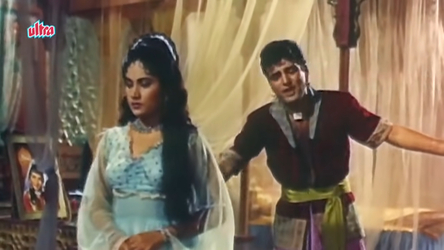
However, the path of love is not all smooth sailing in this case. Not only are Qamar and Nargis at two different ends of the social spectrum; Qamar has also incurred the wrath of the commander, Yusuf Beg (Amarnath), who has his eye on Nargis. Yusuf Beg is a nasty character, and soon arrests Qamar and has him hauled up in front of the king, who is furious at Qamar’s boldness. He sentences Qamar to labouring on the high seas: on a ship [shades of Ben-Hur?]

Karim and Rahim are there too, guarding Qamar—and up to no good. They decide there’s no point keeping Qamar alive; he’s better off dead. So they toss Qamar over…
But, fortunately for our hero, a well-wisher is at hand. The ship’s captain [I assume that’s what he is, since he’s at the helm], Mashallah (Mukri), quickly tosses a large bench over that can be used like a raft. Karim and Rahim [who totally belie their names] toss Mashallah over too.

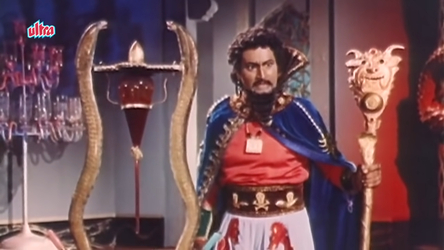
Qamar and Mashallah manage to swim onto a rock in the middle of the ocean, but just as they think they’re finally safe and sound, the rock begins to shudder. Then, amidst much shaking and bolts of lightning, it slips underwater, taking Qamar and Mashallah into the realm of an evil sorcerer named Maakha (BM Vyas). Maakha has learnt his magic from a sorceress named Marjina (Ratnamala) whom he has subsequently [oh, the ingrate] imprisoned by turning her to stone from the neck down. This doesn’t, of course, stop Marjina seeing everything around as well as commenting on everything around. And cursing Maakha for having misused so terribly the magic she taught him.
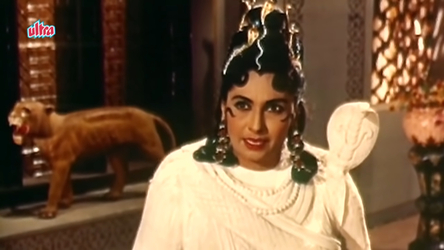
Also prisoner at Maakha’s is the princess Hamida (Naaz). Qamar recognizes Hamida at once: she is Nargis’s younger sister, who has been missing all this while, presumed dead and drowned in the sea. It now transpires that Hamida is not just Nargis’s sister, she’s also Marjina’s daughter. It is not explained, now or later, how Nargis never mentioned her missing sorceress mother to Qamar. Surely this is one of those things—that your mum’s a powerful sorceress, capable of shape-shifting and more—that you’d tell a boyfriend when you two were cozying up and sharing confidences?
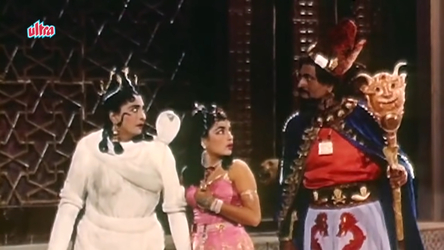
Maakha, like all adept sorcerors, has a magic lamp [with attendant genie] who is at his beck and call. This, besides Hamida doing his bidding, dancing and singing to entertain him. If you’re wondering why a scoundrel like Maakha is happy to have Hamida merely dance for him, it’s because of a condition that Marjina has set: his magic will evaporate if he even lays a hand on a woman who does not consent of her own free will to have him.
To cut a long story short, Qamar and Mashallah have a run-in with Maakha, and manage to get the magic lamp, with which they escape. Hamida blocks Maakha’s path long enough for the two men to run away, and up to the rock from which they had descended. Meanwhile, Marjina too tries her best to block Maakha [By glaring at him. If looks could kill…], but Maakha escapes.
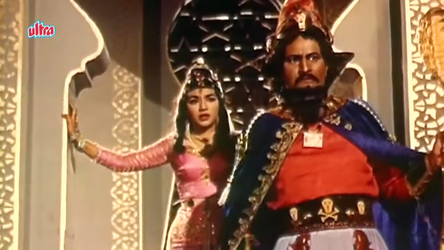
With the magic lamp now in his possession, Qamar summons the genie and commands him to rescue Hamida. But the genie says he can’t do that: the code of the genies prevents him from touching a woman. [I like that some elements of this story revolve around respecting women and not treating them always as objects].

Qamar and Mashallah have to be content with getting the genie rig them out in grand clothing and provide all the props to enable Qamar, now in disguise, to go to Nargis’s father’s court, pretending to be the prince of Khorasan. Nargis’s father is an old friend of the king of Khorasan, and so is happy to welcome whom he takes to be the son of his pal.

He is even happier to accept a proposal of marriage between Nargis and the prince; Nargis herself [like all Hindi film heroines, too myopic to recognize her beloved under all that shrubbery] is distressed and tells the prince repeatedly that she doesn’t want to marry him.
Eventually, though, the truth is out, and Nargis discovers who the prince really is. All is happy and well.

But is it? Because there’s the wily Yusuf Beg hiding in the wings, ready to sway Nargis’s father [who is unbelievably impressionable as well as anti-Qamar]. And, not to forget: there’s Nargis’s little sister Hamida, caught in Maakha’s den under the sea, also to be rescued. Though Qamar doesn’t know it yet, Maakha has managed to find a way to get around that bit of magic that prevented him laying hands on an unwilling woman. Now he rigs up an hourglass-like contraption that drips a red liquid one drop at a time. If Hamida hasn’t said yes to him by the time the last drop falls, she can say goodbye to her honour.
Over the years, I’ve ended up watching several Hindi fantasy films, and I must admit I’ve grown to rather like the Wadia brothers’ brand of fantasy cinema. While their earliest venture in this realm—Laal-e-Yaman—was somewhat inept (and with reason: teething troubles?), they got better and better at it.
Homi Wadia, directing Chaar Darvesh for Basant Pictures, used the Urdu Qissa-e-Chahar Dervesh as a basis for the story. The original Chaar Darvesh was supposedly created by Amir Khusro to cheer up his dear friend, Hazrat Nizamuddin Auliya, while the Hazrat was ill; like the Arabian Nights, the story was not really one story, but lots of shorter stories strung together to create an entertaining, allegorical whole. Starting in 1801, an Urdu scholar employee at Fort William College (Calcutta), Mir Amman Dehlvi, translated the story into everyday Urdu as Bagh-o-Bahaar. I haven’t read this text (or even its English translation, Tale of the Four Derveshes, but from the summary available online, it doesn’t sound as if Wadia and his crew used much of the original story.
What I liked about this film:
The overall plot, which is zippy and fun. It all pretty much fits together and makes sense, plus the adventure is fast-paced.
Then, the main reason I wanted to watch Chaar Darvesh: GS Kohli’s music. Kohli composed this score to lyrics by Raja Mehdi Ali Khan, Anjaan, and Saba Fazli, and there are several very good songs here, ranging from the devotional qawwali Tere karam ki dhoom, to very OPN-esque romantic songs like Pyaar ke daaman se lipte. Chaar Darvesh isn’t one of those painful films for which I’d say the music is the reason you should watch, but the music is definitely the icing on the cake here.
What I didn’t like:
The special effects. I suppose that’s to be expected, given that Indian cinema was still nowhere near the West when it came to SFX (and the West, too, wasn’t all that great). Some of this is intentionally funny, but not in an over-the-top way that (say) Parasmani was guilty of.
Then, the mystery surrounding Marjina. How come the king had married a sorceress (or at least impregnated her, if marriage was not part of the deal)? Hamida and Nargis seem to be very dear to each other and no mention is made of them being half-sisters, so Marjina is obviously the queen—but no background information is provided regarding this woman. Also, given that Nargis is (probably?) her daughter as much as Hamida is, why doesn’t Qamar tell Marjina that he cannot honour the condition she imposes later in the film?
But that’s a minor quibble. Overall, this was a film I enjoyed a good deal.
 Dustedoff
Ooh, I love these fantasy films; they are such fun to watch! Thanks for the review.
LikeLike
You should watch this one, Anu. Highly recommended for anyone who likes this type of fantasy film – really one of the best I’ve seen. :-)
LikeLike