Aarzoo (1965)

A couple of months back, my sister Swapna was invited to head a quiz team at a pub quiz (Jai Arjun Singh, who was also there, wrote about it here). Telling me about the quiz later, Swapna mentioned that there was one question that even Jai didn’t know. In Aarzoo, which place in Delhi does Rajendra Kumar’s character say he belongs to?

Nobody could answer that question. But the answer is Okhla Village.

… which sort of struck a chord with me, because till we shifted from Delhi to Noida, my husband and I had spent many years living very close to Okhla. And Noida, in case you weren’t aware of this, is actually an acronym for New Okhla Industrial Development Authority. Okhla follows us around. Or we refuse to really move away from Okhla.

This incident reminded me, though, that I have never reviewed Aarzoo on this blog, though I’ve watched the film at least twice. Time to amend that, I decided.

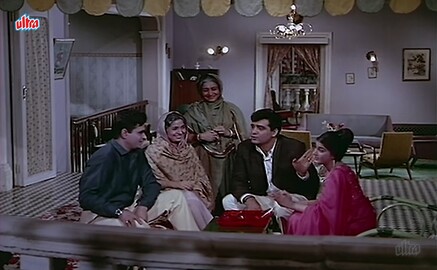
Newly-minted medical graduate Gopal (Rajendra Kumar) and his neighbour Ramesh (Feroze Khan) have been best friends since their childhood. Gopal’s younger sister Sarla (Nazima) and his widowed mother (Achla Sachdev) regard Ramesh pretty much the same as Gopal: a member of the family, a brother/son just as Gopal is.
Continue reading

Chaar Darvesh (1964)

YouTube suggested this film to me, and for a few days, I was torn. Should I watch it (Feroz Khan is not a favourite of mine, though I don’t find him as irritating as some others), or should I not? Sayeeda Khan, after all, is someone I’ve wanted to watch, mostly because I was intrigued—she was married to film director/producer Brij Sadanah, and was murdered by him on their son’s eleventh birthday party (Sadanah also shot and killed their daughter, before committing suicide). Yes, macabre (not to mention tragic), but that’s how it is.

Eventually, it was the music—by the very talented but vastly underrated GS Kohli—that tipped the scales in favour of my watching Chaar Darvesh. Kohli, who did a lot of work as assistant to OP Nayyar (and it shows, in the rhythms and styles of much of his work), composed music on his own for several B-grade films, of which among the best-known are Shikari (1963; easily his magnum opus, with one great song after another) and Chaar Darvesh. Even if just for the music, I wanted to watch this film.

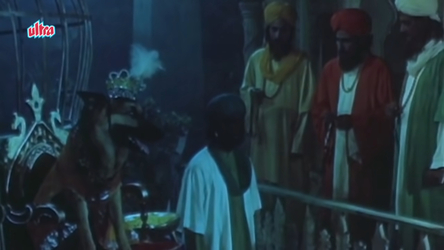
The story is set in some fictitious fantasy kingdom somewhere in the Middle East. At a shrine, three bearded darveshes, clad in flowing robes, have gathered to pray for boons. One is seeking a treasure [that sounds a little shallow, for a darvesh]; another is searching for his sweetheart, who’s gone missing.

These three men have learnt, though, that their wishes will only be granted once they have been joined by a fourth darvesh… who, thank heavens, arrives soon after. This is Qamar (Feroz Khan in blackface), and he proceeds to tell them his tale of woe and to explain how he happens to have turned so black.

Continue reading

Suhaagan (1964)

I’ve had this film on my radar for a long time. I first came across a mention of it online about ten years ago, and since Guru Dutt had acted in so few films, I was curious about this one (which, incidentally, was also his last film). Back then, I used to subscribe to a video rental service, and having found Suhaagan on that, ordered it—and what I got was the absolutely execrable, horribly regressive Suhaagan that starred Geeta Bali [if ever I decide to draw up a list of Hindi films you must not watch, that Suhaagan will be on it].

The Guru Dutt-Mala Sinha Suhaagan, which several people on my blog have mentioned in the past (including fairly recently), and which I’d searched for on Youtube now and then, finally cropped up in Youtube’s recommendations for me. So I bookmarked it.

Continue reading

Bahurani (1963)

Inspirations to watch (and review) films come to me from all over. Friends and relatives are occasionally badgered to suggest genres; blog readers’ requests and recommendations (some of them, alas, long-pending) are taken into consideration. And, sometimes, I get inspired by the most outlandish of things. For instance, this film—which I first watched years ago, on TV—jumped to the top of my to-watch list because one day, while washing up in my kitchen, I was reminded of Mala Sinha.

[And no, not because I happened to be scrubbing a colander].

Mala Sinha in and as the Bahurani Continue reading

Ek Sapera Ek Lutera (1965)

And besides that ‘one snake charmer, one bandit’ (and not a single snake, mind you)—there’s also one pretty lady, a nasty patricidal king, a ghost (who appears for all of one very short scene) and a trio of comic courtiers who go bananas trying to differentiate between their crown prince and an impostor. There’s also, to add to the fun, a variety of disguises. And a decent enough score by Usha Khanna, including the depressing hit song Hum tumse judaa hoke.

Continue reading