
I have decided it’s high time I began rewatching some of the old Hindi films I last saw when in my teens (or, in some cases, even before that). Back then, all our film viewing used to happen on India’s sole television channel, Doordarshan, which would telecast Hindi films every weekend, and sometimes in between as well. Most of the films were old classics, and I have fond memories of first viewings of films which became firm favourites almost from the get-go: Junglee, Teesri Manzil, Nau Do Gyarah, Dekh Kabira Roya, Woh Kaun Thi?, Mera Saaya…
There were also films that I watched (we watched everything, there was such a paucity of options for entertainment) but which I ended up not liking. Or, as in the case of Chitralekha, not really understanding. I guess this was a simple case of being too young, too immature, to grasp the niceties of a film that wasn’t the standard masala entertainer.
About time, I thought, I saw this one again.
Kidar Sharma, who directed Chitralekha, had already made this film (based on a novel by Bhagwati Charan Verma) earlier as well. The 1941 Chitralekha starred Mehtab (who of course later married Sohrab Modi) and the juiciest bit of information about the film is that it featured a bathing scene (Cineplot used to have an article about this, an excerpt from Kidar Sharma’s autobiography, but since Cineplot now seems to be sadly defunct, that’s gone). Kidar Sharma did say, from what I recall of his autobiography, that the original Chitralekha was far superior to the 1964 remake.
But the 1941 film is, I think, gone—or at least not available for viewing online, though there are songs and stills galore. I may as well watch the 1964 Chitralekha, I decided, since that was the one I had hazy recollections of watching as a child.
The story is set in Pataliputra during the heyday of the Gupta Empire. Aryaratan Samant Beejgupt (Pradeep Kumar), a high nobleman, has just returned to Pataliputra after a sojourn elsewhere. Beejgupt’s arrival in the city is greeted with anticipation: his fiancée Yashodhara (Shobhna) is shyly hopeful that this time he will marry her.
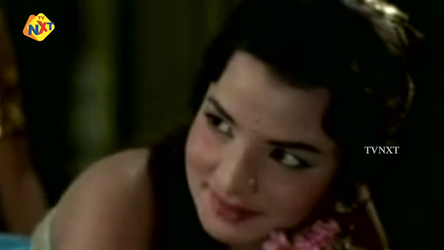
In another, grand house, another woman is curious. The eponymous Chitralekha (Meena Kumari) is a dancer, much feted in Pataliputra. She is told that Beejgupt, the ‘jauhri’ (jeweller, one who need only look at a gemstone to be able to gauge its worth, so to say) will be coming to see her performance. Chitralekha is intrigued, but also strong-willed; Beejgupt may be a prince and have the eye of a connoisseur, but she’s not going to go easy on him.
She will dance, not alone, but with two of her fellow danseuses. And all three of them will wear masks, so that Beejgupt cannot tell one from the other.

At the end of the performance, the woman who oversees Chitralekha’s home, Gayatri Devi (Achla Sachdev) steps forward and announces, on behalf of Chitralekha, that if the Samant correctly identifies the dancer who is Chitralekha, she will personally garland him.
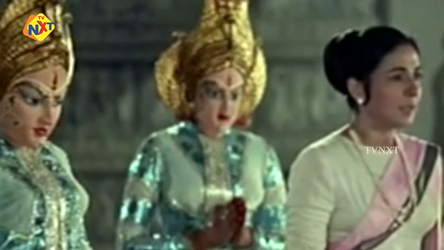
Beejgupt, of course, doesn’t hesitate: he uses his knife to cut the strings of the mask, revealing Chitralekha’s beautiful face. There is a moment of instant chemistry (well, more in Meena Kumari’s eyes than Pradeep Kumar’s; her acting ability far outshines his…). Beejgupt takes the necklace she was going to place around his neck, and turns away.

His fiancée Yashodhara, watching this, breathes a sigh of relief; surely there is nothing to fear there. Not a word was exchanged. But her friend Rambha (Zeb Rehman), a lady in service at Beejgupt’s palace, is not quite so easily satisfied. Words were not exchanged, she agrees; but glances were. Yashodhara had better not be so complacent.

Rambha’s been prescient. Beejgupt begins to frequent Chitralekha’s home, spending hours there, talking to the dancer, being entertained by her. Their talk is not obviously flirtatious; instead, there are moments of philosophizing on both sides, on pondering over topics like life, love, sacrifice, and more.

In the midst of all these rendezvous, Beejgupt receives a visitor. Brahmachari Shewtank (Mehmood) has come to Pataliputra, bearing a message for Beejgupt from his guru, Yogi Kumargiri (who also happens to have taught Beejgupt). Kumargiri has sent Shwetank to Pataliputra to help this naïve fellow understand life, sin, temptation. Will Beejgupt shelter him, look after him?

Beejgupt readily agrees, and though Shwetank initially cringes and cowers at the sight and sound of all the maids and ladies in the palace, he soon consents to dressing in regular clothes, rather than his saffron robes. He also begins to run errands for Beejgupt now and then, even going one day to Chitralekha’s home with a message from Beejgupt.
Beejgupt’s relationship with Chitralekha is not quite the predictable one of a customer visiting a courtesan. Their conversations, for one, are intense (through a metaphor, she tells him the sad story of her blighted life). And Beejgupt has no qualms about bringing her to his home, where Chitralekha too behaves as if she belongs there, she is the mistress.
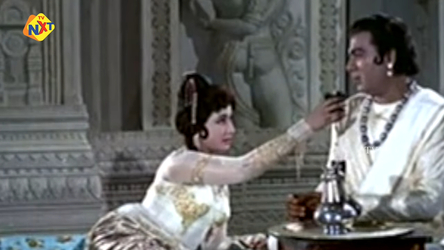
Enough, in fact, to one day (while she’s waiting for Beejgupt to arrive) force the bewildered and shy Shwetank to drink a glassful of wine. She is a force to be reckoned with, and Shwetank, though not as all at sea as he was initially, is unable to cope even now.
Meanwhile, Beejgupt’s fiancée Yashodhara has realized that her betrothed is indeed involved with Chitralekha. She bursts out crying one day, confiding in one of her friends.
From here, two things happen, both of which result in Chitralekha taking an important decision.
For one, Yashodhara, entering the temple to offer prayers, happens to bump into Rambha. Rambha, of course, is seeing firsthand the relationship between Beejgupt and Chitralekha; she commiserates with Yashodhara and says that she (Rambha) has been praying that Beejgupt may soon be parted from Chitralekha and take his rightful place—beside Yashodhara. Yashodhara, however, counters this by saying that that is not what she’s going to be praying for. Her love is true; she wants only that Beejgupt be happy. So she will pray that he gets what his heart desires, even if that is Chitralekha.

The second thing that happens is that Yashodhara’s father Mrityunjaya comes to know of how Beejgupt has betrayed his daughter. He sets out to correct matters, by talking to Beejgupt’s guru, Yogi Kumargiri (Ashok Kumar), who has come to Pataliputra. Mrityunjaya begs Kumargiri to talk some sense into Beejgupt and remind him of his duty towards Yashodhara.
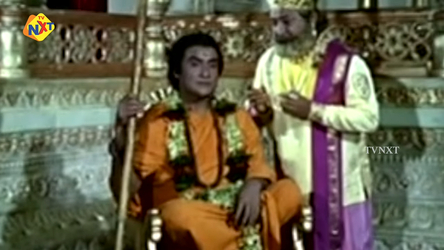
Thus it happens that a disapproving and irate Kumargiri turns up at Chitralekha’s mansion, using foul language and telling her, in effect, to get her talons out of Beejgupt. Chitralekha and Kumargiri have met before, in Kashi; then, too, he had treated her in a similar way, admonishing her, berating her, treating her like scum. Chitralekha refuses to let him dominate her; instead, she manages to have the last word.

… but once Kumargiri is gone, she breaks down and cries. This harrowing conversation, Kumargiri’s insults, have had their effect.
Also, Chitralekha has heard of Yashodhara’s words. Whose love is stronger and truer? The one who will selfishly cling to Beejgupt, denying him what is best for him, or the one who will selflessly give him up for his greatest good?
And thus it is that Chitralekha takes a momentous decision: to give up Beejgupt, to give up her career as a dancer. To give up Pataliputra and all the pomp and wealth and glamour.
To go to Kumargiri, to ask him to let her become a disciple of his.
I understand why I didn’t appreciate this when I was young; in a cinema dominated by masala entertainers, with only the odd film now and then that focussed on other themes, this was—even by the standards of the outliers—perhaps rather outré. Kidar Sharma may not have made this visually shocking (Meena Kumari and in fact all the women, even the dancers played by Bela Bose, Minoo Mumtaz, and Neeta, are always decorously clad, even in mostly full-sleeved clothing)—but the themes here were far removed from the ones commonly prevalent in Hindi cinema back then.
What I liked about this film:
The fact that it tackled so many deeply personal (and interpersonal) issues, topics and emotions that don’t often get talked about in the melodrama that is 50s and 60s Bollywood. Lust, love, self-respect, hypocrisy, ethics, the idea of sin and virtue… each of these, and more, form part of a tale that is seemingly quite simple on the surface but is actually fairly complex and mature in the way it tells this story, in the way its characters behave.
I haven’t read Bhagwati Charan Verma’s novel, so I cannot tell how faithful Kidar Sharma’s film is to the original work; but between them Kidar Sharma (who wrote the dialogue, in addition to directing the film) and Rajinder Kumar Sharma (who wrote the screenplay) manage to create a fairly compact story of human emotion and human nature. Despite the presence of Mehmood (I shuddered when he first appeared: in the recent past I’ve had some bad experiences with films that had especially tiresome comic side plots featuring Mehmood…), it remained on track, and even Mehmood’s naïve celibate character was pertinent to the plot.
One of the most impactful aspects of the writing are Kidar Sharma’s dialogues. In a film where the characterization is far more important than the plot, the dialogues play a major part in helping define the characters; and Sharma’s dialogues stayed with me long after the film had ended. For instance, this, where Chitralekha confronts Kumargiri, asking him what he’s crowing about at having resisted temptation by becoming a recluse:
“Akele rehkar, duniya se door bhaagkar, shareer par bhabhooti malkar sabhi tapasya kar sakte hain. Jahaan paani ki boond na ho wahaan pyaase rehkar dikhaana koi bahaduri nahin. Tapasya wohi hai ki jahaan uske bhang hone ka saamaan bhi maujood ho aur phir bhi woh bhang na ho, Gurudev.”
(“Staying alone, running away from the world; rubbing ash on one’s body and meditating: everybody can do this. Where there is not a drop of water to be found, what determination is there in showing that one can tolerate thirst? Meditation is that which is done in the presence of that which might shatter that meditation, but is unable to do so.”)

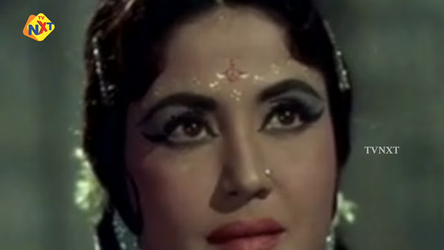
Of the actors, the one who stands out is (no surprise here) Meena Kumari, who is superb as Chitralekha. This woman allows her vulnerability to peek through her armour of success and sexual power as the dancer; and yet, when she has given it all away and has nothing, she is able to summon up the courage to stand for what she believes in. Meena Kumari is wonderfully expressive, her very mobile face and expressive eyes speaking volumes.

Then, there’s the music, composed by Roshan and with lyrics by Sahir Ludhianvi. This is not one of their best-known scores (barring, perhaps, Mann re tu kaahe na dheer dhare), but there are some very good songs here, including the mocking Sansaar se bhaage phirte ho, the romantic Ae ri jaane na doongi, and the comic Ke maara gaya brahmachari.
What I didn’t like:
This is very minor, and really rather superficial; but anyhow… the costumes (and Meena Kumari’s hairstyles), which may have been historically accurate (I cannot say for sure) but looked pretty unattractive. And Pradeep Kumar’s makeup: the less said, the better.
 Dustedoff
I’m so glad you reviewed this, Madhu. It is one of my favourite films, though as Kidar Sharma himself admitted, it was not a patch on his original version. (Nor on the book.) But I loved this one for the performances, specifically Meena Kumari’s and Ashok Kumar’s – even if both were past their prime to fit the characters.
Your take closely mirrors mine (no surprises, there). :)
With your permission:
https://anuradhawarrier.blogspot.com/2012/05/chitralekha.html
LikeLiked by 1 person
I figured it was about time I reviewed this – especially since your review (I remember it) had reminded me that I hadn’t blogged about this one, or even seen it since back then.
I completely agree with you re: Meena Kumari and Ashok Kumar. TBH, I hadn’t even noticed that both were too old to be acting these characters… she, though rather plump to be a believable dancer, was still beautiful; and somehow Kumargiri’s character is such that I, at least, imagined him as a middle-aged man (especially since he’s supposed to be guru to Beejgupt). Whatever. An excellent, thought-provoking film.
LikeLike
Madhu,
I have read the book, but not seen the film. After your nice review I have to watch it. Thanks a lot.
AK
LikeLiked by 1 person
If you do watch it, AK, please let me know how it compares to the book.
LikeLike
Nice review. I like Chitralekha mainly for Meena Kumari ‘s acting and the songs apart from the unusual theme. The song “sansar se bhaage firte ho” puts in a nutshell the theme of the book. The lyrics of Sahir are not just deep but revolutionary if you really start thinking about what they are saying.
Meena Kumari was only 30 or 31 when she did this film so actual age wise not so very older than her character in the book, but her face and body were both terribly ravaged by her ill health. The poor make up and costumes / get up seem to have compounded the problem. Or maybe the poor colour film technology. But her eyes, her expressions, her voice just perfect!
In the book Kumargiri is not Beejgupt’s guru as far as I remember. Beejgupt’s guru is Shwetank’s guru.
LikeLiked by 1 person
I agree. As much as Roshan’s music, Sahir’s lyrics are noteworthy – both in Sansaar se bhaage phirte ho and Mann re tu kaahe na dheer dhare, I think. Searing in the first, so deeply philosophical in the second.
I think Meena Kumari still looks lovely here, compared to somewhat later films (Chandan ka Palna, Bahaaron ki Manzil), by which time she was looking even more ravaged. Yes, she’s too plump to be believable as a dancer, but beautiful. And I agree completely with you about her eyes. She can speak volumes without saying a word.
Kumargiri is not Beejgupt’s guru as far as I remember. Beejgupt’s guru is Shwetank’s guru.
Oh, so Beejgupt’s and Shwetank’s shared guru is someone else, completely?
LikeLike
Madhuji,
I was reading the book and then decided to watch the film simultaneously. In the film, Ashok Kumar is shown as falling for Meena Kumari. But in the book, it is the other way round or let us say mutual. Also, I think the ending is different. Mehmood is very irritating in the movie but the character in the book I recall is saner.
In the book, Kumargiri doesn’t die. He announces that he has emerged victorious even if his own weaknesses have been exposed.
LikeLiked by 1 person
That’s interesting. Thank you for telling me, now I’m even more curious about reading the book. I should put it on my list.
LikeLike
I really wanted to read Chitralekha, but I read some excerpts and sample chapters and realized it was a bit heavy for me.
Haven’t watched the movie but I really like ‘Mann re tu kahe na dheer dhare…’
LikeLiked by 1 person
Oh. I had wanted to read Chitralekha, but your comment made alarm bells start ringing. ;-) I have never attempted this one, but just one page of Vaishali ki Nagarvadhu, and I had to give up – it was a little out of my range!
LikeLiked by 1 person
My experience is similar. I gave up on the book
I watched this film on DD long ago, probably at age 11 or 12, and I’ve heard a lot about the book. So I did try to read the book, but it was too much of a struggle.
Any regular reader is used to encountering unfamiliar words, and that’s not usually a problem. Chitralekha must be the first book I abandoned because I couldn’t deal with the vocabulary. Online Hindi dictionaries are not good enough, and I didn’t want to keep referring to my fat printed dictionary.
And I don’t want to read Hindi books in English translation.
LikeLiked by 1 person
Same here, I don’t want to read Hindi books in English translation. I always feel I am somehow doing injustice to my mother tongue if I do so. ;-)
LikeLike