
In 2018, for World Book Day, I compiled a post on Hindi film characters depicted with books. I had not meant it to be the first part of a series of posts; not at all. It had taken me a good bit of effort, many days of trawling through films, much research, to come up with those ten books on that list. To be honest, besides those ten books, those ten characters, I couldn’t think of any other Hindi film characters I’d seen with books.
I don’t know how it is with you, but I have noticed one thing about myself: as soon as I’ve done a post on some theme (or even thought of one), I keep noticing that theme again and again in films I watch. After 2018, I found myself spotting books in several old films I watched. Enough to enable me to post a follow-up list: ten other books.
And now another ten. As I’ve done for the other book lists I’ve made, these are all from films I’ve seen, and (barring one film, Dil Daulat Duniya, 1972), from before the 1970s. I’ve made an exception for Dil Daulat Duniya because (like—say, Sharmeelee—it has a very 60s look and feel to it, and is anyway on the cusp of the decade). These ten books are all real books, and can be bought online even today; I’ve provided links to buy, wherever possible.
In no particular order:
1. Sadhana reads They Do it With Mirrors in Dil Daulat Duniya (1972): In most Hindi films, if you see a character reading a thriller or a detective novel, chances are there will be some element of crime in the film (Waheeda Rehman in Baazi, listed in the first of these posts, is a case in point). There is a crime in Dil Daulat Duniya—Om Prakash takes up residence in the currently-unoccupied mansion of a millionaire and brings in sundry other destitute (or nearly so) characters as well. But that’s it. Sadhana’s character, a wealthy young woman pretending to be commonplace, is probably reading this book, by one of India’s favourite British crime writers, just by way of showing she’s a well-educated modern miss.
A Miss Marple novel, They Do it With Mirrors was first published in 1952. I have to admit I’d never even heard of this one, let alone read it.

2. Ajit reads (or tries to read) Star Money in The Killers (1969): American writer Kathleen Winsor is, for me, familiar only because of her book Forever Amber (which I read way back in my early twenties, and of which my most vivid memory revolves around the Black Death). Star Money isn’t a novel I’ve read, but it seems to be about a woman, on her own during World War II, trying to make something of her life while her husband is away fighting. To me it sounds like a book about a rather liberated woman, a piece of feminist writing and therefore a little surprising as a read for a character in The Killers (which, in typical Dara Singh film style, isn’t intellectual at all). But who knows? Perhaps this character only chose the book because of that somewhat raunchy cover. Or perhaps he (a good guy, who infiltrates a gang to save his father, whom they’ve kidnapped) actually does want to see things from a woman’s point of view.
To me, this looks like a simple case of a prop being whatever was nearest to hand.

3. Manoj Kumar reads (or should be reading) The British Encyclopaedia of Medical Practice in Himalaya ki God Mein (1965): Characters in Hindi films are often shown to be reading not for entertainment but because they have to. Students, of course, are a prime example of this type of reading; but here’s another: a doctor reading a medical encyclopaedia. Manoj Kumar’s character, a doctor who’s running a small clinic pretty much single-handedly up in the mountains, is so exhausted by the end of the day that he probably doesn’t even get much reading done.

4. Dilip Raj and Surekha read Aahang in Aasmaan Mahal (1965): This is an unusual item on this list. For one, it is a book appearing in a song. But there are other books, in other songs, too; what makes this one unique (at least to me) is that two people, separated by a space—not, however, so much that it becomes an ‘impossible duet’—read their individual copies of the same book, the Urdu poet Asrar-ul-Haq Majaz Lucknawi’s Aahang. Even more interesting, the book is integral to the song: they sing one of Majaz’s nazms (Main aahein bhar nahin sakta) from Aahang. This is one of those rare instances, too, where a book is very much a part of the story: these two lovers, divided by class and status, bond over a shared love of poetry and of Majaz in particular. In one early scene, they give each other tokens of their love: and this is the book that both of them, individually, have bought for the beloved.
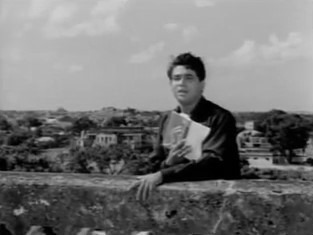
5. Sanjay Khan reads Refrigeration in Dus Lakh (1966): A book by James A Moyer and Raymond U Fittz, the complete title being Refrigeration: Including Air Conditioning and Cooling and Household Automatic Refrigerating Machines. Published in 1933, well before ‘fridges’ became as ubiquitous as they now are (or even as relatively common as they were in 1966). Sanjay Khan’s character in Dus Lakh is a college student, and there’s no indication that he’s supposed to be studying engineering or any other subject that might call for him having to study this book (and he’s definitely supposed to be ‘studying’ it, not reading it for the fun of it). It does seem to have turned out to be a boring book, because he abandons it swiftly enough and goes off to sing a song. To me, this book seems like a poorly thought-out prop, just bunged in because it has a respectable-looking cover, without a lurid illustration that might seem to indicate frivolous contents.

6. Kanhaiyalal reads the Quran in Saaz aur Aawaaz (1966): … and, uses it for an unusual (at least for Hindi cinema) purpose. There are several instances of characters shown with the Quran in Muslim socials and Mughal-era (especially) historicals, but most of those are characters deep in prayer. In this case, Mehar Baksh (Kanhaiyalal) hasn’t dived into the Quran to pray, but for faal: divination, using the holy scripture to seek an omen. This man is honorary uncle to Geeta (Saira Banu), whose father has promised her in marriage to a lecherous and nasty prince; but Geeta is in love with Rajesh (Joy Mukherjee). When Geeta and Rajesh come to Mehar Baksh for help, he finds himself torn: Geeta is like a daughter to him, but her father is his oldest, dearest friend. In a dilemma, he turns to the Quran to let Allah show the way.

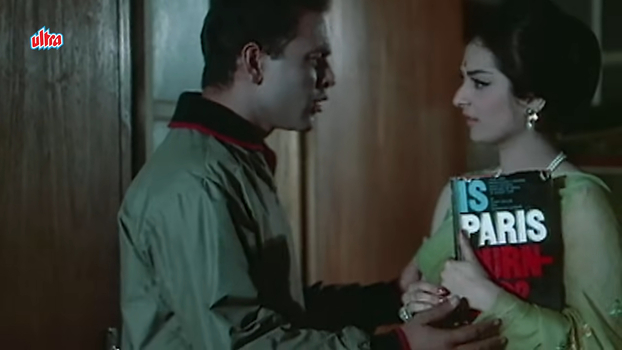
7. Saira Banu reads Is Paris Burning? in Yeh Zindagi Kitni Haseen Hai (1966): In the same year that she starred opposite Joy Mukherjee in Saaz aur Aawaaz, Saira Banu also acted opposite him in another complicated and rather annoying film that tried to be a deeply mysterious thriller and just ended up being more a hot mess than anything else. Near the beginning of the film, Sarita (Saira Banu, in a double role which had her playing two look-alikes, both named Sarita), is shown reading this book.
Is Paris Burning? is a book about the liberation of Paris during World War II, a major success for the Allied forces. Written by Larry Collins and Dominique Lapierre, the book was published in 1965, so must have been pretty new when this film was made—but Sarita doesn’t seem to be one of those readers who like to keep their books in pristine condition; her copy has quite a tattered dust jacket. However, to have a heroine reading something like this—non-fiction, not something related to study—as opposed to either pulp or even literary fiction—is a bit unusual, so kudos for that.
8. Mala Sinha finds Stiletto boring in Jaal (1967): Boring enough to send her to sleep, at any rate. Not a great reflection on its author Harold Robbins, who was one of America’s most popular writers ever. Robbins wrote what the Wikipedia article on him describes as ‘prurient’ fiction, replete with sex, violence, and the sort of high-flying life that was stereotypical of the Hollywood stars he liked to portray in several of his works. That Mala Sinha’s fairly Westernized character Sheila would want to read a Harold Robbins book is fairly predictable; that she finds stuff like this also boring enough to result in her ‘aankh lag jaana’ (falling asleep), as she confesses to her honorary ‘auntie’, makes me like Sheila a little bit more. I am all for light fiction; but I do wish our heroines (and heroes) would be shown reading a little more sophisticated light fiction. PG Wodehouse, for instance. Have you ever come across a character reading Wodehouse in Hindi cinema?

9. Surendra ploughs through the Reading and Thinking Series in Anmol Ghadi (1946): Though what you really see here is the books piling up on top of the chakki his mother (Leela Misra, in the sort of weepy, self-sacrificing role Leela Chitnis would perfect soon after) is shown slaving away at. Surendra’s character Chandra was separated from his child sweetheart by her disapproving father, and since then—thanks to the hard work and dedication of his mother—has worked hard at improving herself, as the Reading and Thinking books suggest. (Incidentally, there have been various rejigs of this title over the decades; in the 1970s there was a series authored by Arthur J Evans with this name. Currently, ‘New Reading and Thinking’ books are available, but it’s not clear who’s written them. Chandra appears to be reading a 1930s series published by T Nelson & Sons.
Even otherwise, books play an important part in Anmol Ghadi, and appear again and again. Noorjehan’s character Lata is a writer who has written a collection of short stories; Chandra is shown reading her book, and there are scenes set in the publisher’s office which Chandra visits in an attempt to get in touch with the author who seems to read his mind so well.

10. Sunil Dutt (probably) reads The Indian War of Independence 1857 in Kundan (1955): Sohrab Modi’s Kundan, a fairly faithful adaptation of Victor Hugo’s classic Les Miserables, starred a very young Sunil Dutt as an ardent Indian freedom fighter. He is never really shown holding this particular book, though given that he’s a college student, he is often seen carrying a bunch of books. In one scene, just before he goes off to a political meeting to sing fervent songs of patriotism and revolution, Amrit puts some of those books down. In the next frame, we see this, a copy of Vinayak Damodar Savarkar’s tome about the 1857 uprising. So I’m connecting the dots and assuming it means Amrit reads this.
Ironically enough, given Veer Savarkar’s anti-Congress stance, Amrit is actually shown to be quite an ardent supporter of the Congress. The meeting room where he holds centre stage is decorated with portraits of everyone from Gandhi and Nehru to Khan Abdul Ghaffar Khan, Maulana Azad, Sarojini Naidu and Vallabhai Patel; and several of these leaders are mentioned in the song Naujawaanon Bharat ki taqdeer banaa do.

So that’s my list. Have you read any of these books? Or do you have any more books to offer, which you’ve seen in films?
And: Happy World Book Day! Do you enjoy reading? What are you reading right now?
 Dustedoff
Madhu,
I think I have read your other parts in the series. This one is one notch above the others as the actors show their serious side with their choice of the books. Do you know if those shown with these books, were reading types. Most of them are professedly not very literate, some perhaps may be.
I was impressed by Smita Patil character in Ardha Satya. She looked quite literate. Govind Nihlani’s Party was also entirely about literary discussions, though with some pretensions. A Bengali film, I remember starring Soumitra Chatterjee and Mamta Shankar, had a good deal of literary discussion. Book as a prop, and serious literary backdrop as the theme are two different things. Probably most of the mainstream cinema has used book as props.
AK
LikeLike
Thank you, AK, for the kind words. Yes, several of the characters (especially surprising, I think, is Saira Banu’s from Yeh Zindagi Kitni Haseen Hai) do show their more intellectual side – though in most cases (not Aasmaan Mahal) it doesn’t really seem as if they’re actually keen on reading! At least three people on that list are asleep. ;-) – and a couple of others are either reading text books, or rather trashy pulp fiction.
Which was the Soumitra Chatterjee-Mamta Shankar film, do you remember? Even Charulata had a literary touch to it, what with him playing an aspiring author and her spending a lot of her time reading in an attempt to ward off the boredom…
LikeLike
Madhu,
I do not remember the name. But saw it on Prime Video. They were quite old. Mamta Shankar was an English professor in England. Her old lover Soumitra Chatterjee was living the life of a recluse in Kolkata. On her visit, Soumitra invited some of his literary friends and they had a nice evening. Enough now to locate the film.
AK
LikeLike
It seems to be Shesher Golpo. Thank you for telling me about this, AK. Will try and check it out sometime.
LikeLike
What an interesting and apposite post, Madhu. I tremendous your previous posts on this theme as well. I wouldn’t have thought there were so many characters who read ( or tried to read) books in our films! I’m impressed with your research. :)
I’ve to wrack my brains to think of examples that haven’t been covered in your series. Will be back if my half- brain cell comes up with something.
LikeLike
This is not so much ‘research’ as simply watching tons of films – and trawling through films I know have either studious characters (professors, students) or hip Western-style ones (who, when they’re not reading Life magazine, may be seen with popular novels). ;-) I have a couple of other screenshots sitting in my cache where I’ve either not been able to identify the book in question, or have discovered that it’s a dud – no such book actually exists.
The next thing I’m going to attempt (perhaps next year?) is to try a post of characters from regional language cinema who are seen reading. Of course, in that case, unless the book is an English/Hindi one, I will probably need help deciphering titles!
LikeLike
Oh!
They Do it with mirrors is one of the best by Miss Marple. Of course one of my favourites. Read it. I’m sure you’ll like it. It’s very interesting.
A good list. Very keen observation indeed. Very interesting post.
LikeLike
I had to do a double take and see who posted this comment – I thought it was Anagha! I didn’t realize you were a fan of Christie too, Anupji. :-) Will certainly put the book on my to-read list. Thank you!
LikeLike
😀 Hehe ..
We both are Christie fans. As siblings our choices at least in literary things do match.
:-)
LikeLiked by 1 person
:-) My sister and I are Christie fans too!
LikeLike
Thanks for the well-researched article, dear Madhu.
Of all the books mentioned here, I think I’ve read only Agatha Christie’s “They do it with Mirrors”. When I read its title I always mistake it for “The Mirror Crack’d from Side to Side”, which has been made into a movie quite often.
LikeLike
I haven’t read a single book here, but someone’s just told me that They Do It With Mirrors is a decent read. Frankly speaking, there are only a couple of books on the list that sound intriguing enough for me to want to read them! :-)
LikeLike
They Do It With Mirrors is quite a good mystery and still I think it is not quite up to the mark, atleast what we are used to with Agatha Christie’s more famous works. But I won’t dissuade you from reading it.
LikeLiked by 1 person
Will keep that in mind. Thank you, Harvey.
LikeLike
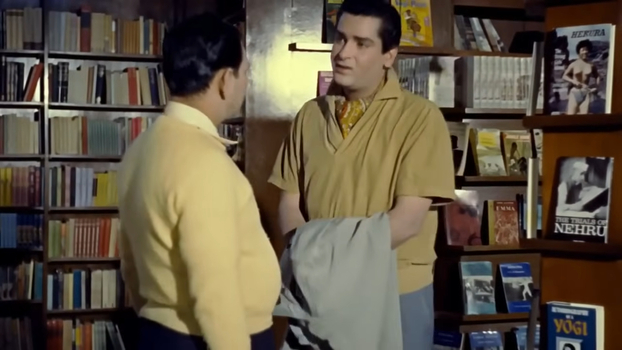
From which movie ist the screencap with Shammi Kapoor? It has an interesting array of books on display. Particularly on Shammi Kapoor’s right side, I could discern
Hekura – The diving girls’ Island, by Fosco Maraini
The Trials of Jawaharlal Nehru by Ram Gopal
Autobiography of a Yogi, by Paramahansa Yogananda
There is also Jane Austen’s Emma in a side shelf.
I haven’t read Hekura, but I think it is about Japan’s lady divers. I had seen a documentary on this topic a few years back and there was this old lady (around 80 something) diving without oxygen for minutes (don’t ask me how many, but very long) and looking very happy.
I have read the Autobiography of a Yogi, which was a nice read. I heard that it was one of the favourite books of the Beatles.
LikeLike
Yes, that first screenshot is interesting, no? It’s from Professor. Shammi Kapoor’s character goes to a Darjeeling bookshop in search of a Sanskrit primer. The Sanskrit primer is really more like a pamphlet than anything else, which was why I didn’t include it. But it’s supposed to be Baal Sanskritam, and I have a screenshot of him reading, so if ever I do a part 4 of this post and am scraping the barrel, I will pull it out!
I haven’t read Hekura, but I have heard about those women divers of Japan – must be pretty fascinating! I’ve read Emma, which is one of my favourite Austen novels.
Thank you for commenting, Harvey, it’s always so wonderful to read what you write.
LikeLike
That is so sweet of you. Thank you.
I had not heard of a Sanskrit primer or for that matter a primer of any other language. Baal Sanskritam sounds like child Sanskrit, but I am sure it is more than that. But since I have never even tried to learn Sanskrit I maybe forgiven for not knowing it.
Emma is good isn’t it? I have surely read it twice, but have conveniently forgotten the plot and its details. That makes me ready to read it the third time.
So I am looking forward to part 4 in a year’s time. Wish you a nice time researching (watching Hindi movies) and searching for the original works.
LikeLiked by 1 person
Baal Sanskritam sounds like child Sanskrit, but I am sure it is more than that.
No, that is what it’s supposed to be. Shammi Kapoor’s character is supposed to teach Sanskrit to two children, though since he’s never studied it, he needs to start from scratch.
Yes, Emma is very good! I have also seen two versions of it in the form of movies, so perhaps my recall of the plot is a bit better than usual. ;-)
I am actually thinking I might try my hand at doing a list of characters reading books from regional cinema – I currently only have two books on the list (!) so let’s see what happens.
LikeLike
I was just watching Bandini (1963). There are some scenes where Kalyani’s father is shown reciting from a book. But we don’t see the book cover or title in any of the scenes.
Kalyani‘s father, Sadashiv Babu (Raja Paranjape), recites/reads from Vidyapati‘s poem „Madhav ham parinam nirasha“. This is right at the beginning of the flash back when she narrates her story to the jailor. It seems this particular poem is published in a book called Vidyapati ke Geet.
After that we hear Kalyani (Nutan) humming “Jamuna ke nire tire kadamb tale mile khaana re chori” with several books in her hand.
We also see her translating some spiritual text at Prabhadidi’s (Praveen Paul) home, but no mention is made as to which text she was working on.
Soon afterwards we see Sadashiv Babu recite/read “aaju rajani ham jeevan bhaag puyalu dekh loon priya mukh chanda” with Vikas Babu (Ashok Kumar) listening attentively.
Google helped me find the source of the first verse but it couldn’t help me with the other lines.
LikeLiked by 2 people
Oh, this is very interesting! It’s been a long time since I watched Bandini, so I’d completely forgotten, though I do remember that her father was a studious and progressive sort – which seems to fit with what you mention. I should watch it again; it sounds much more boook-and-reading-intensive than the average Hindi film.
LikeLike
I presume Bimal Roy loved books and he wanted his characters to read as well. Remember Sunil Dutt standing in his library on a ladder and reading in Sujata?
Even the small boy in Parakh (1960) gets a book to read or at least to pretend he is reading, since he is holding a book in his hands, which would be way beyond his age. It has the title Bhavukta ka Mulya. There seems to be a book with that title but the records say it was published in 2017. Maybe it is just a 2017 edition.
In Prem Patra (1962) Bimal Roy shows Praveen Choudhary reading a book called Prem Patra Kaise Likhein quite prominently. The fact that no author name is shown and the title seems common place makes me think that it is only a prop, though it seems like a well-done prop. I think it serves as an introduction to the movie itself.
In Vachan (1974), which looks very 1960ish, Shashi Kapoor is shown holding a book called History of India, which is hollowed out to hold a white mouse. Quite disrespectful towards the book, I would say.
LikeLiked by 1 person
Thank you so much for this, Harvey! Especially for the book from Parakh – that fits my timeline (unlike Vachan) and is also a genuine book, not just a prop designed only for the film (unlike Prem Patra; I remember putting that on my longlist when I was making one of these posts, but then taking it off because it was not a ‘real’ book).
There are several books of this sort in Hindi cinema. For instance, in Anupama, Dharmendra’s character is a poet and gifts Sharmila Tagore a copy of his newly-published collection. Also, in Kaajal, the first time Dharmendra encounters Padmini (he hears her singing and follows her song to a hammock, where she’s left her belongings while she goes for a swim) – he sees the book she’s reading. It’s titled How to Win A Husband, but I couldn’t find any evidence that this was a real book, though it looks it.
LikeLike
How to Win a Husband! That is an “interesting” title. In the 60s many such self-improvement titles came in the market. I am putting it in that box, because in that time and age, marriage was considered sort of a self-improvement. So I won’t be surprised that such a book was indeed available in the market. But on the other hand such props are used quite often in films.
Then I remember the scene when the younger Suchitra Sen and Dharmendra argue about a divorce case in Mamta (1966) and they both cite from certain law books. I presume they are the All India Reporter.
LikeLiked by 1 person
Talking of law books, I had hoped to be able to actually see some law tomes (titles clearly visible!) in films like Yeh Raaste Hain Pyaar Ke or Mamta or Kaanoon, but no luck so far. I might look again, this time more carefully…
LikeLike
It seems there is a book called “How to Win and Hold a Husband” by Dorothy Dix. The book shown in the Kaajal (1966) though is supposed to be from Allahrakhi. But there seems to be a book called “Winning the Heart of Your Husband” by an islamic scholar Ibrahim Bin Saleh Al-Humood.
LikeLiked by 1 person
Yes, I saw that attribution to ‘Allahrakhi’ and thought that the graphic shown on the cover didn’t seem to match with the name (which does sound more Islamic-scholar-like than anything else!)
LikeLike
It’s a very interesting series. And yes, since I did a post on my blog (inspired by your post), I too notice this theme in the films I watch. :) Also, I wonder how Sadhana’s face changed so much over time.
LikeLiked by 1 person
I’m glad you enjoyed this! Thank you.
Sadhana had developed a severe thyroid problem, I think, which made her eyes bulge. To disguise that, I think they overdid her eye makeup. Also, as she grew older, she lost her very pretty plumpness (of the face) and became more gaunt – which also contributed to making her look very different from in her films from just a decade earlier – even less, actually.
LikeLike
Oh, okay . Sorry, I didn’t know that.
LikeLiked by 1 person
Well of course, right now, I am reading your always interesting blog!. Most of my reading in recent years has been online blogs and informational sources. What book reading I’ve been dong has been of a very light character, E.M Delafield’s ‘Diary if a Provincial Lady’ series and an old children’s book E. Nesbit’s ‘The New Treasure Seekers’. There is a novel I keep meaning to read ‘A Wreath for the Enemy’ by Pamela Frankau, about a frienship, that sounds intriguing..
LikeLiked by 1 person
I am always happy to discover what others are reading (especially when they have recommendations to offer). Thank you for answering that question of mine! The book I am reading currently is Greg Jenner’s ‘Ask a Historian: 50 Surprising Answers to Things You Always Wanted to Know’ – very informative, but also actually very witty, so in a sense it is light reading.
LikeLike
Madhu ji, one needs a keen eye and great observation skills to make a list like this. Here is a song from Lal Patthar where Hema Malini is reading – Gora – Rabindranath Tagore’s novel. The song is Re Man Sur Mein Ga.
LikeLiked by 1 person
Thank you for this one, Anitaji! It’s been several decades since I watched Laal Patthar, so I’d forgotten this one. :-) I can’t tell which book it is, though – do you know?
LikeLike
There’s a scene in Jab Jab Phool Khile with Nanda and Shashi Kapoor, with Nanda reading Vladimir Nabukov’s Lolita. Though I’m not sure why they had her character specifically reading the book. Probably to make her seem more cosmopolitan.
LikeLiked by 1 person
Yes, I’d listed that in my first post in this series:
https://madhulikaliddle.com/2018/04/23/people-with-books-in-hindi-cinema/
I agree that it’s probably there to make her look more cosmopolitan. More broad-minded? Enough to fall in love with an illiterate boatman? (or, on the other hand, not the sort of woman who might fall in love with an illiterate boatman).
LikeLike
I watched Taxi Driver (1954) along with Ava today. Kalpana Karthik is shown reading Ramayana or better said singing some phrases from it in Lata’s voice and Dev Anand too reads it sometime later. The title says Ramayana Mulya 2
LikeLike
Oh, thank you, Harvey! I will search it out and screen-grab.
LikeLike
In Thodisi Bewafai (1980) Shabana Azmi reads the English version of Notre Coeur (1890, same numbers but 90 years apart) Our Hearts. The scene is around 15 minutes into the film. The love is still young. Interestingly the novel is about a man who loves two women. In the movie, the character played by Shabana Azmi suspects her husband is having an affair with another woman and leaves him. The novel also deals with egoism, which the movie puts squarely on the poor heroine’s shoulders.
This took some time to research, since it seems de Maupassant’s novel was translated as Alien Hearts and Google search came up only with Our Hearts were Young and Gay (1942). World Cat gave me the clue which lead me to Guy de Maupassant.
LikeLiked by 1 person
This is so interesting, Harvey. It’s unusual to come across a book that actually has such a significant parallel with the plot of the story: makes one feel that somebody took a good bit of effort to find just the right book, not something just bunged in as a mere prop.
Thank you for telling me about this one. I’ve seen Thodisi Bewafai, but many many years ago, so I’ve forgotten it.
LikeLike
Lovely post as always, it is always a pleasure to come back here from time to time & reminisce on the good ‘ol days of blogging. I see you are still going strongly. Your post is keeping me entertained during my nursing night shift :) I read this post and immediately thought of this image of Rekha Reading the swiss accountant in 1981’s ghungroo ki awaaz
https://shorturl.at/OtUKq
LikeLiked by 1 person
So happy to see you here, Bosun! How have you been? And thank you for this fabulous addition to the list – I hadn’t known about this one (TBH, I don’t think I’ve even heard of this film).
LikeLike