
Today is the 100th birth anniversary of one of my favourite Hindi film directors, the suspense-specialist Raj Khosla (I hasten to add: I am well aware that that’s a generalization, since Khosla made a lot of films, too, that had nothing to do with the thriller/suspense genre: Mera Gaon Mera Desh, for example; Chirag, Main Tulsi Tere Aangan Ki, Do Badan, etc). But it is Khosla’s prowess with this particular genre that I especially admire, a skill and talent he showcased in classics of the genre such as Woh Kaun Thi? ((1964), Mera Saaya (1966), CID (1956) and Kaala Paani (1958). In each of these films, he managed to combine the classic elements of the Hindi masala film—a romance, a comedic side track, lots of fabulous songs—while making sure that the suspense remained (mostly) taut, the mystery a solid one.
To commemorate Khosla’s birth centenary, I wanted to review one of his suspense films. Several of these (CID, Mera Saaya, Ek Musaafir ek Haseena, Woh Kaun Thi?) I have already reviewed; I was torn between some of the others: Solva Saal, Kaala Paani, and Anita, all of which I have seen at some time or the other. I decided, eventually, that it was time to rewatch Kaala Paani, a film that I’ve watched several times, but too far back to have reviewed it on this blog.
The story begins on a night in Bombay, with a woman (Mumtaz Begum) hurrying through the streets to the home of a family friend, Mr Kapoor (?). She is in great distress, and confides in Kapoor: Karan has discovered the truth. What this truth is we discover when Kapoor hurries to Karan’s home to find Karan (Dev Anand) sitting, looking bereft. He has found out (how, we aren’t told) that his father Shankar Lal has, for the past fifteen years, been incarcerated in Hyderabad jail for the murder of a tawaif named Mala. Not, as Karan has been led to believe all these years, dead.
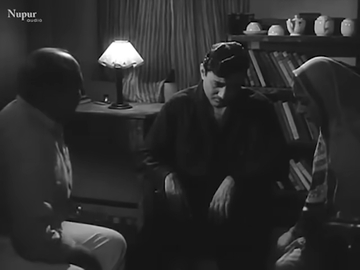
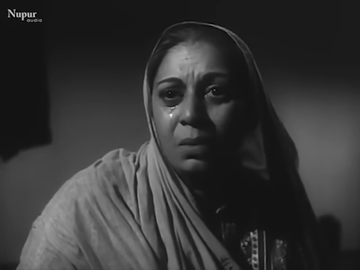
Kapoor tries to explain to Karan: his mother has dedicated all her life to educating Karan, bringing him up all on her own. She kept the truth from him to shield him, because she did not want him to be labelled a murderer’s son. Karan’s mother, in a moment of indignation, also bursts forth: why should she feel anything for the husband who left her for a tawaif?
Karan is unable to rest easy after this, and goes to Hyderabad Jail to meet Shankar Lal (MA Latif). After some initial hiccups (the jailor refuses; Shankar Lal, hurt and angry, refuses to meet Karan, the son who—according to him—has ignored his father’s existence all these years), Karan finally gets to talk to his father.
Shankar Lal insists that he is innocent. He was wrongly accused, wrongly convicted. One man, a baniya named Ram Das whose shop was next to Mala’s kotha, did testify in Shankar Lal’s favour, but his testimony was ignored.
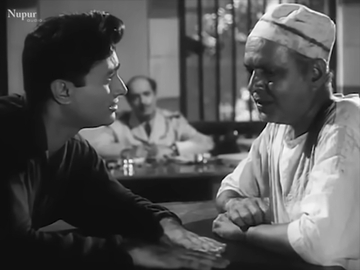
Karan follows up on this clue, going to the shop of Ram Das (Rashid Khan), where Ram Das—finally—explains what had happened. How he had been at the shop that evening, fifteen years ago, when he heard a woman’s scream from the kotha upstairs. Ram Das raced upstairs, and was one of the first to enter the room where Mala was lying on the floor, dead, with Shankar Lal standing beside her. Even as Ram Das watched, Shankar Lal had bent down and picked up a bloodstained dagger that was lying on the floor. He had not been found with the dagger in his hand, and Ram Das had said as much in court.
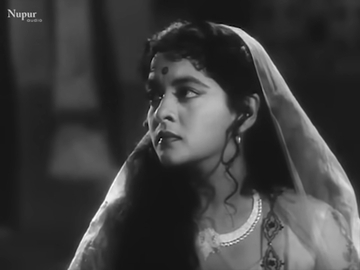
Two people, however, had testified against Ram Das. Jumman (Krishan Dhawan) and Kishori (Nalini Jaywant), both of whom worked at the kotha, had said that Ram Das had very poor eyesight and could not see without his glasses.

Ram Das gives Karan his next lead: the investigating police officer, Inspector Mehta, might be able to able to throw some light on what had happened. Karan manages to find Inspector Mehta (Nazir Hussain), a lonely man, racked by guilt and self-blame. He tells Karan that he had resigned shortly after Shankar Lal had been sentenced: he could not handle the feeling of being responsible for an innocent man being wrongly convicted.

Inspector Mehta adds to what Ram Das has already told Karan. He had gone to meet the prosecutor, Rai Bahadur Jaswant Rai (Kishore Sahu), and Jaswant Rai had pretty much told the inspector that there was no point carrying on with the case, because the evidence was all against Shankar Lal. It was obvious that Shankar Lal had killed Mala.
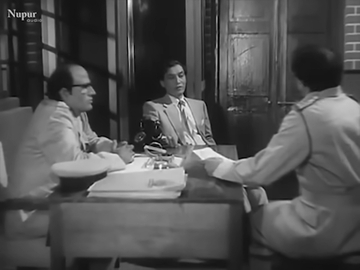
Disheartened, Inspector Mehta had left the prosecutor’s office. And, on his way out, he had inadvertently stumbled upon a clandestine conversation: Jumman and Kishori talking, Kishori cheekily telling Jumman that she possesses some very incriminating letters, something that could put the real culprit behind bars. That was going to be her nest-egg for later times.

Inspector Mehta rues the fact that he kept quiet, that despite realizing that there was some conspiracy underfoot, he had not re-opened the case. Had let Shankar Lal remain in jail these last many years.
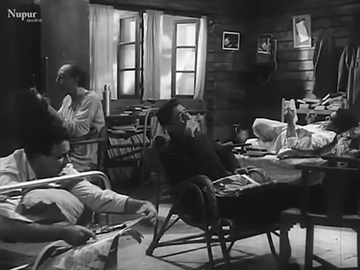
Karan realizes that if he has to get to the bottom of this case, he must do some investigating on his own. And he must find accommodation in Hyderabad. For the latter, he goes to a boarding house (aka ‘hotel’) run by a rather bossy woman (Praveen Paul). Here, Karan is given a bed in a room he must share with two others: Daulat Chand (Jankidas) and the poet ‘Madhosh’ (Mukri, in one of his most memorable roles). These two, along with the waiter-and-general dogsbody, Badru (Agha), become Karan’s best friends in Hyderabad, his partners in unveiling crime and upholding justice.
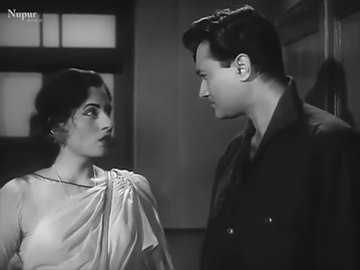
The other person who befriends Karan is someone he meets when he goes to the office of the daily newspaper Deccan Times: the chief reporter Asha (Madhubala). Asha is in charge of the archives, and the moment when they come up against each other is a spark of instant chemistry.

… and it’s like destiny has played a hand here (or, actually, it’s Hindi cinema’s tried and tested love for coincidences). Because when Karan goes to the hotel that night and sits down for dinner, who should be there, sitting at the end of the table, but Asha (who, it turns out, is the niece of the landlady)?
Now, of course, it’s not just a question of Karan and Asha running into each other at the offices of the Deccan Times. Living in the same building, they bump into each other—increasingly intentionally—again and again. It doesn’t take long for them to express their love for each other, and everything is roses and moonlight.

However, what Asha doesn’t know is that Karan is following up another lead in the meantime, and it’s going to impact their relationship. Inspector Mehta’s recollection of hearing Jumman and Kishori talking, Kishori gloating over the evidence she’s got tucked away with her, goes further. Also, Karan has learnt that Kishori is now the most sought-after tawaif in town.
Karan turns to his three friends, Badru, Daulat Chand and Madhosh, for help, and they give him further advice as well as material help. They tell him that Kishori’s status as Hyderabad’s hottest tawaif means that she is very snooty about which patrons she will entertain. You have to be handsome, wealthy, and a poet. They agree that Karan is handsome; the wealth will have to be begged or borrowed; and as for the poetry—Madhosh, who’s been composing an exquisite ghazal (Mukri sings Hum bekhudi mein tumko pukaare chale gaye and that wonderfully)—is generous enough to offer his shers to Karan to make an impression.

Armed with that (and clad in an achkan and cap that Badru has ‘borrowed’ from another guest’s room at the boarding house), Karan goes to Kishori’s. It doesn’t take him long to charm Kishori, and by the time he leaves her kotha that evening, Kishori is already looking forward to him coming back.

How long before Karan is able to get hold of those incriminating letters? And will he even be able to put them to the use he hopes they will be? Who is the man really responsible for Mala’s murder?
Based on Scottish writer AJ Cronin’s 1950 novel Beyond This Place, Kaala Paani was directed by Raj Khosla for Navketan Productions. Beyond This Place was, in fact, adapted by Indian cinema even before its British adaptation (in 1959). In 1955, the Uttam Kumar-Suchitra Sen starrer, the Bengali film Sabar Uparey, was the first screen adaptation of the novel.
Kaala Paani proved to be the last Navketan film of the 1950s. Raj Khosla, by then an established and successful director (he had already directed Dev Anand in Milaap and the immensely successful CID) made this one too into one of old Hindi cinema’s best suspense films: entertaining, slick, and with ‘total paisa vasool’ value.
What I liked about this film:
Kaala Paani, for me, ticks all the boxes. This is a great example of what good commercial Hindi cinema could be when done well: entertaining, escapist, of course; but at the same time making some pertinent points. Here, the story of a gross (and deliberate) miscarriage of justice, and how it is reversed a decade-and-a-half later, becomes a vehicle for much else: for a romance; for some light-hearted (but never intrusive, never distracting) comedy, and some interestingly nuanced characters.
When it comes to nuanced characters, Nalini Jaywant’s Kishori stands out. This is a woman who has callously let an innocent man be accused of, and convicted for, murder while selfishly retaining the evidence that could have sent the actual criminal to jail instead; yet it’s hard, at times, to not empathize with Kishori. When Karan manages to convince her of his love for Kishori, she lets down all the barriers she has built around her and shows herself at her most vulnerable: a woman who is taken advantage of; her art, her voice and her body bought again and again by men. A woman, it is apparent, who has had to fend for herself, is repeatedly exploited. Can one really blame her for trying to look out for herself? The way Nalini Jaywant plays Kishori, the dialogues (Bhappi Sonie’s), and Raj Khosla’s direction, make her one of Navketan’s great ‘shades of grey’ vamps. Incidentally, Nalini Jaywant won a Filmfare Award for Best Supporting Actress for this role.
Dev Anand also won a Filmfare Award, for Best Actor, for Kaala Paani. While I don’t think he’s absolutely fabulous (Dev Anand is for me always a star, never a ‘great actor’), he’s immensely watchable—and his chemistry with Madhubala is wonderful.
Madhubala (one of my favourite actresses) is gorgeous as always, but I like also the way Asha is depicted. This is a working woman, a reporter who truly does believe in the importance of the work she does. She’s self-confident, intelligent, and yet not the sort of spectacled bluestocking that this sort of female is often portrayed as in Hindi cinema. Also, her relationship with Karan is (again refreshingly) one of equals: she has no qualms about breaking it off when she thinks he’s cheating on her. And no qualms about admitting that she was wrong—and he accords her enough respect to accept that apology. (Though I do wish Karan had thought fit to include Asha in his plans re: Kishori; she deserved to know, and to know that it was all a farce).
And, finally: SD Burman’s music (assisted by Jaidev; the lyrics were by Majrooh Sultanpuri). My favourite songs are the sublime Hum bekhudi mein tumko pukaare chale gaye and the playful Achhaji main haari chalo, with Najar laagi raja tore bangle pe right up there too; but Jab naam-e-mohabbat/Chhodo yeh taraana and Dilwaale ab teri gali tak are also good songs.
Talking of Achhaji main haari chalo: this is one of 1950s cinema’s best examples of a really well-picturized song. The lead pair, the singers, are delightfully teasing, but the way Khosla also switches in between to the supporting cast: Jankidas, Mukri and Agha (all three of whom blink, or bob their heads, or skip down the stairs in time with the music)—so much fun.

What I didn’t like:
Some minor nitpicking here, nothing that seriously impacted my enjoyment of Kaala Paani. For one, we are never really told about what other evidence there was in favour (or not) of Shankar Lal. The murder occurred in 1943, at a time when forensics were certainly advanced enough to enable fingerprinting and such like. While Shankar Lal’s prints may have been found on the dagger, surely there would have been others as well? What else did the police unearth, and what motive was ascribed to Shankar Lal’s murder of Mala?
But other than that (and the fact that Karan’s mother seems to forgive her husband’s infidelity fairly easily once he’s released from jail), I enjoyed this one immensely.
Thank you for the cinema, Mr Khosla. May your films continue to entertain many more generations!
 Dustedoff
I remember the song- ‘Acha ji main hari’, black and white classic, seen first time on doordarshan chitrahar. The next day visited Archies and purchased a life-size poster of Madhubala!!. Madhubala was radiant, ever green song. I thought it was from Jali Note, film. Must see this now. There is a postage stamp released on Madhubala by India post and two stamps on Raj Khosla. One to commemorate 100 years of hindi cinema, some time in 2012 and one recently to commemorate his birth centenary.
LikeLiked by 1 person
Madhubala is indeed radiant in that song! She looks especially lovely, and I think the fact that she’s so simply dressed and made-up makes her shine even more bright.
LikeLike
Kala Paani is one of my favourite Dev Anand films. Just like CID the film holds together well. It doesn’t meander too much. The songs are good, the acting is good. I saw the film the last time nearly 20 years back, so I can’t remember all the details., only that the ending seemed to me quite hurried.
Incidentally just today I was looking at Raj Khosla’s filmography and was surprised to see that he hardly had any lesser-known films. That means nearly 90% of his films must have done really well. At the end he must have lost his touch though. Once I attempted to watch Teri Maang Sitaron Se Bhar Doon (1982), because somebody told me that Nutan plays a con-artist and is pitted against Amjad Khan. It was simply embarassing. Just 10 years before he had produced a better heist film Do Chor (1972). But in the 80s, the best of the directors lost their touch. But hats off to the director, who managed to stay on the top by not just delivering hits but also quality films.
Thank you for your legacy, Raj Khosla!
LikeLiked by 1 person
Yes, indeed Raj Khosla had pretty much a straight run of hit after hit during the 50s and 60s – he had the Midas touch, I would say! I have to admit I haven’t seen his later films (except a few from the 70s, such as Do Chor and Mera Gaon Mera Desh), but I agree with what you say, about most directors havign gone off their game by the 80s – the next two-three decades were bad for Hindi cinema, I think, so one cannot really blame Khosla. But then, with a stellar history like his, he could be forgiven later errors of judgement, I guess. :-) Human.
LikeLiked by 1 person
Strangely, I haven’t seen this film. I’m going to watch it (and CID) now. And the films you have mentioned are really good. Even Anita was so intriguing in the beginning. The director seems to have a signature style.
As for the famous song — I can watch it over and over again. It’s so wonderful! Their expressions are priceless.
Also, Dil Ka Bhanvar Kare Pukaar.
LikeLiked by 2 people
Oh, you must watch this one and CID, both are very entertaining suspense thrillers. Have you seen Nau Do Gyarah? That was directed by Vijay Anand (also of Tere Ghar ke Saamne and therefore Dil ka bhanwar kare pukaar) – another good suspense film and a rare example of a gritty suspense scene that actually takes place in real time.
LikeLiked by 2 people
No, I don’t remember watching Nau Do Gyarah. Will watch. :))
LikeLiked by 1 person
If you do, tell me what you think of it! :-)
LikeLiked by 1 person
Pakka! 😊
LikeLike
Have faint memories of watching Kala Pani on Doordarshan in the early eighties. However after reading your fabulous review, I am determined to watch it again. Achchhaji Main Haari is a song seen and heard by me many times during Chitrahaar (on Doordarshan) with immense joy every time. Am also an admirer of Raj Khosla. All the same, let me add that (just like Hrishi Da) he needed a good script to make a good movie. Whenever he got a weak script, his direction also faltered.
LikeLiked by 1 person
Sorry for the very delayed response, Jitendraji – I was travelling, and tend to go offline when I am not at home.
Thank you for that comment, and especially for that remark about Raj Khosla needing a good script. I had not thought about it, but you’re very right (also re: Hrishida). I recently rewatched Anita, and that really proves your point – a somewhat haphazard script, and therefore a relatively forgettable film.
LikeLiked by 1 person
Madhu Ji – Thank you so much for your blog. Have discovered multiple gems through it. Old hindi films ( I am also like one of you, dont venture beyond 1970s) are a succour and you do all the hard work so I dont have to sift through forgettable ones. I havent ventured a comment so far, finally decided it was time to say thank you.
Will definitely check out Kaala Paani. You are so right about Dev Anand being a star and not actor, but what a star he was. Mesmerising on the screen, and charming to the hilt. Madhubala is always a delight to watch.
LikeLike
Thank you so much for that very kind comment! I am always so happy when somebody tells me that they’ve been able to find movies they’ve enjoyed, as a result of reading my blog. :-) Do let me know what you think of Kaala Paani once you’ve watched it.
LikeLike
Oh, your thoughts are so similar to mine regarding this movie! :) No surprises there, right?
One of my favourite Dev Anand films, and Madhubala was such a joy to watch in this. Bollyviewer and I watched this ‘together’ and we had such fun.
Thanks for this review, Madhu. Brings back good memories!
LikeLiked by 1 person
I can just imagine what fun you and Bollyviewer must have had, watching this one together – it is indeed such a delightful film. Dev Anand and Madhubala are a joy to watch, the music is fabulous; Nalini Jaywant is pitch perfect… what’s not to like? :-)
LikeLike
Dev Anand was at his peak when this film was released. The mannerisms suited him so well. Also, there went possibly an urban legend that Dev Anand was asked not to wear black because girls would go into a frenzy on seeing him in that. That image of Dev Anand in this post reminded me of that.
LikeLiked by 1 person
I personally don’t think he was really entrenched in his mannerisms at this point – just a few years down the line (by the time Teen Deviyaan happened) that had become a little overblown, and the superstar had replaced the star. :-) Here, he was just very handsome, and not bad in the acting department either.
LikeLike