
I have to admit I have never watched this film in all my years of watching and blogging about old Hindi cinema. Part of the reason is, I suppose, that this film—directed by Bimal Roy—somehow always tends to get sidelined in all the praise that’s showered on his better-known works: Do Bigha Zameen, Bandini, Devdas, Parakh, Sujata, Madhumati… then, too, there’s the fact that Kamini Kaushal has never been one of my favourite actresses. I’ve always found her a little affected, her diction and expressions too exaggeratedly innocent.

But I recently came across several mentions of Biraj Bahu, including praise for the film, and decided I may as well watch it. Perhaps, I figured, Bimal Roy would compensate for Kamini Kaushal.
The story, based on the novel of the same name by Sarat Chandra Chattopadhyay, is set in Bengal. Here, in a village in the countryside, lives a very saintly man named Nilambar Chakravarty (Abhi Bhattacharya). Nilambar spends most of his time reading the Ramayana, singing bhajans, and so on. His devoted wife Biraj (Kamini Kaushal) gets upset when her husband goes away for long hours, to tend to the spiritual solace of those around; she worries for her husband’s well-being.

Also living in the same house is Nilambar’s younger brother Pitambar (Randhir) and his wife Mohini (?), and the two brothers’ teenaged sister, Punnu (?). Punnu is a rapscallion, always defying Biraj and going her own way—but she’s utterly devoted to her eldest brother, her Nilu Bhaiya.
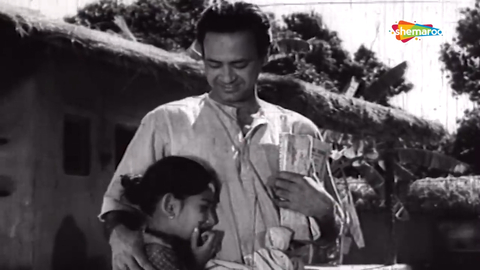
Biraj and Nilambar have been married since they were children, and are deeply in love. Biraj worries: what if she were not beautiful? Would he not love her? And what if she were to die somewhere far away from him? She pleads with him to bestow this blessing on her: that when she dies, it should be at his feet.
The first several scenes help to establish the relationships and characters of this household, and then the story takes a step forward, a few years later. Punnu (now Kammo) is old enough to be married, and Nilambar has found a suitable match for her. Suitable, eligible, yes; but hardly affordable. When Nilambar goes to meet the young man’s father to finalize the match, the man puts forward a pretty shameless demand for a fat dowry. Also, since the bridegroom is studying to be a doctor and still has two years of medical college to go, Nilambar should finance his remaining education.
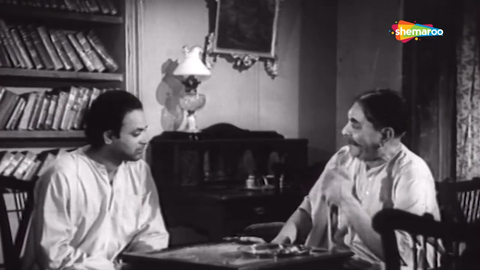
Nilambar tries to demur, then realizes that to have a sister lying unmarried at home will not do. So he agrees to pay whatever is demanded, and decides to take a loan to pay it all off.
This decision is where the story takes a turn, because from here stems the rot that destroys Biraj’s otherwise idyllic home life.
Firstly, when Pitambar discovers that his elder brother has taken a loan from the moneylender (and promised his land as surety), he is livid. As it is, Nilambar does no work; it is Pitambar who works (he’s a lawyer), Pitambar who knows how much hard work it takes to earn money. He wants out. Nilambar initially gets angry and yells at Pitambar; but he cannot stall the inevitable. The household is divided, a bamboo fence erected between Nilambar and Biraj’s home on the one side, and Pitambar and Mohini’s on the other.

Fortunately for Biraj and Mohini, neither of them thinks—like the quintessential shrewish bahu of countless Hindi films—that the other is now an enemy, and not to be even acknowledged. The two of them still talk every now and then (even if on the sly, because Pitambar continues to be sore about the entire topic). They go down to the river ghat together, they come to each other’s help.
And it is at the river ghat where a new problem crops up. The son (Pran) of the local zamindar has arrived in the area, and happens to be lounging about the riverbank with his minion (Iftekhar, in a cameo) when he sees Biraj pass by, with her maid, Sundari (Manorama) in tow. The zamindar’s son is immediately entranced, so much so that he sets out to try and snatch Biraj…

…by first making contact with Sundari. Sundari is a bit of a flibbertigibbet, more than happy to be of service to anyone who’s willing to give her money. The zamindar’s son is eager to have an informer on the inside, so to say, so he makes sure he plies Sundari with lavish gifts of money which buy her loyalty.


Meanwhile, things have been going haywire for Biraj and Nilambar. More so for Biraj, who—pativrata that she is—tries to hide the truth from her husband for as long as it’s possible. Nilambar will not go out to look for work; nor does he have the sense to realize that with his crops failed, his property gone (and the moneylender Bhola Nath—played by Moni Chatterjee—threatening to sue Nilambar), it’s high time he found some stable income. Sitting around reading the scriptures and singing hymns is not going to cut it any longer.
The situation is dire, but devoted Biraj does not, at least for a long while, let her husband see it. She skimps and saves, she does without. When she discovers that her maid Tulsi (?) makes mud toys and sells them, she asks Tulsi if Tulsi will sell toys on her behalf too—and then she gets down to making toys.
This can’t go on for long, not without Biraj eventually cracking. It is frustrating to always have to be doing without, even being on the brink of starvation. On top of that, when the zamindar’s son starts getting more fresh, a sequence of events is set in motion that will result in tragedy.
I have to confess that I haven’t read Sarat Chandra’s original novel, so I cannot judge how close (or not) Bimal Roy’s film is to the source material. But I was struck by the resemblance to the Ramayana. Not, of course, in the falling-out between the brothers, but in other elements. How ‘saintly’ and fully focussed on the Ramayana Nilambar is; how devoted he and his wife are to each other, and how her only desire is to die before him and to die with him beside her. How another man intervenes (Pran’s character is nowhere close to Ravan in stature and evil; this is a rather more cowardly creature, yet selfish enough and thoughtless enough to cause trouble far beyond his immediate desires). How that intervention causes havoc, and leads to ‘Ram’ suspecting ‘Sita’ of infidelity. And much more. If the parallels with the epic weren’t already obvious, there’s the song Suno Sita ki kahaani.
What I liked about this film:
As with pretty much all of Bimal Roy’s films, the screenplay, the way the story plays out. Everything happens in an organic manner, and there’s very little that is not pertinent to the story in some way. All dialogues, all action contributes in some way or the other in character development, in delineating a relationship, or helping build the plot. There is no comic side plot to detract attention; the cast of characters is contained, and there’s a sort of realism to the whole thing which I liked very much.
The music, by Salil Chaudhary. This is probably not one of Salilda’s best-known scores, but I loved the way he manages to evoke Bengal so beautifully. While Rafi (with Suno Sita ki kahaani) and Shamshad Begum (with Na jaane re na jaane re) sing two songs that aren’t typically Bengali-toned, the rest are sung by Bengalis and are an out-and-out ode to Bengal: Hemant sings Mere mann bhula bhula and Jhoom-jhoom Manmohan re (which is my favourite song from the film), while Shyamal Mitra sings (as a duet with Lata) Tera ghar aabaad rahe jaa ri dulhaniya, and Nirmal Chaudhary sings Maajhi re le chal re naiyya. Given that Nilambar’s character sings hymns and parts of the Ramayana every now and then, there are plenty of occasions when we get to hear just a few lines, sung in Hemant’s voice. There is, in addition, a verse here or there, echoing in the background, sung in Bengali.
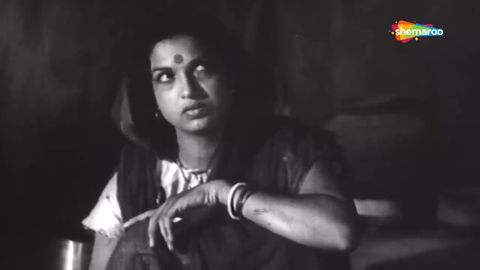
Then, Abhi Bhattacharya and Kamini Kaushal as Nilambar and Biraj. It’s not as if I totally like the two characters (more about this in the ‘What I didn’t like’ section), but they were portrayed very well: very real, and their chemistry—the deep and intense affection—was believable. A special shout-out for Kamini Kaushal (who, by the way, got a Filmfare Award for Best Actress for this role): I can see why. She plays Biraj really well. So well that in the end scene, I actually had tears in my eyes—all because of her excellent acting.

What I didn’t like:
The regressive attitude of Biraj. Yes, I can appreciate that this was how it was back then; or even that since the film takes its cue from the Ramayana, this too reflects Sita’s attitude, but still. It irritated me that this woman forgives her husband everything and continues to pine for the comfort of dying at his feet.
It’s not as if Nilambar is an abusive (or at least, for the most part, he isn’t) or unfaithful husband—both of which are the usual sins Hindi film pativratas readily seem to forgive; but he is far from the ideal spouse. He is so wrapped up in his own cocoon of saintliness and doing for others that he disregards his own home. He is neglectful and oblivious—but still Biraj goes on forgiving, goes on praying for her swami to allow her to die at his feet. Ugh.
Despite that, though, a film I’m glad I finally got around to watching. It’s well-made (Bimal Roy got a Filmfare Best Director Award for it), and the acting is superb.
Shemaroo has a copy of Biraj Bahu on its YouTube channel, here. There are brief (and thankfully occasional) sections where the audio goes for a toss or there are scratches in the print, but mostly, it’s a fairly good copy.
 Dustedoff
Thanks for the review Madhu! I heard about the film also quite late. I think it must have been sometime early 00s. Then I read about the plot somewhere and it put me off. Afterwards, I did hear some praise about the movie and the awards it won, but I was still wary and to tell you the truth, I still am. I don’t know if I could tolerate the characters and their behaviour, but Bimal Roy has a way to portray characters in a favourable light, but then on the other hand all his direction didn’t help me like Devdas much. Thus, I don’t think Bimal Roy is going to help me much in Biraj Bahu’s case too.
LikeLike
I have to agree about Devdas! It’s been ages since I watched it (I think on DD, decades back), and given the moroseness of that film, I cannot even summon up the courage to rewatch it.
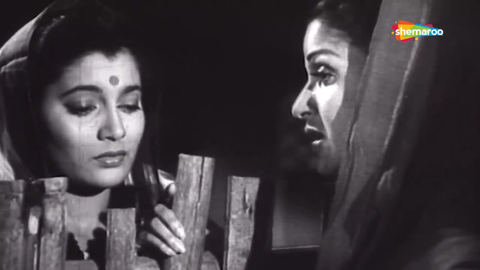
This film is well-made, but yes, that regressiveness didn’t appeal to me. :-( There are a few moments, though, that really highlight the sense of belonging – surprisingly enough, my favourite scene from the entire film is a short one at the fence between the two brothers’ homes. At night, when Mohini sneaks out to talk to Biraj and to offer help because she’s know that they’re deeply in debt. A lovely, sensitive, scene.
LikeLike
I read the book when I was in school or maybe in college (I’ve read many many books by Saratchandra, all Hindi translations and I didn’t even realise back then the importance of translation). But I don’t remember a thing. Perhaps I still have the book or perhaps it’s at my parents’ place. If I can’t find it, then I’ll watch the film instead. And, I like Abhi Bhattacharya.
LikeLike
My sister was the one who had told me that the best translations of Sarat Chandra were in Hindi! I haven’t read too many of his books, but the ones I’ve read (all in Hindi) are very good.
I like Abhi Bhattacharya too. And he does justice to this role: even though Nilambar is far from perfect, Bhattacharya plays him well so that you do end up forgiving him.
LikeLiked by 1 person
Madhu ji,
I quite share your views about Nilambar. Somewhere, one feels that he is not worthy of such a loving and pious wife.
I had also reviewed Biraj Bahu, though I usually don’t do film reviews. Here is the link:
LikeLiked by 1 person
I did stumble across your blog post when I was doing some background research for this post, Anitaji. Read it after I’d written my own review, so that I wouldn’t inadvertently get influenced, but I did see that we shared some views on the film!
LikeLike
Despite your wonderful review, Madhu (and I’m struck by how much you liked the film despite your reservations), I share Harvey’s doubts about watching the film myself. Like you, I’ve stayed far away from Biraj Bahu, despite Bimal Roy’s credentials.
Sarat Chandra Chattopadhyay must have been a misandrist at heart. His male characters are such wimps!
In any case, I will let your review stand in place of watching the film.
LikeLiked by 1 person
I’m struck by how much you liked the film despite your reservations
LoL! The acting is very good, and there are moments – the scene at the fence, between Biraj and Mohini – that are really sensitive and beautiful. I think that, and the sort of gentle Bengali-ness of the music, appealed to me. But you know what, despite all the pros, I wouldn’t watch it again.
LikeLike
I had read Biraj Bahu probably in school, and remembered very little of the story except the main outlines. Then some years ago I watched Biraj Bahu on television during a retrospective of Bimal Roy and I was surprised by Kamini Kaushal, who I usually found affected in her mannerisms ( that of the characters she played) and her diction. I had never thought that Kamini Kaushal could be so good in a role of that kind. I have always found SharatChandra Chattopadhyay annoyingly regressive despite his strong female characters. Not only are most of the male characters wimps, the ones that are not wimps are even more detestable. I found it surprising, considering that he was a contemporary of Rabindranath Tagore who is not at all regressive and is extremely enjoyable and relevant even today. It is more surprising because SharatChandra Chattopadhyay was almost 15 years younger. I suppose it was due to the different environment in which the two writers grew up. Inspite of disliking the character Devdas, I like Bimal Roy’s film very much and have watched it several times and I think he brought the characters to life, especially Devdas and Chandramukhi.
Maybe after reading your review I will be able to screw up courage to re-watch Biraj Bahu, even if only for Kamini Kaushal.
LikeLiked by 1 person
Thank you for such an interesting and insightful comment, Roma. I have to admit it had never struck me just how wimpish and weak-kneed Sarat Chandra’s male characters are. Yes, you’re very right. Now that I think back to all the books of his I’ve read (or, in some cases, films I’ve seen that are based on his books), the males are invariably pretty spineless and forgettable. It’s the women who shine.
Kamini Kaushal is really good in this, so I’d recommend it just for her.
LikeLike
I see that my incomplete comment has been posted inadvertently. Sorry.
LikeLiked by 1 person
No problem. I saw that, and deleted it. :-)
LikeLike