
When Dharmendra passed away some months back, it reminded me that while I have seen a good bit of his filmography from the 1960s—including little-known, forgettable films like Begaana, Main Bhi Ladki Hoon, Chandan ka Palna and Jab Yaad Kisiki Aati Hai—I haven’t reviewed too many of his films. Some, yes; but plenty, even much-loved films or well-known ones, have somehow slipped under the radar. Time to correct that, I decided.
And why not with this film (directed by Raghunath Jhalani), which I had last seen perhaps a little over 20 years ago, and which I remembered vaguely. Nirupa Roy, having (once again) misplaced a child. Aruna Irani on the verge of becoming an unwed mother if some good Samaritan doesn’t come to her rescue. Asha Parekh, lower lip quivering and eyes swimming with tears. Some very well-known songs.
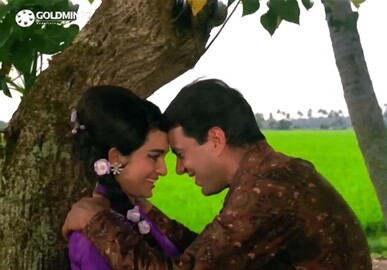
The film begins in the home of a very drunk man (Uma Dutt), where widowed Maya (Nirupa Roy) works as a maid. In pouring out a drink for her employer, Maya’s saree slips off her shoulder, and the sight inflames the man so much that he pounces on her, intent on evil. There is a scuffle. A pistol emerges from somewhere, and Maya shoots the man dead.
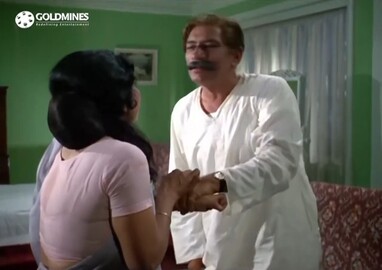
The next minute, she realizes that her baby—in the next room—will now be known as the son of a murderess. She cannot have that, so Maya goes to a temple and leaves her baby there, in the hope that he will be brought up in a good home, away from her tainted influence.
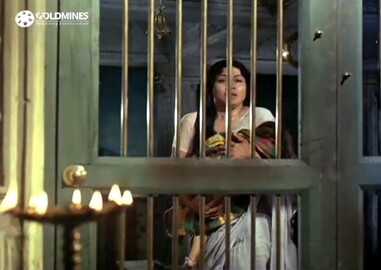
… and which is what happens. The pandit finds the baby, and soon after, a wealthy Seth (Nazir Hussain) and his wife (Dulari), who are childless and have been praying for a baby, come by. The baby is a godsend to them, and they happily take him home. Maya, meanwhile, has been arrested and ends up spending many years in jail.
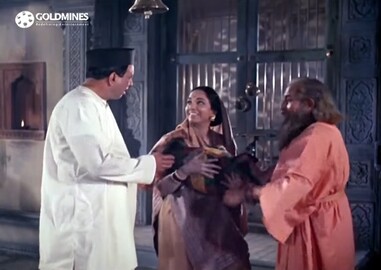
The baby is named Jai, and as the credits roll, we see him growing up happily in Sethji’s home, much loved and lavished with tons of affection. His parents (as he takes them to be; they do not tell him he’s adopted) eventually have a daughter too. Years pass, and Jai grows up (now Dharmendra), his sister Sita now Bindu, who is married to Rajesh (Ravindra Kapoor). Sethji’s wife has passed away in the meantime.
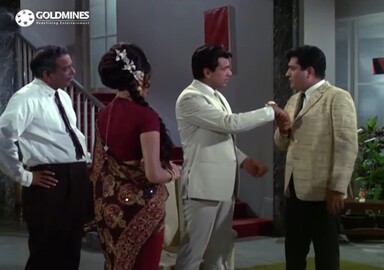
Over the next few scenes, we get a glimpse of all the main characters, and what’s happening in their lives.
First up, there’s Sita’s husband Rajesh, who is having an affair with a dancer named Rita (Laxmi Chhaya). He lavishes not just time but also a lot of money on Rita…
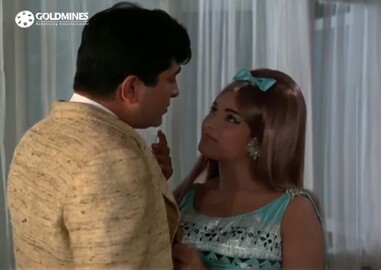
… unaware that to her, he is really just a source of money. Behind his back, Rita has a good laugh with a friend and helper (Keshav Rana), both of them triumphant about how Rita has managed to hoodwink this gullible fellow. Another man (Mac Mohan) hovers around Rita’s workplace, cackling wildly and passing vague remarks about how faithless she is.
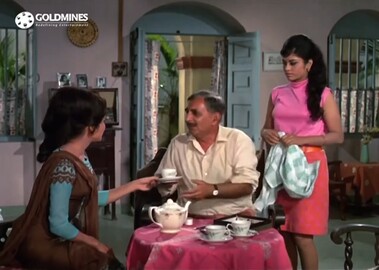
Then, there’s Aarti (Asha Parekh), who lives with her widowed father (Shivraj), her younger sister Mala (Aruna Irani) and little brother Pappu (Master Shahid). Pitaji is always neglecting his own needs to make sure his children are well-fed, well-clothed, well-educated. Aarti and Mala are anxious about his health, and the affection between the members of this family is touching [or meant to be. I found it a little on the saccharine side of emotion].
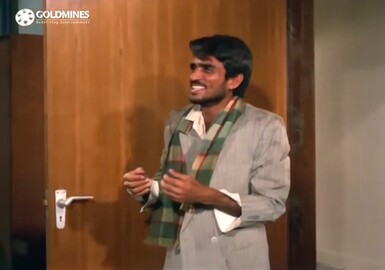
At a show she’s organizing, Aarti is expecting a famous singer named Jai-something-or-the-other. Aarti’s colleague, Sadhuram Sood (Rajendranath) is hovering about outside the hall, and hears a passerby calling to Jai, who’s just alighted from his car; Jai has come to see the show. Sadhuram assumes this is their star singer, and a misunderstanding ensues. Jai, who is taken to meet Aarti, falls for her instantly (and she has that demure look on her face that implies she’s smitten as well), and so he keeps up the charade.
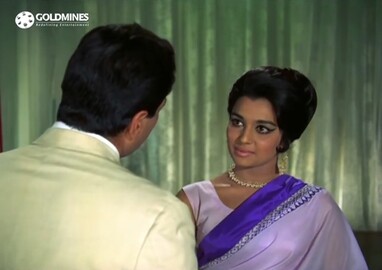
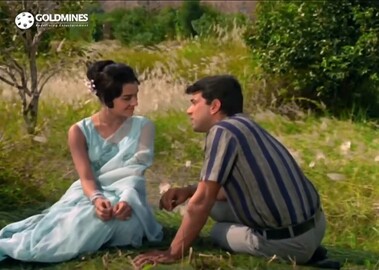
It doesn’t take long for the real Jai to turn up. Then, though Aarti is furious (at Dharmendra-Jai) and tries to shame him, he wins the audience over (and Aarti too) by singing what seems to count as a whopper of a song. The long and short of it is that Jai and Aarti have met because of one of those convoluted, coincidental and utterly improbable incidents old Hindi cinema was so fond of, and now they can get down to the job of romancing each other and singing songs in pretty locales.
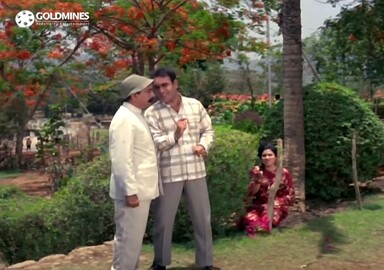
There is a very tedious (and pointless) comic side plot involving Sadhuram, the woman he falls in love with (Naaz), and her father (Sunder), a doctor who has been treating Sadhuram for kleptomania. This, however, has absolutely zero bearing on the main plot, and after Sadhuram and his girl get married, the entire ensemble in that CSP disappears, thank goodness.
But there are other elements which do contribute to the story, and in a big way.
For one, there’s Maya (remember? Jai’s mother), who has now been released from jail. [I wonder at this sentence she was handed out. Did she make no attempt to explain that the gun was fired in self-defence? Did nobody listen to her? What?] Anyway, one day, a now broken and miserable Maya goes to the temple where, many years ago—to the day—she had left her baby.
In the courtyard of the temple, Jai (whose adoptive parents have always regarded the day they got him as his birthday) is distributing food to the poor, by way of thanking God. Jai is going upstairs into the temple, carrying a thali full of flowers, when he trips and some of the flowers fall at Maya’s feet. [Uff]. Maya stops him when he tries to pick up the flowers; fallen flowers cannot be offered to the gods. But Jai only smiles sweetly and says that elderly people are nothing short of gods.
When he asks her who she is and what she’s doing here, Maya explains that she lost her son here, many years ago.
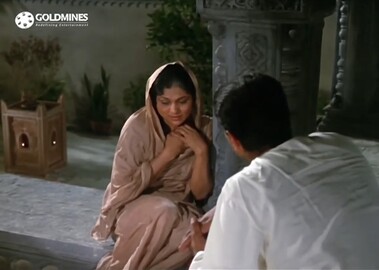
Jai goes back to his work of distributing food to the poor people who’ve gathered there in the courtyard, and is in the process of handing out stuff when there’s suddenly a hue and cry: the old woman sitting on the temple steps has collapsed. Jai goes to help, and is so sorry for Maya that he, helped by Sita, takes her to their home. Maya will live with them.
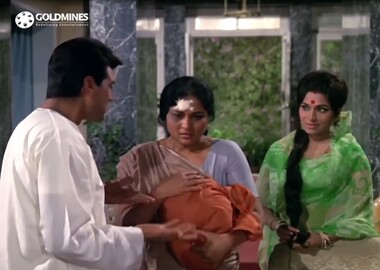
Maya soon settles into Sethji’s home, all of them (including Maya) totally unaware of how they’re connected.
Things seem to be going well.
But in Aarti’s home, Mala harbours a secret that she isn’t telling anyone yet: she has acquired a boyfriend. Deepak (Jalal Agha) is a wealthy collegemate of Mala’s, and one day, she found him waiting for her in his car along the road she takes to walk to college. Deepak offered her a lift, and refused to take no for an answer. Mala (perhaps flattered by his attention?) finally agreed, and since then, they’ve gone from being collegemates to friends—to betrothed, all unknown to everybody else.
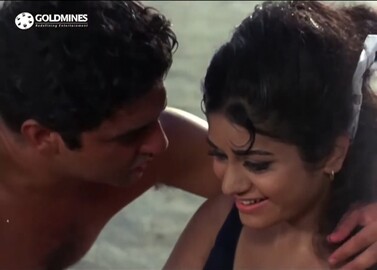
Then Aarti (who, it turns out now, was also in college; her exam results have just been announced) has sailed through, first division and all. Pitaji is ecstatic, and Aarti vows that she will get a job and help out. Pitaji will have enough money now to buy himself an umbrella (he gets soaked every time it rains), they will be able to afford this and that… a watch for Aarti, Pitaji insists.
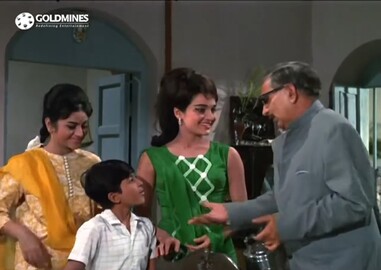
A very excited Pitaji, returning home from work that day, stops at the shops and buys the watch. He is so entranced by it, he walks onto the road, holding the watch and admiring it. [Very like a lot of modern-day people who can’t seem to take their eyes off their phones]. And the inevitable happens: he is struck by a car and dies on the spot.
Guess who’s driving the car? None other than Jai.
Jai and Aarti have never met each other’s parents; thus Jai does not immediately realize who has died, crushed under his car. However, he discovers soon enough, and is horrified. More so when he goes to Aarti’s home to offer his condolences, and even before he can say anything, can admit to being the one in part responsible for her father’s death, Aarti starts sobbing and spewing hatred for the unseen murderer who killed her father.
Jai cannot bring himself to confess the truth to Aarti.
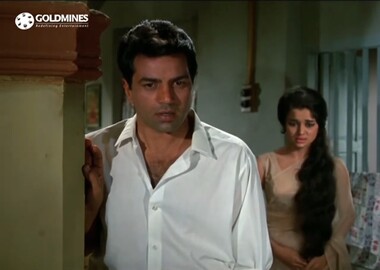
And soon Jai—the very picture of a ‘devta’, as someone in the film calls him—ends up harbouring several other sordid secrets, all of them combining to make him appear no less than a monster to Aarti, his adoptive father, his sister Sita, and pretty much everybody else.
Aaya Saawan Jhoomke is to me one of those quintessentially 1960s’ entertainers. Not a good film if you are looking for a meaningful story (Mamta may fit that, and Satyakam) or even one that’s not ‘serious’, but well-made fun (Aankhen, or Pyaar Kiye Jaa, Jewel Thief, Humraaz, Mera Saaya…). This one is let down by a bad script and high melodrama (which makes for some fairly hammy acting, especially by Dharmendra and Asha Parekh), but on the other hand, at least there’s never a dull moment, and there are some okay songs.
What I liked about this film:
The entertainment value of it. The story, for one, is fast-paced, and (as was pretty much standard for Hindi films of the 50s and 60s, as well as beyond) once the romance and the love songs have been completed, the real story begins. After Aarti’s father is killed, the story gets even more deliciously complicated. There is one twist after another, up to the point when you’d think the story is now complete. It’s never boring, even though some of it is a bit tedious.
There are nice-looking people here; the locales are lovely (several of the scenes, and most of Saathiya nahin jaana ke jee na lage, are set in Kerala, amidst the backwaters and against a backdrop of the Chinese fishing nets).
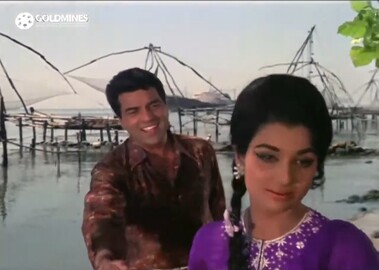
And, the music, by Laxmikant-Pyarelal (with lyrics by Anand Bakshi). Bura mat suno bura mat dekho, Saathiya nahin jaana, Rama duhaayi mere Rama duhaayi, and Yeh shama toh jali roshni ke liye are among the more popular songs of the film, though the ones I like best are Main ek haseena and Maanjhi chal o maanjhi chal.
What I didn’t like:
The melodrama is of course par for the course in a lot of films of this period and this style; so I will not dwell on that. But what gets my goat is the level of misunderstanding. That too is also pretty much standard, but it still annoys me no end. Why is that people who should know an individual very well—closest family, dearest love—should so readily believe the absolute worst of that person (even when said person is fervently denying the accusations so tearfully levelled against them)? And there should be a limit to how much misfortune, how many misunderstandings and false allegations, might fall to the lot of one person. Whew.
And yes, how come after spending so much needless time and effort on the chronicles of Sadhuram Sood, his girlfriend and her father, the trio simply drops out of the film completely, never to be seen again, and without any sort of closure to their story (a tame wedding doesn’t count, as far as I am concerned).
Anyway. Not a frightful film, and entertaining in its own way. But there are better films of this type and this period out there.
 Dustedoff
In one of Feluda’s adventures by Satyajit Ray, he offers Jatayu, an author who specializes in ridiculous thrillers with alliterative titles a foolproof formula for writing a Hindi film script. ( from what I remember, could be slightly off the mark)
1. Duration: a solid three hours, divided into two halves
2. First half: construct the story until it collapses into a majestic confusion. 3. Second half: Add generous helpings of misunderstanding and more confusion. Then, in the final ten minutes, untangle everything.
4. Happy ending
5. Songs: minimum six. Mandatory inclusion of one devotional number. Preferably when the plot has absolutely no use for divine intervention. ;)
The Hindi films of the mid-to-late 1960s followed this recipe with complete devotion
LikeLike
LoL! That is perfectly summed up. :D Do you remember which story this was?
LikeLike
No. do not recall the story at present. But give me some time, I’ll check my Feluda collection. This happened in 1978 or thereafter. Because Jatayu’s first story for Hindi cinema was in 1978. The film was named “Jet Bahadur” (ROTFL)
LikeLike
That made an interesting reading, dear Madhu. Thank you for the article.
It is quite possible that I have seen the movie from DD times, but I can’t remember it. It is interesting that the movie has so many threads to it. The novelty though seems to be that the hero is the instrument of death of the heroine’s father. Otherwise all other tropes are to be found in other films too. Sisters as potential unwed mothers were very much the big stay in the films of 60s, 70s and 80s. And I presume the movie’s title has nothing to do with it.
LikeLiked by 1 person
Did you oversee my comment, dear Madhu?
LikeLike
Arre, I’m so sorry, Harvey, I missed this comment. Or, actually, I read it when the notification popped up in my mail (I didn’t come to the blog to read it), and since I can’t answer directly from my mail, I forgot all about it. :-( Sorry about that!
And yes, quite a few well-worn tropes here. But yes, the heroine’s father (or actually anybody close to one of the leads) getting killed by the other lead – now that is definitely new and refreshing. Kuchh toh new and refreshing hona chahiye! :D
LikeLike
I totally get that. It happens to me all the time with emails or WhatsApp. I read them, think “I’ll reply later,” and then later quietly disappears into another dimension.
As for “new and refreshing”… new, absolutely. Refreshing, though? Hmm… I might go with “boldly morbid”. Not sure parental homicide quite gives me that fresh spring breeze feeling! BTW, did I miss some subtext there
LikeLiked by 1 person
LoL. Yes, you’re right, of course. Nothing refreshing about it – just a little offbeat and unexpected. I certainly didn’t remember that (and wouldn’t have seen it coming, the first time I watched this film).
Not culpable homicide, though. And honestly, it really was the father’s fault – walking down a busy road without looking where he’s going (something a lot of people seemed to do in Hindi cinema back then, invariably with disastrous results. It happened in Aaye Din Bahaar Ke too, to Asha Parekh’s character).
LikeLike
wish you had mentioned Producer J Om Prakash and Director Raghunath Jhalani in the write up For me the role played by Dharmendra was an institution for a school boy like me during its release Also full song Majhi chal was shot on the back waters of Kerala for the first time probably
LikeLiked by 1 person
I had thought I had mentioned the director, at least, but thank you for drawing that oversight to my attention – will add that in.
Yes, I don’t think there were any other songs before this one which were filmed on the backwaters. It’s a lovely backdrop.
LikeLike
Madhuji,
Like Anirudha mentioned, the formula was more or less set. Baby swapping and adopted children were the staple of such films. And most films ended with a prolonged courtroom drama. Perhaps it was felt that that was the most judicious way of mopping up operations!
Anita
LikeLiked by 1 person
… and the court scenes would invariably bear no resemblance to what actual courts are like. :-) My father used to be a police officer (and he is a film buff too), and he has always lamented how completely devoid of reality court scenes in Hindi cinema are. Or, of course, how the police is depicted.
LikeLike
I spent half of this review utterly confused, wondering why this film sounded so different from what I remembered… then scrolled back up to the title and realised this wasn’t Aaye Din Bahar Ke. Why so many 60s films sound the same to me, I have no idea (though, since both films in this case share the same director-producer duo, I’ll happily pin the blame on them).
Thank you for the lovely review!
LikeLiked by 1 person
Not just the same producer-director duo, but also the same lead pair, and the Dharmendra character having been separated from a parent early on in life! It’s easy to mix up the two films, I think. :-)
Thank you for your kind words. I’m glad you enjoyed this!
LikeLike
It always cracks me up when well dressed heroes or heroines bemoan lack of money for an umbrella or something. At the very start of Professor, Shammi Kapoor is wearing a lovely plaid coat but there is no food in the house.
I watched Aaya Sawan Jhoom ke when it came out. I loved it as a 9 year old kid. Now, I don’t think I can watch it.
Lovely review as usual, Madhu. I really admire your consistency in keeping the blog up and look forward to your reviews.
LikeLiked by 1 person
You’re so right, Ava. This cribbing about not having money to buy an umbrella or a watch – when all the time going about dressed to the nines – this gets my goat. (And Professor is an excellent example in this case).
Thank you for sticking by me and continuing to read and to comment. That means a lot to me!
LikeLiked by 1 person
Coming to your blog after a long time (long story…) to read this one. I always mix this one up with Aaye Din Bahaar Ke too. Well, that was melodramatic alright, but this one went over the top, especially the part where Dharmendra’s entire family accuse him of this, that and the other.
Re: Ava’s comment about heroes/heroines complaining about being poor: I’d always remarked that being ‘poor’ in a commercial Hindi film was actually quite nice (with no bearing to reality). What used to crack me up is the spacious rooms/houses they live in, with some strategically placed broken plaster… especially when the movie is set in Bombay where 500sq ft would house a family of six or more! :)
A friend used to remark that she knew the heroine was poor if she wore cotton saris instead of silks! But, clean, well-starched designed cotton saris, of course.
LikeLiked by 1 person
Oh, yes – those huge houses with the strategically placed broken plaster! :-D I was suddenly reminded of Mela (Nargis, Dilip Kumar), where the man she’s married off to is so poor that his double-storeyed house has these patches of bare plaster everywhere.
Also, it’s odd that old, sickly parents (think Leela Chitnis in Inteqaam, Achla Sachdev in Waqt) are clad in threadbare (often patched) saris, while their children go about looking so stylish, you’d never imagine there was any lack of funds there…
LikeLike
Exactly what A and B said was running through my mind too.
My pet theory is that the quietly subversive director is trying to tell us something: the parents have clearly sacrificed everything for their children, including, apparently, all fabric not already patched three times, while said children parade around in immaculate outfits and an air of moral superiority, are in reality nothing but spoiled brats.
So the real message might be: less “noble suffering” and more “congratulations, you have raised a very well dressed, and entirely insufferable brat.”
LikeLiked by 1 person
With A and B, I meant Ava and Anu. Why A and B? Don’t ask. Lately, my favourite answer to all my shortcomings is, ‘I’m getting old.’
LikeLiked by 1 person
Somehow A and B sounds better than A and A, even if it’s not literally correct. Maybe you could have written AS and AW?
But I am totally a supporter of that “Don’t ask. I’m getting old” thing. I do it all the time!
And: I love this.
So the real message might be: less “noble suffering” and more “congratulations, you have raised a very well dressed, and entirely insufferable brat.”
You can bet that sometime in the course of the film that same insufferable brat will spout some sanctimonious dialogue about being willing to give up everything for Ma. :D
LikeLike
So the real message might be: less “noble suffering” and more “congratulations, you have raised a very well dressed, and entirely insufferable brat.”
I laughed out loud at this! But isn’t it very telling that it’s always the heroines who are spoilt, insufferable brats, who need to be shown the error of their ways by the morally upright (insufferable!) hero, who’s almost always the son of a bechari, who’s wearing ‘fabric patched three times’ (love this description, and I’m warning you, I’m going to filch it sometime!) and is equally spoilt but is not deemed so?
(And if this sentence doesn’t make any sense, well, “I’m getting old and it made perfect sense in my mind!”)
LikeLiked by 1 person
Oh, yes! It’s often the well-dressed female who must learn how self-sacrificing her poor, sewing-clothes-inspite-of-being-near-blind Maaji has been. But then, like Aaya Saawan Jhoomke, there are equally any number of films where everybody (except longsuffering parent) looks well-dressed and khaate-peete ghar ke, but apparently cannot afford a watch or an umbrella.
*shakes head in bafflement*
LikeLike
Yes, the openly spoilt child is always the heroine (provided she is rich), who is ‘reformed’ by the hero, the well-dressed and coiffured son of the aforementioned, “saintly figure in tattered white, fixed to a sewing machine while coughing her lungs out” mom.
My theory is that through this portrayal, the director is really holding up a mirror to the audience, asking: “Look closely—who is truly beyond reform here?” ;)
love this description, and I’m warning you, I’m going to filch it sometime!
mera mujh me kuchh nahin
sab kuchh hai jo tera
LikeLiked by 1 person
I love you, Harvey! :)
LikeLiked by 1 person
I had seen this movie years back on Doordarshan and after growing up on YouTube. Your review is spot on. The narrative contains twist after twist and doesn’t bore at all. There’s a suspense element also in the ending reels. Hence it’s at least a one time watch. The flaws pointed out by you are agreeable though.
LikeLiked by 1 person
Yes, despite the flaws, it’s still a good one-time watching. At least it’s entertaining.
Thank you for reading, Jitendraji.
LikeLiked by 1 person