
In Satyajit Ray’s 1966 film Nayak (‘The Hero’), the eponymous ‘hero’, the hugely popular superstar Arindam Mukherjee (Uttam Kumar), is travelling by train from Kolkata to Delhi to receive an award. He is sharing a compartment with a family, of whom the father, Mr Bose (Ranjit Sen) spends most of his time outside the compartment. The mother (Bharati Devi) is left pretty much on her own to look after their teenaged daughter Bulbul (Lali Chowdhury), who is unwell and is lying on the upper berth.
When Arindam first enters their compartment, the effect of his arrival is palpable. Bulbul has been reading a book; one look at him and the book ends up beside her, forgotten. On the berth underneath, Mrs Bose, having settled in (and informed Arindam that her daughter is a fan of his) surreptitiously opens her handbag, takes out a mirror and takes a quick peek at herself.
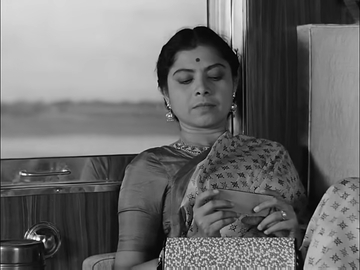
Such is the effect of close proximity to a celebrity.
Today, September 3, 2026, is the hundredth birth anniversary of Uttam Kumar, one of the greatest superstars the Indian subcontinent has ever seen (yes, not just Bengal; I think Uttam Kumar’s shadow sprawled far wider than that). The ‘mahanayak’, as he was dubbed by millions of adoring fans. The man who carried, sometimes single-handed, more often than not with Suchitra Sen, film after popular film on his shoulders. An actor who was often overshadowed by the star.

Over the course of the many years I’ve been blogging, I’ve watched and reviewed a fair number of Uttam Kumar films, from romances like Sagarika and Agnipariksha, to comedies like Ekti Raat and Shaarey Chhuattar. I’ve watched him in a taut suspense thriller (Thana Theke Aschi) and in a period adventure film (Jhinder Bondi). Plus others. What film, I wondered, should I review for his birth centenary?
I finally settled on the film that doesn’t just star Uttam Kumar; it is about a man such as him. A larger-than-life ‘hero’, a hugely successful film star. A man who has the adulation of millions, is the very picture of one who has reached the pinnacle of all that most people seem to desire so much: wealth, fame, a certain level of power.
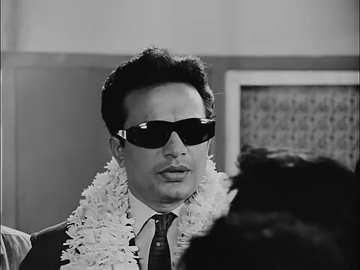
And yet.
When we first see him in Nayak, Arindam is at home, going about getting dressed while his friend and manager Jyoti (Nirmal Ghosh) hovers about, doing this, saying that, making sure everything is in place. There has been a disturbing piece of news in the newspaper: at a club recently, a drunk Arindam was involved in a brawl. Arindam freely admits to that; he was coming to the rescue of a beleaguered woman. There’s nothing to it.
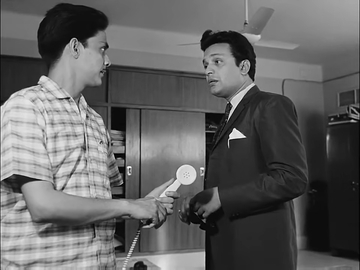
A man comes by to try and get a contract signed, but Arindam dismisses him. Cordially, politely, but unmistakably.
The signs are clear: Arindam Mukherjee is in control. He has reached that place where he is untouchable.
It shows in other ways, even after he’s boarded the train on which he must travel because air tickets weren’t available. In the quietly appreciative looks of Mrs Bose and her unwell daughter. In the eager-to-please demeanour of the conductor, the man in charge of meals and other amenities. Even, later on in the film, when clamouring crowds gather on a platform outside the dining car window where Arindam is seated with a journalist (Sharmila Tagore) opposite him.
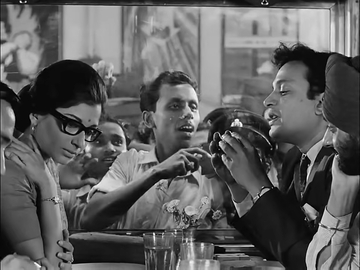
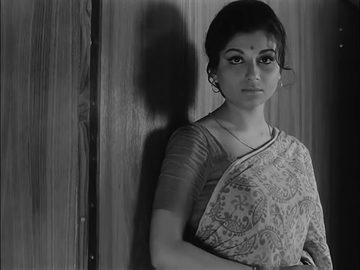
This woman—her name is Aditi Sengupta—exemplifies the other side of the public. Not the adoring public, but the cynical, critical public. In her very first conversation with Arindam, Aditi bluntly tells him that she thinks Bengali cinema doesn’t portray reality. She publishes a small women’s magazine (for which she is also writer/journalist, editor, and general dogsbody, even handling customer subscriptions), and cinema is not one of the subjects discussed in the magazine.
Yet Aditi, perhaps slightly intrigued, too, ends up listening when the woman (Jamuna Sinha) sitting next to her in the chair car encourages her to try for an interview with Arindam. This woman is a fan of Arindam’s, and it’s obvious that she’s hoping for some vicarious pleasure through Aditi’s conversation with Arindam.
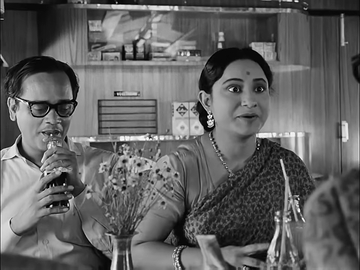
Though Aditi introduces herself to Arindam, even asking him outright if she can interview him, he fobs her off. Not, however, for the length of the train journey; again and again, they cross paths, at times in the dining car, or in the corridor outside the compartments. And slowly, because she is neither starry-eyed, like Bulbul, nor judgmental like the old man (Jogesh Chatterjee), who writes letters to the editors of newspapers, complaining about the evil of cinema…
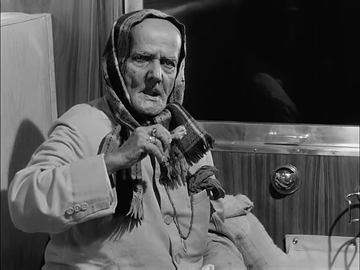
… Arindam begins to open up. Through a series of conversations with Aditi, through his dreams in the fitful bouts of sleep he snatches during the day and night, the story of Arindam’s life emerges.
This was the second film of his for which Satyajit Ray wrote a completely original screenplay, and the very real, three-dimensional look at the world of cinema is believably that of a Ray. We see this world through the eyes of Arindam (even if those eyes are covered, at critical moments of the film, with his sun glasses). A man who nonchalantly, even smilingly, accepts the praises and affection of his fans, and with just as much nonchalance—even a sense of humour—faces the barbs and unwarranted criticism of disapprovers.
A complex man. A man who looks the epitome of self-confidence, even swagger: a man who dreams of strolling happily through mountains of currency notes…

And yet, a man who sees that dream twist into something frightening when skeletal hands emerge from among those currency notes, and eventually, the money, quicksand-like, swallows him—while his friend and mentor from his pre-cinema theatre days just stands by and watches.

A man who remembers the actor, Mukunda Lahiri (Bireswar Sen) who, on Arindam’s very first day on a set, his first day of work in the cinema industry, belittled him in front of the entire crew. Mukunda Lahiri, then the reigning actor, showing off his seniority before the debutant. A scene that has remained etched in Arindam’s mind, a bitterness that has festered over the years.
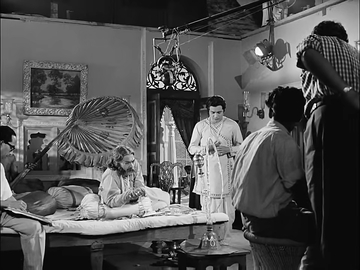
Arindam Mukherjee is careful about what he will say and do, about how he will appear, what he will be quoted about. Everything and anything can affect the box office. His life, it seems, revolves around the box office, and he is painfully aware that he too has feet of clay. Three flops in a row, and he will be history.
There is pain in this man’s past. There is the anger against people like Mukunda Lahiri, as also the (natural) desire to have revenge. There is the sense of shame and of guilt at having abandoned the friend, Shankarda (Somen Bose) who had mentored him in theatre, and who had advised him not to join cinema. There is annoyance, and possibly a somewhat wistful nostalgia, for the leftist friend (Premangshu Bose) with whom he used to hang out through school and college, and who tried to use Arindam’s star power to push his own agenda.
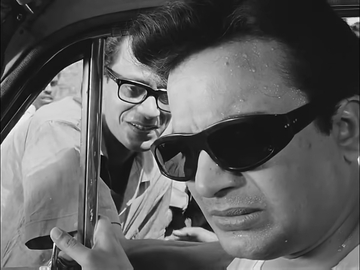
Arindam is torn and angry. Anxious. There is turmoil, and the fear of what the future may hold.
While Arindam Mukherjee is the focus of Nayak, the story does not stop at him. It revolves around him, but travels elsewhere too. To Mr Bose, who spends his time ogling the pretty wife, Molly (Susmita Mukherjee) of a fellow traveller, Mr Sarkar (Kamu Mukherjee). Mr Sarkar is an advertising man and is hoping to get good business from the wealthy Mr Bose; he is willing, therefore, to do anything to sweeten up Mr Bose.
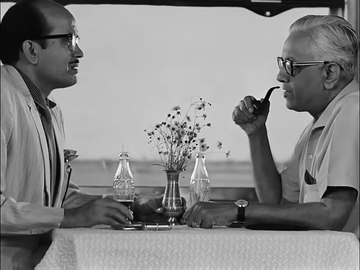
Even if it means telling Molly to be ‘nice’ to Mr Bose.
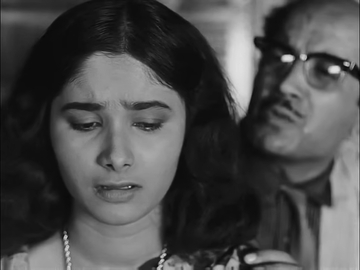
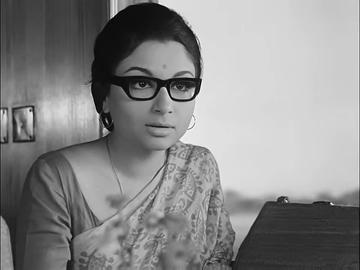
If there is Molly, so summarily objectified by both her husband as well as Mr Bose, there is also, on the other hand, Aditi Sengupta: efficient, no-nonsense, possibly quite capable of fending off any attempts at sexual harassment. Interestingly, in one scene where Aditi slips off her glasses and receives a compliment her on her looks, she immediately slips her glasses back on. Like Arindam’s dark glasses, which hide his feelings (à la Madhabi Mukherjee’s shades in Kapurush), Aditi’s specs do more than just help her eyes.
If there is the admiration in the eyes of Mrs Bose and Bulbul when Arindam first enters their compartment, there is the expression on Mrs Bose’s face when a drunk Arindam staggers into the compartment at night and slumps, his feet and legs trailing on the ground, on the berth. Even as she gets up and pulls his legs up onto the berth, her daughter watches on, looking at the condition of her hero.

And yet—perhaps because they have seen him as a vulnerable man, perhaps because he has revealed the hurting, distressed human behind the façade of the hero?—they still admire him.
Aditi Sengupta, too—who has come to know something of this man through their conversations—may not have changed her views about the superficiality and escapism of Bengali cinema, but her attitude towards Arindam Mukherjee has softened.
Coincidentally enough, one of the first Satyajit Ray films I ever watched (and reviewed) on this blog was also an Uttam Kumar film: the 1967 Chiriakhana. That one, a whodunnit starring Uttam Kumar as detective Byomkesh Bakshi, was made the year after Nayak, and now, when I look back at it, I can’t help but marvel at the difference between the two films: they’re like chalk and cheese.
Nayak is easily one of Ray’s best films: deeply nuanced, deeply sensitive, and very real. All through the film, silences speak louder than words, and one has to read between the lines to understand the truth that underlies both words and actions. There is no melodrama, not even in fraught moments that might logically have led to a ‘scene’. And yet, there is at times so much raw emotion that it sears its way into a viewer’s mind.
A superb screenplay, excellent directing—and brilliant acting. From all the cast, but especially from Uttam Kumar. I have always been fond of him, but I think it’s in Nayak that I’ve seen his best acting so far. He is so very believable here, as the man so used to donning a face, so adept at acting, that he finds it difficult to set that mask aside. And—is the relief of letting it all finally hang out (so to say) so great?—when he opens up, when he allows himself, too, to confront his own fears and his insecurities, the result is (even if only fleetingly) unsettling.
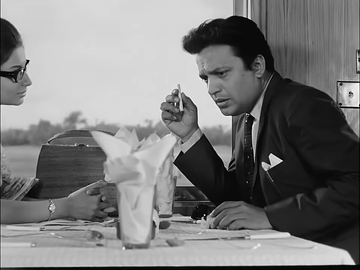
And how completely Arindam Mukherjee is Uttam Kumar. How arrogant, how self-confident. How hurt. How angered and vengeful, how kind and understanding. How admired, how reviled. How much the ‘God’ (as Aditi refers to his persona in one dialogue), and yet how human, too.
Thank you for the cinema, Uttam-da. How fortunate I am that there are still so many films of yours I am yet to watch.
 Dustedoff
Thanks for writing about Nayak. I can add my own bit about the film as well, but shall let it go. Lovely review, as usual. And Uttam was superb in Chiriyakhana as well :)
More on that sometime…
LikeLike