
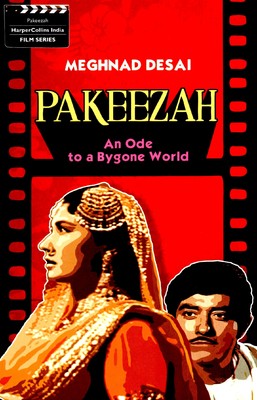
When I posted my review of Pakeezah last week, I mentioned that I’d be posting something further about Pakeezah. This is it, and the reason why I rewatched Pakeezah in the first place: I wanted to see, once again, the nuances of the film, before I got around to reading Meghnad Desai’s Pakeezah: An Ode to a Bygone World (Harper Collins; 2013; ISBN: 978-93-5029-369-0; 152 pages; Rs 250).
Five styles of medieval building decoration

Some months back, I’d posted an article here about some interesting architectural elements you can find in medieval monuments in North India, including Mughal monuments. Kangura battlements, for instance, and damaagas, from which boiling pitch could be poured on to … Continue reading
Pakeezah (1972)
Whenever people ask me what my movie blog is about, I say pre-70s cinema. Pre-70s, yes, but with a few (very few) exceptions, and those are films released in the very early 70s, but with a distinctly 60s feel to them. Pakeezah is the example I invariably give: a film released in 1972, but with an aura that’s recognisably of an earlier period about it, whether it’s in the fashions, the actors, or the overall look of the film.
Since I generally steer clear of reviewing very well-known films, the format of this review is going to be slightly different from my usual film review. I’ll begin with a much briefer synopsis than usual, then go on to discussing—in far greater detail than I normally do—what I liked about the film, what I didn’t like, and sundry other musings regarding Pakeezah.

The Mouse That Roared (1959)
What is a country to do if its economy suddenly takes a nosedive? What if the country’s sole source of income is a product that’s suddenly no more in demand? Are economic reforms in order? Or a smart political move?
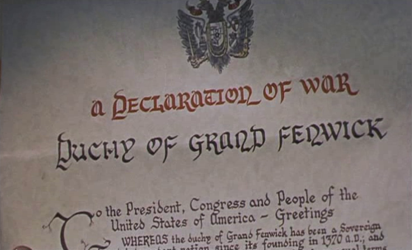
No; I’m not talking a 1950s tale of courage and enterprise in the face of economic disaster (not in the way one would’ve expected, at any rate). Not when you know that the star of this film—in a triple role, too, one of which is a woman—is the inimitable Peter Sellers. And not when you know that it revolves around a fictitious country, supposedly the smallest in the world, which decides that what its economy needs for a turnaround is to declare war on the United States of America.
Dhool ka Phool (1959)
Yash Chopra’s debut as a director, Dhool ka Phool is unusual in a lot of ways.
Leela Chitnis, for instance, is not a coughing-her-guts out (or basket-making) pathetic old mum.
The hero and heroine travel by train—and that too in trains that go over bridges—without the train falling into the river or crashing and the protagonist losing their memory in the process. Or being given up for dead.
And two people in love in the first half-hour of the film end up moving on in life and not loving each other till the end of time.
On the flip side, it does have a long-lost mother feeling an inexplicable affection towards a strange boy, who for no reason that he can fathom, instinctively calls her “Ma!” It does have a thunderstorm at the end of a love song, with the expected consequences [read: raging hormones, libido and “Humein aisi galti nahin karni chaahiye thhi”]. And it does have Manmohan Krishna being the goodie-two-shoes who stands up for what is right and righteous.

Restaurant Review: Yauatcha

Seven years back, on a trip to London, we decided we had to eat at a Michelin star restaurant. The choice, after much juggling between budget and location and cuisines we like, ended up being Yauatcha, in Soho. We loved … Continue reading
Restaurant Review: Town Hall
When a restaurant’s cuisines are listed as ‘North Indian, Chinese, Thai, Asian, Continental’, I tend to raise my eyebrows and wonder which—if any—they are really able to do well. In my experience, multi-cuisine restaurants are invariably flops. Town Hall, newly … Continue reading
Restaurant Review: Soi Thai

Basant Lok Market was, till the 90s, one of South Delhi’s most popular places to hang out—and then stand-alone cinemas gave way to multiplexes. Priya Cinema, the main attraction in the market, suddenly found itself (despite a plush new look) … Continue reading
Restaurant Review: Dao
About two decades back, Thai restaurants were all the rage in Delhi. There was (or so it seemed) one in almost every major market, and a chain—Bangkok Degree 1, 2 and 3—had also set up shop. It looked as if Thai food, with its curry-like flavours, its spice and freshness and obvious points of appeal to Indian palates, was here to stay.
Then there was an odd shift. Every other Oriental restaurant (even those which proclaimed themselves as Chinese) began serving Thai curries and rice. That may have been the only Thai dish on their menus, but it was there, often in a not-at-all-authentic form. And the primarily Thai restaurants retreated into the background, either shutting down or just going downhill.
We have always been very fond of Thai food, so this, of course, was a bit of a blow for us. And there was much excitement when we discovered (on a Facebook foodies group) that a Thai restaurant had opened in Greater Kailash’s N Block Market. Someone who’d eaten there had praised the authenticity of the food, so we were especially keen to check it out. Within hours of hearing about Dao, we’d booked a table for Sunday lunch here with my sister and brother-in-law.
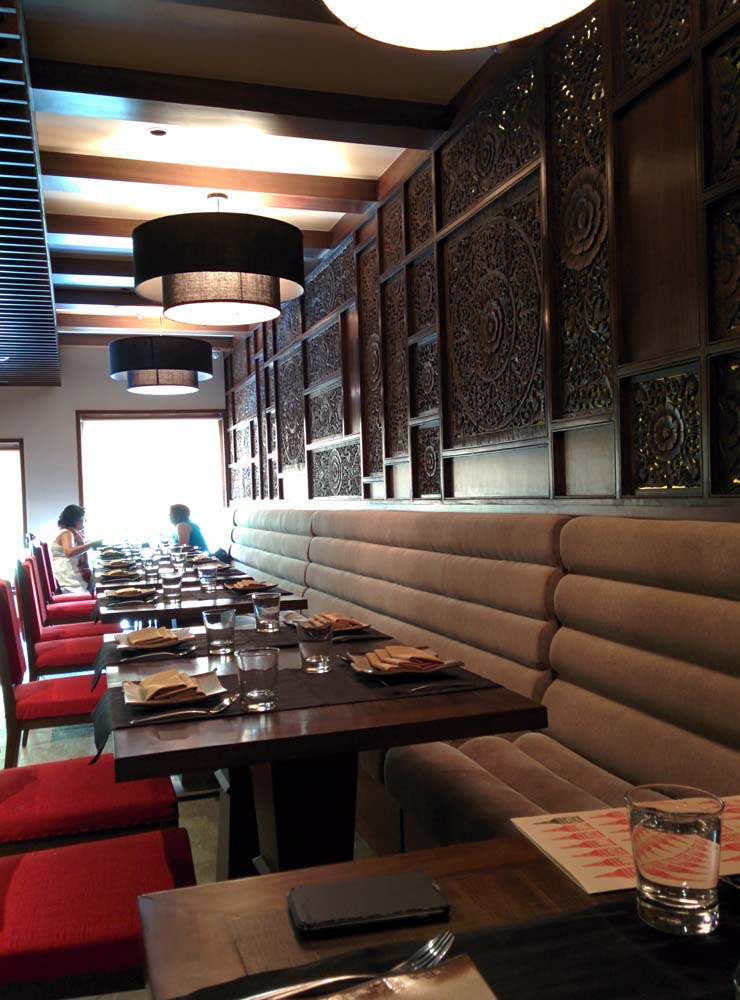
At Dao.
Restaurant Review: Krispy Kreme

My husband and I end up visiting Select CityWalk Mall every other week or so, invariably combining shopping with lunch, followed by coffee and cake, mostly at either The Coffee Bean and Tea Leaf or Starbucks. When we saw that … Continue reading
 Dustedoff