What’s named after Dara Singh?

A reblog of an old post, from when my blog was only a couple of months old.

Reblogged, because there’s an addition to this list.

After many years of thinking I knew all the obscure (and not) ways in which popular actors are immortalised in everyday objects, I had a moment of serendipity—an unexpected addition to this all-too-short list.

The other day, our gardener turned up, bringing with him a rather nice-looking plant with glossy striped green leaves. Would we like to keep it, he asked my husband. It’s a good indoor plant. We really don’t need any more indoor plants (we have plenty as it is), so we declined, but my husband asked him, out of curiosity, what it was called.

Dara Singh ka paudha,” he said. Dara Singh’s plant.
Why on earth?
Bahut shaktishaali hai,” he explained. “Marta nahin hai.” It’s very hardy, doesn’t die.

Later, when I had some time, I checked the plant out on Google Lens, and the penny dropped. This, to give it its botanical name, is Dracaena fragrans. Dra-caena, which has a similar set of syllables to ‘Dara Singh’, barring that g at the end. In a country where we have gardeners mangling names of plants left, right and centre (a friend has ‘begum bailiya’ flowering profusely in her home, another looks forward to pansotia at Christmastime), this is hardly unexpected.

Anyway, so we’ve said no to Dara Singh’s plant. But I’ve learnt something new in the process.

Mahabharat (1965)

I hadn’t heard of this version of the Mahabharat till a few days back (not, of course, that the existence of this film is surprising; given Hindi cinema’s love for mythology, there was bound to be at least one version of this epic floating about). Then, commenting on my jewellery songs post, blog reader Afsal posted a song from Mahabharat, and mentioned part of the cast: Pradeep Kumar as Arjun. Dara Singh as Bheem. Padmini as Draupadi.
And good songs.

That sounded deliciously unlike the usual B grade Hindi mythological, so I went looking for it on YouTube, and watched it.

I won’t narrate the complete story here; the Mahabharat is too well-known for that (and if you aren’t familiar with it, I’d advise checking it out first before watching the film). Suffice to say that the film begins right in the middle of some action, without setting any preliminary background in place. At the court of the blind King Dhritrashtra in Hastinapur, the entire court is watching the two cousins Bheem (Dara Singh) and Suyodhan/Duryodhan (Tiwari) engage in a wrestling match.

The wrestling match at Dhritrashtra's court

Continue reading

Rustom-e-Rome (1964)

Another tribute, to yet another great who’s passed on. Dara Singh, the wrestler-turned-actor who made such a big niche for himself in a slew of films, especially in the 1960s, passed away on July 12, 2012.

As a child, nearly all my movie-watching was restricted to what was aired on Indian TV—Doordarshan—(and later, the few TV channels that showed Hindi movies). Somehow, I never ended up watching any Dara Singh movies. Despite that, Dara Singh was a very familiar figure and name. A synonym for formidable strength, for something like the Rock of Gibraltar: utterly immovable, impossible to defeat.

Continue reading

Rustom-e-Hind (1965)

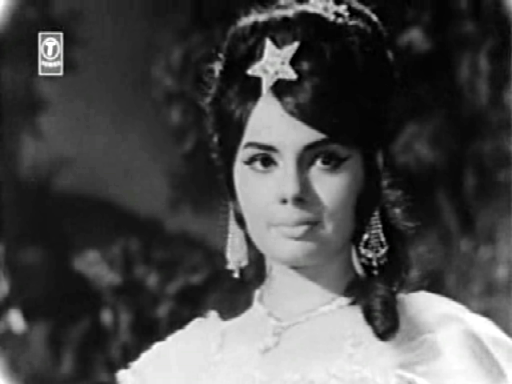
Mumtaz, as I mentioned in my last post, was one of the best things that happened to Mere Sanam. She may not have had much screen time in the film, but she certainly left her mark – more than she’d been doing in the B-grade films she’d mostly appeared in till then.
Rustom-e-Hind, made in the same year as Mere Sanam, is an example of that type of film. It’s basically a Dara Singh showcase – so there’s lots of showing off of wrestling – but Mumtaz gets to smile prettily and flutter her eyelashes, if nothing else.

Continue reading