Arsenic and Old Lace (1944)

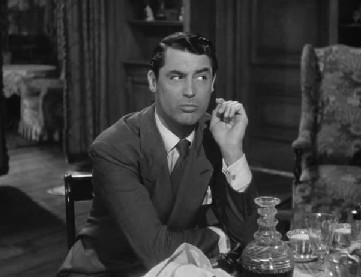
Fellow blogger and Cary Grant fan Sabrina Mathew’s sometime-ago link to this stunning slideshow of the actor made me take a silent vow to do a Grant post soon. It’s taken a while, mainly because I wasn’t able to make up my mind whether I wanted to review Arsenic and Old Lace, Charade, or Operation Petticoat—all classic Grant comedies—but the wait’s finally over. I’ll do Operation Petticoat and Charade later; for now it’s this hilarious, sometimes slapstick, dark comedy directed by Frank Capra, that I remember as being the first Cary Grant film I ever saw. It also remains one of my favourites—across time, genres, actors, everything.

Cary Grant in Arsenic and Old Lace

Continue reading

Dekh Kabira Roya (1957)

Rewatching this film after donkey’s years, I was struck by the similarity in basics with How to Marry a Millionaire. Here too are three beautiful girls, each of whom falls in love with a man she meets—but doesn’t realise is not quite the sort of man she’d hoped to end up marrying.
That’s where the resemblance ends. Our girls, like good bharatiya naaris, aren’t mercenary gold-diggers. Which, of course, is good news for the three men whom they fall for, since their heroes aren’t exactly rolling in wealth either.

Shbuha Khote, Anita Guha and Ameeta in Dekh Kabira Roya

Continue reading

How to Marry a Millionaire (1953)

Here’s how:

(a) Look like Marilyn Monroe/Betty Grable/Lauren Bacall
(b) Dress as if you were already married to that millionaire
(c) When asked the definition of scruples, open those baby blues wide and say “Huh?”
(d) Be very, very lucky
…which more or less sums up the `strategy’ the three protagonists of this film use to try and hook great (read wealthy) husbands for themselves.

Marilyn Monroe, Betty Grable and Lauren Bacall in How to Marry a Millionaire

Continue reading

Anuradha (1960)

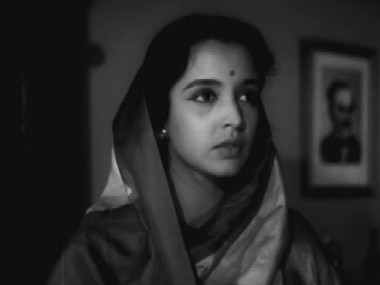
While I’m a sucker for masala films that bear not a shred of resemblance to reality, I’m also very fond of the sort of films that directors like Bimal Roy and Hrishikesh Mukherjee sometimes made: films about everyday people and their everyday lives. The protagonist of this film, Anuradha, is one of those: a young woman who gives up her dreams for the love of a man—only to discover eventually that even that sacrifice hasn’t brought her what she wanted.
And this is, of course, a belated tribute to one of Hindi cinema’s most luminous faces: Leela Naidu. If I hadn’t been exulting over Robert Mitchum last month when Leela Naidu passed away, I’d probably have reviewed this film then. But better late than never, I guess. RIP.

Leela Naidu in and as Anuradha

Continue reading

Goopy Gyne Bagha Byne (1968)

There are some films that offer deep, mind-searing insights into human life. There are some that allow one to escape for a couple of hours into a world of make believe where good and beautiful people always win and the bad always come to a sorry end.
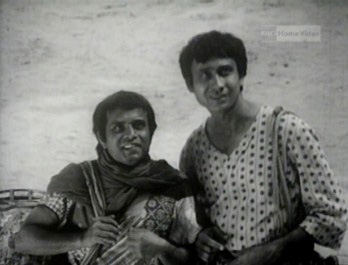
And there are films like this one, which I seriously think should be prescribed as an anti-depressant. Goopy Gyne Bagha Byne (The Adventures of Goopy Gyne and Bagha Byne) isn’t  among Satyajit Ray’s most profound works—it’s not in the same league, perhaps, as the Apur trilogy or Nayak. It is, however, one of the most charming films ever made in India, and a sure cure for the blues. I adore this film. Every delightful little bit of it.

Goopy and Bagha

Continue reading

House No. 44 (1955)

If I have one major failing when it comes to selecting films to watch, it is the stubborn (naive?) belief that any film which has good songs and a good cast must also necessarily be good. This has been proven to be a completely baseless criterion for film selection, but I plod on optimistically, buying and renting films that have superb music but fall absolutely flat on other fronts: House No. 44, for example, a Dev Anand starrer that tries to be noir but doesn’t quite make it.

Dev Anand in House No. 44

Continue reading

Stagecoach (1939)

Years ago, an issue of Reader’s Digest carried a list of ten Hollywood films any self-respecting film collector/lover must possess. At the time, I had seen only one of the films on the list—Gone With the Wind—but since then I’ve seen some more, Singin’ In the Rain and Stagecoach among them. And though I’m a Gene Kelly fan (and not a John Wayne fan!), I must admit that I’d rate this film higher than Singin’ In the Rain. It is a Western, of course, and with all the usual trappings of a Western: the Apaches that attack out of the blue; the hooker with the heart of gold; and the wronged ‘outlaw’ who’s bent on revenge. But Stagecoach has a lot more going for it, and makes good viewing even for someone who’s not really into Westerns.

Stagecoach

Continue reading

Kathputli (1957)

I had been meaning to see this film for a while now, and Richard’s recent post—on the occasion of Vyjyantimala’s birthday—encouraged me to hurry it up a bit. So I finally got around to pushing the DVD to the top of my rental queue, and saw it. Impressions? Well, somewhat mixed. I think I’d club Kathputli in the same category as Barsaat ki Raat: beautiful on the eyes and the ears, but disappointing in other ways.

Vyjyantimala in Kathputli

Continue reading

Love Affair (1939)

When I watched Gaslight a few months back, I ended up hating Charles Boyer (which goes to prove what a fine actor he was). He was just so supremely evil in a suave sort of way that I mentally vowed to slot him among those whose films I wouldn’t be actively searching for. Thankfully for me, bollyviewer came along with a suggestion that would help me like Charles Boyer a little better. This was it.

Love Affair is an oft-repeated tale, popular both in Hollywood and Bollywood. It’s spawned nearly half a dozen remakes and ‘inspirations’ that I have seen, and who knows how many others. An Affair to Remember (1957), with Cary Grant and Deborah Kerr, is a very faithful copy of this one. Bollywood came up with Bheegi Raat (1965), more inspired by Love Affair than an exact copy, as well as Mann (1999), which was a copy, down to the setting in which the protagonists first meet.

Charles Boyer and Irene Dunne in Love Affair

Continue reading

Barsaat ki Raat (1960)

For all those who thought I’d deserted classic Hindi cinema to wax eloquent about Robert Mitchum: good news. I’m back. After gushing for a week (well, a little more) about Mitch and his films, I’ve returned to Bollywood—and with a film that’s a must-watch for anyone who likes Muslim socials; who thinks Madhubala is gorgeous; or who loves old Hindi film music—especially qawwalis.
I fall into all three categories, so Barsaat ki Raat was long overdue for a rewatch.

Bharatbhushan and Madhubala in Barsaat ki Raat

Continue reading