The Bishop’s Wife (1947)

For the first few years of blogging, I marked each Christmas with a review of a Christmas-themed film: The Shop Around the Corner, A Christmas Carol, Christmas in Connecticut, The Holly and the Ivy, and so on. Then, somewhere along the way, I fell out of the habit (I am, in some ways, not a creature of habit: I get bored too easily).

But this year, wondering what I should post next—after a slew of tributes—I decided that since Christmas was coming up, and there were several Christmas films I hadn’t yet watched, why not? Therefore, this: a film starring Cary Grant as an angel. Yes, you read that right. Cary Grant as an angel sent down on Earth at Christmastime to help out a beleaguered bishop.

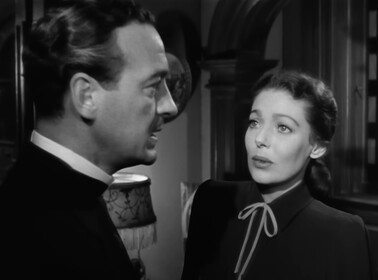
The bishop in question is Henry Brougham (David Niven), a harried man because he’s trying to raise funds for the construction of a new cathedral. As the story progresses, we learn that Henry used to once be a kinder, gentler man, the sort of man who had time to go out for walks and meals with his wife Julia (Loretta Young), who could take time to visit his old parish and listen to the boys’ choir. A man less obsessed with the grandeur of a new cathedral…

Continue reading

Butch Cassidy and the Sundance Kid (1969)

RIP, Robert Redford.

I will not pretend that Robert Redford was my favourite actor. In fact, offhand, I’d be hard put to remember how many (or, embarrassingly, how few) of his films I’ve watched. All the President’s Men, yes; A Bridge Too Far, yes. A few others, none of them (like Captain America: Winter Soldier) films for which he’s known.

Mea culpa. It isn’t a reflection on Redford, but on me, because most of my life has been spent watching Hollywood from the 30s to the 50s; my favourite era in Hollywood was over by the time Redford burst upon the scene. But it says a lot for him that despite that, I liked him in the few films of his that I watched. A great actor (and so handsome!). Deeply committed to the cause of environmental conservation, and by all accounts, a genuine, warm-hearted person.

Continue reading

Where the Boys Are (1960)

RIP, Connie Francis, the voice of my teenage years.

Continue reading

Charley’s Aunt (1941)

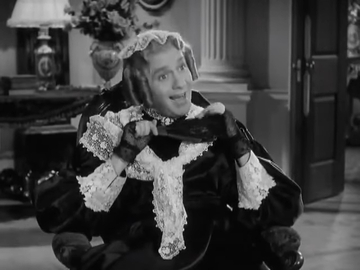
Two young men in Victorian England, eager to propose to their respective girlfriends, fix up a lunch date with the ladies, expecting that the aunt of one of the young men will oblige as a chaperone for the girls. However, the aunt, who has just arrived in England from Brazil, is called away elsewhere and sends a wire pleading her inability to come. Desperate, the young men seek a substitute as chaperone—and pick a friend of theirs, who then ends up spending the day juggling costumes, personas, and more.

That is the gist of Charley’s Aunt, a three-act play written by Brandon Thomas and first performed onstage in 1892. It’s a play I’d heard about often enough, but only got around to reading a couple of years back—and once I’d read it, I wanted to watch at least one cinematic adaptation of it (and yes, there are plenty of adaptations, including silent films as well as films in various languages, ranging from English to German to Arabic, the last-named in a couple of Egyptian versions of the film). Luckily enough, the best-known English adaptation of Charley’s Aunt, starring American comic actor Jack Benny in the lead role, is available even on YouTube (here).

Continue reading

It Happened One Night (1934)

Last week, to commemorate the 100th birth anniversary of Raj Kapoor, I reviewed my favourite film of his as an actor: Chori Chori, which was a remake (uncredited) of It Happened One Night. I had seen Chori Chori before; I had also seen It Happened One Night before, though in both cases, I had not reviewed the film in question.

Since I’ve finally reviewed Chori Chori, it seemed to me about time I reviewed It Happened One Night as well (which is why there’s also a comparison with Chori Chori further along in this post). Directed and co-produced by Frank Capra, this film was based on a short story, Night Bus, by Samuel Hopkins Adams. It is generally regarded as the first ever screwball comedy, having pretty much invented the genre; it was also the first of only three films so far to have won all five major Oscars: Best Picture, Best Actress, Best Actor, Best Director and Best Adapted Screenplay.

But, to start at the beginning: on a private yacht moored off the coast at Miami, where Ellen ‘Ellie’ Andrews (Claudette Colbert) has been confined by her banker father (Walter Connolly). Mr Andrews disapproves, unreservedly, of Ellie’s having gotten married to a man named King Westley (Jameson Thomas), whom he (Mr Andrews) is convinced is a rotter: only interested in Ellie’s wealth, nothing else.  

Continue reading

The List of Adrian Messenger (1963)

YouTube suggested this film to me, and when I looked up a synopsis, it sounded fairly interesting. A man asks a favour of a friend who is ex-MI5: here is a list, of ten men, living in various parts of Great Britain, nothing seemingly to tie them together, no similar occupation, no similar background, nothing. But find them , ask each of them if all is well, whether they’re still living at the addresses given in the list.

The important word here being ‘living’. Because, when the friend—Anthony Gethryn (George C Scott) sets about tracking down the men, it doesn’t take him along to find out that most of the men on the list are already dead, killed in accidents over the past five years. They couldn’t really be accidents, could they?

Very interesting. Rather like And Then There Were None (which, by the way, is referred to more than once in the course of The List of Adrian Messenger). I decided this was a film I had to watch.

When the credits began to roll, I sat up, because suddenly here were familiar names, one after another. Tony Curtis. Robert Mitchum. Burt Lancaster. Kirk Douglas. Frank Sinatra. Why on earth hadn’t I heard of this film before, I wondered. Tony Curtis, Kirk Douglas and Robert Mitchum, especially, are among my favourites, and even if I haven’t seen all their films, I am mostly at least aware of many of the films they worked in. And one that seemed like such a casting coup? How come I hadn’t known about this?

Continue reading

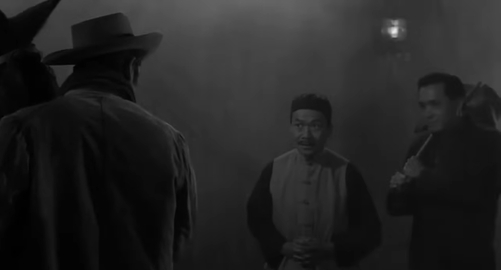
The Treasure of the Sierra Madre (1948)

This is one film I’ve known of for a long time, but have always had conflicting views on whether I wanted to watch it or not. On the one hand, I usually enjoy Westerns (more the escapist adventure kind, I will admit; but also, increasingly, those which go just beyond that). On the other hand, Humphrey Bogart is not one of my favourite actors. Then, again: I knew that this film (unlike another ‘seeking-gold-in-the-West’ film I love, McKenna’s Gold) was more gritty, more real. So Bogart—whom I do acknowledge as a good actor—might have done well in it.

The only way to find out, I guessed, would be to watch it for myself.

The story begins in a small Mexican town, Tampico, where a broke American, Fred Dobbs (Bogart) is wandering about, trying to make ends meet. Dobbs seems to have no set idea in mind of what he wants to do: he doesn’t seem to make any attempts to get a job, and all his energies are directed towards relatively prosperous-looking fellow-Americans who might be able to spare him some money to buy a meal.

Continue reading

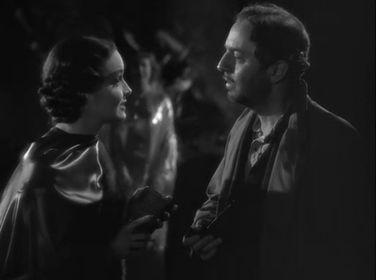
My Man Godfrey (1936)

And also, to some extent, My Man Godfrey (1957).

My Man Godfrey—the original one, starring William Powell—is one film that I’ve been meaning to watch for a long time now, mostly because so many people have told me what a lot of fun it is, and how it seems to have shades of PG Wodehouse in it (an author in whose pursuit I have watched several films, not always with the most satisfying of results).

It did seem to me, within the first few minutes of My Man Godfrey, that there were shades of a Wodehousian sense of humour here.

The film begins at a riverside dump, where a rather ragged, unshaven and tattered Godfrey (William Powell) is among several homeless men standing about when a fashionable high society lady, Cornelia Bullock (Gail Patrick) comes flouncing along, with a formally-dressed man in tow. Cornelia takes one look at Godfrey and tries to get him to come with her. She’s participating in a ‘scavenger hunt’ at a posh hotel, and the first person to bring along a ‘forgotten man’ to the hunt stands to win the prize.

Continue reading

The Spiral Staircase (1946)

Years ago, when I first watched Wait Until Dark, I was blown away by the ingenuity of the idea: a blind woman trapped inside a house with a murderer on the loose. Audrey Hepburn was superb as the woman who must use all her wits to keep one step ahead of her pursuer, and if possible, to turn the tables on him.

That was the film I kept remembering when I was watching The Spiral Staircase, a story about a mute girl who is caught in a large mansion with a murderer coming after her.

The story begins, not at the mansion, but at a small hotel in the nearby town. On the ground floor of the hotel, a film (silent, shown with an accompanying pianist providing the music) is being projected. A small but engrossed audience is in attendance, and this includes Helen (Dorothy McGuire), who is mute.

Continue reading

Bedazzled (1967)

If, like me, you were old enough to be watching films in 2000—and you watched Hollywood films—you might have come across the Brendan Fraser-Elizabeth Hurley comedy Bedazzled. It was about a geeky, socially inept but otherwise sweet fellow (Fraser) who makes a pact with the Devil (Hurley), who promises to grant him seven wishes in return for his soul. Unfortunately for our hero, all his wishes come to nought, leaving him even more distressed than he was originally. It was a funny film, and Brendan Fraser, in my opinion, shone as a comic actor.

I discovered, a few weeks ago, that the 2000 Bedazzled, directed by Harold Ramis, was actually a remake of a 1967 British film of the same name. Directed by Stanley Donen, Bedazzled was based on a story by Peter Cook and Dudley Moore, who also acted as the leads in the film: Dudley as Stanley Moon, Peter as the Devil.

The story begins in a church, where Stanley is praying very hard that God give him a sign. Something to assure a despondent Stanley that there is someone listening.

Continue reading