Rajkumar (1964)

My blog has featured Shammi Kapoor now and then – with reviews of some of his films, in my list of classic Hindi cinema’s handsomest men (which he topped, by a very long margin), and in various lists of songs.

Yesterday morning, when I woke up and logged on to the Internet, the first news headline I saw was that Shammi Kapoor had passed away. I have never been so affected by the passing away of one of the many stars of the past who have died in the recent past… but the news of Shammi Kapoor’s death brought tears to my eyes. I have a lump in my throat even as I type this.

I had not really intended to write this review now. I am in the midst of a blog project in which each post links to the previous and the next posts in some way or the other. But I could not ignore the passing of my favourite actor. I would never forgive myself for that. So, while this post does have a connection to the last (Humayun was a ‘raja-rani’ – ‘king-and-queen’ – film; so is Rajkumar), it is, first and foremost, a tribute to the brightest, most joyous and most entertaining star of the 60s. A sun that will never set.

Continue reading

Jahanara (1964)

Hindi cinema’s fascination for the Mughals is – well, fascinating. Even before independence, we were busy churning out semi-historicals such as Humayun (1945) and Shahjehan (1946); then, in the 50s and 60s, there followed a spate of rather more big-budget extravaganzas, complete with big names, vast armies, glittering palaces and superb music: Mughal-e-Azam, Taj Mahal and Anarkali (Note: As a character, Anarkali seemed to be especially popular. Besides the Bina Rai-Pradeep Kumar version, there were Tamil, Telugu and Malayalam versions of her story; even a Pakistani version starring Noor Jehan. And that list neither includes the two versions made in 1928, nor a 1935 film starring Ruby Myers. Note that Mughal-e-Azam is also about Anarkali).

Continue reading

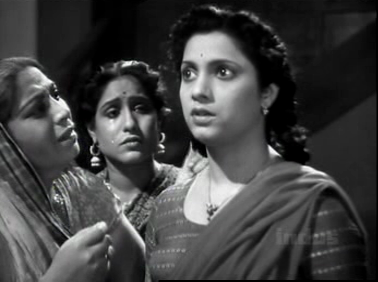
Dahej (1950)

I’ve lost count of the number of Hindi films I’ve seen in which a bride is left at the mandap just because her family hasn’t been able to provide a massive dowry. I have no idea which was the first such film to be made, but V Shantaram’s Dahej is one of the early ones. And to be expected too, from a film-maker who was deeply sensitive to the many shortcomings in the society of his time.

Continue reading

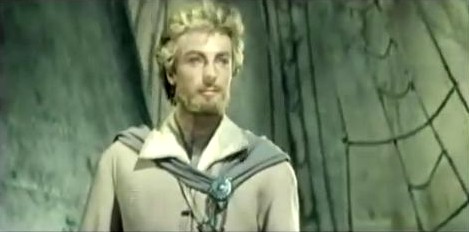
Khozhdenie Za Tri Moray (aka Pardesi) (1957)

Frequent readers of this blog have probably realised I have a soft spot for ‘real life’ stories: Gladys Aylward, Dr Kotnis, Changez Khan, Shahjahan: I’m game. Of course, I don’t always end up with films that bear any resemblance to the life of the person in question, but there’s no harm in trying.

So, another. Afanasy Nikitin was a horse trader from Tver in Russia, who came to India in the late 15th century, having started off from Tver in 1466. His travels took him down the Volga River, through Persia, and then via dhow to India. He is believed to have disembarked in present-day Maharashtra; over the years that followed, he travelled through a large part of peninsular India, including Bidar and Vijaynagar. He died in 1472 in Smolensk, on his way home; his travelogue of India, however, endures: entitled Khozhdenie Za Tri Moray (‘The Journey Beyond Three Seas’), it describes in detail all that Nikitin saw of what was to him a wild, exotic land like nothing he knew.

Continue reading