Julie (1956)

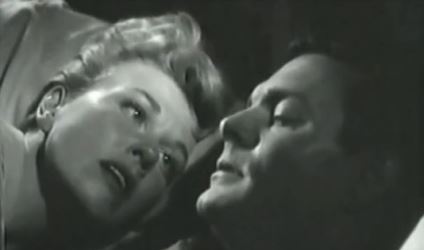
Most of the Hollywood films I’ve watched over the past few years have been suspense films. And, oddly enough, a disproportionate number of those have ended up following a similar pattern. A wealthy woman falls head over heels in love with a very attractive man and marries him. They’re blissfully happy—and then, the shattering truth emerges: he wants to kill her. In several of these films (Midnight Lace, Sudden Fear, Love From a Stranger), the man’s motive for wanting to kill his wife (and to marry her, in the first place) is to get at her money.

Not so in Julie, where Louis Jourdan’s character, playing the evil husband, is out to kill his wife for a very different reason.

Continue reading

Sunghursh (1968)

This was the first film I watched after Dilip Kumar passed away on July 7 this year. The tributes and reminiscences were still in full flow two days later, on July 9, which marked what would have been the 83rd birthday of Sanjeev Kumar. On a Sanjeev Kumar tribute post on Facebook, I read a comment in which someone recalled Dilip Kumar’s remark about Sanjeev Kumar, who was his co-star in Sunghursh: “Is Gujarati ladke ne toh paseena nikaal diya!” (“This Gujarati boy made me sweat!”)

This, I thought, might be an interesting film to review by way of tribute to both Dilip Kumar as well as Sanjeev Kumar. But I had other Dilip Kumar films to also watch: Musafir and Sagina Mahato for the first time, Ram aur Shyam for a long-overdue rewatch. So, while I watched this and wrote the review, I decided the publishing of the review could wait for now.

Because today, August 21, 2021, marks the birth centenary of Harnam Singh Rawail, the director of Sunghursh.  HS Rawail, as he was usually billed, debuted in 1940 with the film Dorangia Daaku, but it wasn’t until 1949, with Patanga (of Mere piya gaye Rangoon fame) that he became famous. Rawail was to make several well-known films through the following decades, but his two best-known works are probably Mere Mehboob (1963) and Sunghursh.

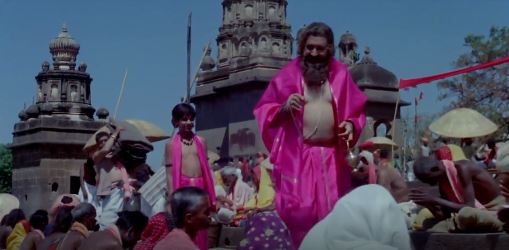
The story, based on Mahashweta Devi’s Laayli Aashmaaner Aaina, begins in Banaras of the 19th century (the riverfront, sadly, looks very mid-20th century). Bhawani Prasad (Jayant), bearded and seemingly benevolent, walks back from the temple after pooja. At his heels follows his grandson Kundan (?). Bhawani Prasad is much venerated, and the way he hands out alms to the poor and blesses those bowing before him, one might be forgiven for thinking him a good man.

Continue reading

La Grande Vadrouille (1966)

Which literally translates as ‘The Great Ramble’, but the English title of this hilarious French film is Don’t Look Now—We’re Being Shot At.

And, that English title is explained within the first couple of minutes of the film itself. This is in the middle of World War II, somewhere over Germany.  An RAF plane, part of an operation to bomb this area, is flying along, commanded by Sir Reginald (Terry-Thomas), along with his co-pilots Pete Cunningham (Claudio Brook) and Alan MacIntosh (Mike Marshall). The operation is code-named Tea for Two, after the Irving Caesar/Vincent Youmans song.

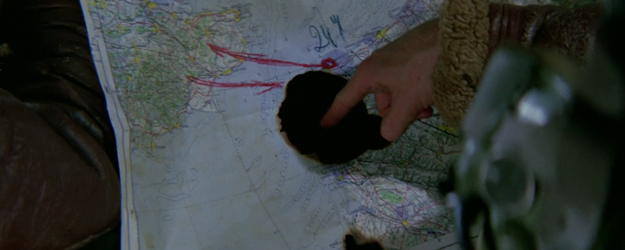
The plane encounters some heavy anti-aircraft fire and sustains some damages. The worst damage of all seems to be to their map, which has a great big hole burnt through the middle of it, as a result of which Sir Reginald & Co. lose their way…

Continue reading

Ten of my favourite ‘Impossible Duets’

Hindi film songs, in the context of being part of films, have always struck me as rather unreal. Of course it’s a miracle that people in cinema (and that’s not just Hindi cinema, but almost any cinema that produces musicals) break into song at the drop of a hat. How do they think up lyrics on the fly? How do they think up a tune as they go along? How can they dance and jump around and not run out of breath while singing?

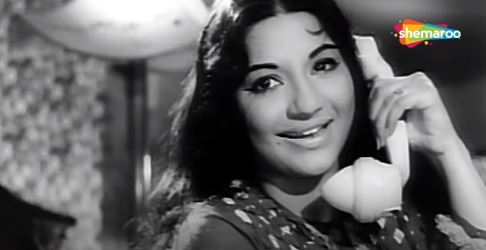
Let’s say that’s all artistic license, and that we need to accept it (we do). But what happens when there’s no way a song could be possible? A duet, for instance, sung perfectly in tandem—the tune the same, one verse completely responding to the previous one, even the voices sometimes blending together? —when the two people supposedly singing the song are nowhere close to each other? One is one part of town, the other in another. Or even, in some cases, not even in the same town. Impossible, that’s what I call such duets.

Continue reading

Teen Bahuraaniyaan (1968)

I had read a review of this film on a blog years ago, but besides the fact that it starred Prithviraj Kapoor as the father-in-law of three women, I remembered nothing of what I’d read. Then, some weeks back, when Shashikala passed away, a couple of people remembered her role, as a popular film star, in this film. I was tempted to watch it.

The teen bahuraniyaan (the three daughters-in-law) live in one rambling house along with their husbands, their children, and their father-in-law Dinanath (Prithviraj Kapoor)a retired school teacher. The patriarch’s three sons, from eldest to youngest, are Shankar (Agha), Ram (Ramesh Deo) and Kanhaiya (Rajendranath). Appropriately enough, their wives, respectively, are Parvati (Sowkar Janki), Sita (Kanchana) and Radha (Jayanthi). Sita’s sister Mala (Vaishali), who’s come to town to do college, also lives with them.

Continue reading