
Happy birthday, Vyjyanthimala! (it’s either her 90th birthday or her 87th today, it doesn’t seem very clear which, but anyway).
Among the recent books I’ve read is Advait Kottary’s Siddhartha: The Boy Who Became the Buddha, a fictionalized retelling of the story of the Buddha. While Siddhartha is the focal point of the narrative, several other important historical personages appear in the book, among them the nagarvadhu or courtesan of Vaishali, Amrapali. Amrapali is shown to have originally had a relationship with the ruler of Magadha, Bimbisara: so much so that she bears him a son, whom she is later compelled by circumstances to hand over to the Buddha to bring up. Bimbisara’s belligerent and headstrong son and heir, Ajatshatru, though he’s never seen ‘his father’s courtesan’ (as Kottary describes her), detests Amrapali.
… until he, injured in a way with Vaishali, impersonates a Lichhavi (native to Vaishali) soldier in order to escape with his life. Fate brings Ajatshatru and Amrapali together: she, thinking him to be Lichhavi, tends to his wounds and heals him, and they fall in love.
It’s been ages since I watched the Vyjyanthimala-Sunil Dutt Amrapali, and while I remembered some of the core elements, I’d forgotten much of it. As far as I remembered, the film had nothing whatsoever about Amrapali’s relationship with Bimbisara or her having a son with him. To be honest, I’d have been very surprised if that aspect of her life had been shown: it would have been far too bold for Hindi cinema, back then, to have a heroine who could have affairs with both father and son, and bear a child out of wedlock.
So I decided it was time to rewatch Amrapali, which begins in Magadha. Here, the king, Ajatshatru (Sunil Dutt), is in conference with his trusted advisor, friend, and Magadha’s commander-in-chief, Veer (Premnath). Ajatshatru is a hot-headed warmonger, and right now baying for the blood of the democratic Lichhavis, whose land, Vaishali, lies across the river to the north.

Ajatshatru’s mother, the Rajmata (Mridula Rani), who is a Lichhavi by birth, tries to dissuade her son. Veer too joins in: why must Ajatshatru go to war with Vaishali? But Ajatshatru isn’t listening.

Far away, in the Vaishali countryside, Amrapali (Vyjyanthimala) lives as a student of Kulpati Mahanama (Gajanan Jagirdar), whom we’re given to understand is the man who taught her dance (we are never shown Mahanama even waggling a finger, so this is suspect; perhaps whoever was in charge might have been better off casting Badriprasad, who was not just a veteran character actor but also a formidable choreographer/dancer).
And Mahanama’s son Som (Zul Velani; thanks to blog reader Pournima for identifying him), who is an accomplished sculptor. It’s obvious that Som is at least infatuated with Amrapali, even if not outright in love with her. But Amrapali chooses to overlook this, and treats Som as a good friend, nothing more.
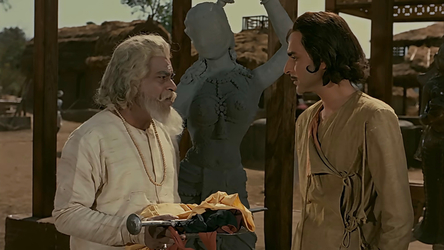
This idyllic and happy state of affairs is shattered by the attack of the Magadhan army. Quickly, the Lichhavis muster forces, the cry running through the towns and villages for all able-bodied men to come to the fore. Amrapali does her bit, running around and exhorting everybody to come to the defence of their beloved Vaishali. When she meets Som, Amrapali has a special commission for him: to bring her Ajatshatru’s head.

The battle is intense (aside: the credits for Amrapali thank the Indian Army for providing not just guidance and advice but also troops to act as extras in the battle scenes). But, to his surprise, Ajatshatru finds himself outclassed: he is hit by an arrow in the shoulder and is close to collapse when Veer comes to his rescue. Veer puts Ajatshatru behind him on his horse and they gallop off into the forest nearby, away from the Licchavi troops.

Some Lichhavi soldiers do follow, but Veer and a very weak Ajatshatru manage to fell them. Ajatshatru orders Veer to go back; he is needed on the battlefield. Both of them can’t be away, and the Magadhan army needs to not know that Ajatshatru is wounded. Veer is reluctant, but returns, even though both he and Ajatshatru know that Magadha has lost this battle.
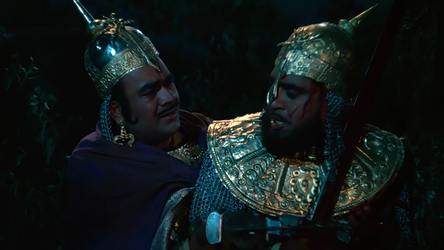
Once Veer is gone, Ajatshatru realizes that, all alone and injured, he is a sitting duck for anybody who chances upon him: this, after all, is Vaishali. He therefore strips a dead Lichhavi soldier of his uniform; discards his own bloodied armour and clothing (why does Ajatshatru not realize that these are so distinctive, if they’re found lying around, everybody will know who discarded them?) and dons the Lichhavi’s clothes. Then, having shaved off his beard at a nearby stream, he sets off.
Behind him, on the ground, the Lichhavi soldier (Keshav Rana) whom he had stripped begins to stir.

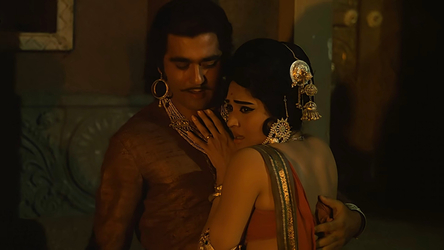
As it happens, Ajatshatru, reeling and tottering by now, bumps into Amrapali, who (naturally enough) assumes he’s a Lichhavi soldier. Patriot that she is, Amrapali takes him to her home and tends to him, wrenching out the arrow from his shoulder and cauterizing it. Ajatshatru may be in agony, but this violent bit of nursing seems right up his street: it sparks off instant chemistry, and Amrapali feels it too.

The next day, there is a big celebration in Vaishali, everybody rejoicing at their victory over Magadha. Ajatshatru, up and about, gets to the town square just as Amrapali is setting fire to a giant effigy of Ajatshatru. The burning effigy falls, almost on Amrapali—but, ironically enough, it is Ajatshatru who saves her. Amrapali has no idea.
Just before this, Ajatshatru finds himself being abducted by a group of men who bundle him into a big sack and carry him away. He is delivered to the home of Balbhadra Sen (KN Singh), who is none other than Ajatshatru’s spy in Vaishali. Balbhadra Sen greets Ajatshatru, and has soon made arrangements for the comfort of his liege lord: a house where he can live, fine clothes, and so on.

Balbhadra Sen has already infiltrated the high council of the Lichhavis, the body of men (yes, only men) who govern Vaishali. Ajatshatru now gives Balbhadra Sen his orders: sway the council, make them more interested in song and dance, less in guarding their sovereignty. Pave the path for a future successful invasion by Magadha.

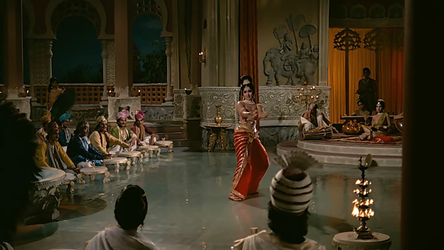
While Balbhadra Sen is hard at work carrying out Ajatshatru’s orders, Ajatshatru, whom Amrapali addresses as ‘Sainik’ (‘Soldier’) has been busy romancing Amrapali. Amrapali is also experiencing dizzying success: at a very special convening of the council, where Vaishali’s rajnartaki or court dancer will be chosen, Amrapali steps forward to call out the errors made by the candidate on the dance floor. Amrapali ends up competing against the dancer, and dances up a veritable storm.

The council and all the audience go all gaga over the performance, and the rajpramukh (Bipin Gupta), the chief of the council, declares Amrapali the new rajnartaki. Amrapali is no longer just a simple dancer living in a village: she is as close to royalty as Vaishali gets. A grand palace, fine clothes and jewellery—and, of course, a mysterious lover whom Amrapali still calls ‘Sainik’.
When and how will Amrapali discover the truth? And what will it mean for her relationship, with Ajatshatru on the one hand, with Vaishali on the other?

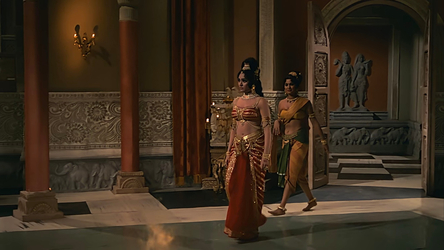
Directed by Lekh Tandon, and with a story and screenplay by Omkar Sahib, Amrapali is a glittery, often grand spectacle: a story of politics, of the hunger for power, of ruthless ambition. It’s also a story of love in different forms: the love between Amrapali and Ajatshatru for one; Som’s love for Amrapali for another. Amrapali’s love for Vaishali. While some of it looks a little off (the helmets and swords of all the soldiers looked woefully fake to me, as if made out of cheap tin), there is some grandeur too, for instance in the sets that comprise Amrapali’s palace.

But, the story. That is where this film takes liberties. Bimbisara is completely missing from the narrative, of course, so there is no question of Amrapali having been his lover or the mother of his child. She is, instead, a rajnartaki, her art being her identifying feature—not the nagarvadhu of Vaishali, which would have implied a prostitute, her body commanded by the wealthy and powerful of the realm. Thus, while the filmi Amrapali is quite clearly in a sexual relationship with Ajatshatru, she remains chaste, the quintessential heroine: because she is faithful to only one man.
If you’re looking for the real story of Amrapali, this is probably not the film to watch.
What I liked about this film:
The music, by Shankar-Jaikishan, with lyrics by Shailendra and Hasrat Jaipuri. Interestingly, all the songs in Amrapali were sung by only one playback singer, Lata Mangeshkar. And all of them, from Tadap yeh din-raat ki to Neel gagan ki chhaon to Tumhein yaad karte-karte, are beautiful.
And, the casting of Vyjyanthimala as Amrapali. She is beautiful, of course, but her dancing makes her even more believable as a court dancer of unparalleled worth. If for nothing else, watch Amrapali for Vyjyanthimala’s dancing.
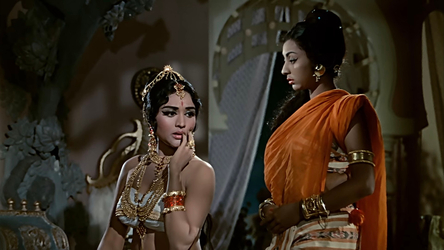
Lastly, a special mention of Bhanu Athaiya, for the costumes she designed for Vyjyanthimala. To research ancient Indian costume, Athaiya visited the caves at Ajanta and extensively studied the paintings there to get an idea of how women dressed in that age, and the result is stunning.
What I didn’t like:
The somewhat unbelievable ‘love story’ of Amrapali and Ajatshatru. This is lust, pure and simple, but it’s been made out to be a great love. There is, to me, nothing there to really show these two falling in love, finding common ground, talking. But since this is a common failing of a lot of Hindi cinema, I guess I can leave it at that.
The second thing is the absence of the Buddha from the narrative. Given that he and his teachings play such a pivotal role in the film, he really needed to have been around more. To have Amrapali come up against the Buddha now and then, to see her hear him and be slowly influenced by him: that would have been more impactful than to have him suddenly sprung on everybody right at the end. In fact, had the Buddha and his teachings been more a part of the film since early on, with Ajatshatru exposed to them along the way, it would have made his final act in the story more believable too.
Note:
I began this review with a reference to a novel, and I’ll end it with a reference to yet another novel. Shortly after I watched Amrapali, I read Tanushree Podder’s Ambapali, an interesting, well-imagined retelling of the life of ‘Vaishali ki nagarvadhu’. It’s a book that is obviously fictional, but based on fact, from Ambapali’s rise to the raj nartaki of Vaishali and then the nagarvadhu of the city, to her deception by Bimbisara. There is intrigue, some suspense and some adventure, but primarily, this is a book that shines the light on a complex woman: beautiful, prosperous, popular—and yet, so exploited. Here is a rather more detailed review, by me, of the book.


Amrapali is one of my favourite period films, not least because of the music and songs. Sunil Dutt and Vyjayantimala both look suited to their roles, if one can overlook Dutt saheb’s somewhat Punjabi accent. Me being a fellow Punjabi myself, I can identify with that. 😁
As for the real Amrapali’s story, my favourite retelling has been आचार्य चतुरसेन ‘s वैशाली की नगरवधु. It’s a multilayered multi charactered narrative, with political intrigue, secret machinations and Buddha’s influence being intertwined together.
Amrapali herself is shown as a very strong character, who doesn’t hesitate to tell off the wise old men of Vaishali and manages to negotiate the best terms for herself in exchange for being named the नगर वधु. An historic role model for performing artistes for all time. 😊
LikeLiked by 1 person
Hehe. I agree with the Punjabi accent coming through! I am married into a Punjabi family, so I can hear it a mile off. ;-)
I have long wanted to read Vaishali ki Nagarvadhu. I’ve tried twice, but both times, could not get past the first page, because the extremely high level of the Hindi scared me off. After reading Tanushree Podder’s book (she cites it in the bibliography), I toyed with the idea of making another attempt, but didn’t get around to it… I should, sometime, now that you’ve praised it so highly.
LikeLike
In school, I disliked studying History (found it extremely boring), but now that I have read some Historical fiction, I feel it’s actually interesting (and our textbooks were written/taught in an uninteresting manner. :)).
I haven’t watched this movie. And I haven’t read Siddhartha. But I read Ambapali by Tanushree recently and really liked it. So well written and imaginative. I checked the blurb of the Amrapali movie on Wiki and was so confused (and the idea of her romance with Ajatashatru put me off).
Also, Vyjayanthimala is beautiful and a fantastic dancer but I feel her expressions are often exaggerated (you know what I mean) and I find it very annoying.
LikeLiked by 1 person
Yes, Tanushree Podder’s book is good – a very good example of well-written historical fiction.
“but I feel her expressions are often exaggerated”
I think that’s pretty much par for the course for most Hindi film actresses of that period! Far too many of them tended to overact, and it took a good director to rein them in. Vyjyanthimala in a film like Sadhana, for instance, or Devdas, is quite restrained, and a pleasure to watch.
LikeLike
Madhu,
Seems to be a nice movie. I have read Acharya Chatursen’s book, so I am a bit familiar with the story. I had not given a thought to the difference between ‘nagarvadhu’ and ‘Rajnartaki’. So that is one more reason to watch the movie. In literature love for an enemy soldier is not unknown. So that is not an irritant for me. Thanks a lot for this review.
AK
LikeLiked by 1 person
“In literature love for an enemy soldier is not unknown.”
Oh, no, absolutely not unknown! This caught my eye in particular in your comment because my last novel, The Garden of Heaven, has as its protagonist a woman from Delhi who falls in love with one of the soldiers of Taimur when he invades the city.
Glad you liked this review, AK. Thank you.
LikeLike
Dear Madhu,
An intriguing review …to say the least!
It has been quite a while since I have been able to post a comment on your blog — .mostly due to preoccupations with other issues on the home front.
But I digress…
This Tribute article (in The Indian Express) by Arushi Jain) on Vyjayanthimala would be of interest to readers here.
LINK given below.
https://indianexpress.com/article/entertainment/bollywood/vyjayanthimala-first-female-superstar-of-indian-cinema-who-towered-over-3-industries-quit-films-at-height-of-fame-8888313/
Praba Mahajan
LikeLiked by 1 person
Thank you so much for this link, Praba! Coincidentally, yesterday, after posting this review, I ended up reading this article. Well-researched and well-written. Thank you for sharing it.
LikeLike
Madhu, this is an interesting writeup (and nice to get so many details about the story too – the real one as well as the one in the film). I’ve seen at least a dozen films starring Vyjayanthimala, but I never watched this one. Of course, I know the main songs and dances well, they are excellent, and it has always been easy to find them on YouTube.
I have read other reviews that also said that this film wasn’t nearly as good as its songs and dances. Of course, I can’t say whether or not that is true, but maybe that’s one reason I never went out of my way to get the whole movie. I understand that it was a big disappointment at the box office at the time (though it gained in reputation later), and Vyjayanthimala was not at all happy about that, because she kind of hoped that it would be regarded as her great dance opus. (I read that somewhere; I don’t remember where.) Her dance attire is a little flashier here than in many other films (and, by the way, I appreciated the extra info that you provided about that), but as far as the dancing goes, I don’t know if this one really stood out, because she was always great. :)
By the way, I have found it frustrating not to be able to name the other dancer in the famous dance-off here. I understand that she was not as famous a dance-off competitor as Helen or Padmini, but one would think that if a dancer got to do a big film contest with Vyjayanthimala, at least someone could name her. I searched before and I’m searching again, but I still can’t find an answer.
LikeLiked by 1 person
Richard, thank you for reading, and for commenting. I agree with the consensus that the songs and dances of Amrapali are far better than the story itself. Really, the story leaves a fair bit to be desired (besides, of course, being very inaccurate, historically speaking. A shame, really, because it could have made for such an interesting tale, given that Amrapali gave up a very glittering and successful life to become a Buddhist nun.
As for the dancer in the dance-off, could it be Sushila? That’s the only name among the women listed in the credits that I couldn’t put a face to. All the others – Mridula Rani, Sulochana, Bela Bose, Madhavi – are accounted for. Sushila, I don’t know who that is. And given that she has an important scene, I would think she would be credited…
LikeLiked by 1 person
OK, I have done a little searching, and a couple of sources say that the other dancer in the dance-off is Madhavi. On one page at IMDb, it says that Madhavi is “Raj Nartaki.” My search also led me to the “Twin Dances in Hindi Films” post at a blog called Conversations over Chai ;) , where the dancer is also identified as Madhavi. So, Madhu, are you certain about having identified Madhavi as someone else? (Could Madhavi have played two roles in the film?)
I’ll look around for any more hints over the next couple of days.
It is very unfortunate that the exact identity of Vyjayanthimala’s rival in such an essential dance-off has been so hard to confirm!
LikeLike
Richard, I don’t know where that identification is coming from (IMDB is unreliable, but Anu?!). Because there is only one Madhavi in the credits (and she’s credited right next to Bela Bose, which sort of makes sense, given that the two of them play Amrapali’s friends).
And Madhavi I am sure of, because I’ve seen her in several other films, including Naunihaal, in which she played quite a major role (https://madhulikaliddle.com/2019/09/16/naunihaal-1967/). She is the woman shown in the penultimate screen shot in this review. Unless there is a second Madhavi (who is not credited), I don’t think there is a chance that the dancer is Madhavi…
LikeLike
Sorry, a few days have passed – I meant to get back to this sooner. :) Now I am thinking that there were actually two Madhavis in Amrapali, one being the dancer and the other, the more familiar actress.
For what it is worth, the IMDb cast page actually does list two Madhavis (scroll down a little on the right after the first one, and you’ll see the second :) ):
https://m.imdb.com/title/tt0060104/fullcredits/cast
I also found a great pic of the two dancers together on the set, in the IMDb “mediaviewer” section, where they specifically list “Madhavi and Vyjayanthimala”:
https://m.imdb.com/title/tt0060104/mediaviewer/rm1559308033/
With nothing else to go by (after I tried a bunch of searching), I think I’ll take this as the answer, at least for now.
LikeLiked by 1 person
Thank you for pointing out that IMDB lists a second Madhavi – because I saw that the second Madhavi is uncredited. In which case, that would make sense!
LikeLiked by 1 person
Madhuji, it has been a long time since I watched Amrapali. But somehow whenever I think of Amrapali, the other movie that comes to mind is Chitralekha. While both had great music, Amrapali is really well made. I cannot say the same about Chitralekha!
LikeLiked by 1 person
You make me very curious about Chitralekha now! I have watched the film, but so long ago – perhaps in the 80s, or maybe very early 90s – that I have no recollection of the plot at all. All I remember is some of the songs, and that because I’ve watched them now and then on YouTube.
LikeLike
Hearty thanks for beautifully narrating and objectively assesssing the movie. I have read Vaishali Ki Nagaravadhu by Acharya Chatursen. Now I am eager to watch this movie.Vyjayanthimala was born on 13.08.1933. She is 90 years old now.
LikeLiked by 1 person
Thank you for your kind words, Jitendraji. I have been meaning to read Vaishali ki Nagarvadhu, but the very difficult Hindi has always deterred me! Maybe I should give it another try.
By the way, on the topic of Acharya Chatursen: thank you for telling me that his revised, shorter version of Dharmputra is worth reading. I read it some weeks back, and liked it a lot. Very well-crafted, interesting, insightful book. Thank you for the recommendation.
LikeLiked by 1 person
My pleasure Madhulika Ji.
LikeLike
As regards Vyjyanthimala’s age it’s almost ceratainly 93.
Bahar was released in 1949 ie 74 years ago and she certainly looks at least 19 in that film.
Be that as it may hats’ off to the way she’s maintained her fitness.
LikeLiked by 1 person
Wow. I am very impressed. Actually, even if she is 87 – as some sites have it – she is amazingly fit for her age. If she is indeed 93, that’s even more commendable. I suppose dance plays a part in keeping fit.
LikeLike
Yes dance.
Vegetarianism.
Iron discipline enforced by her grandmother.
Her own will power.
These achievers are special people.
Apart from all this Vyjyanthi also survived a debut opposite Karan Dewan!
LikeLike
I love this movie so much. It’s so beautiful and the dancing is so good. You’re right she’s faithful to one man but they’re not married, and in basically any other film she’d die for that. Also, the costumes show more skin than I think they would even now which I find interesting.
I guess it’s useless for me to try the novel if there’s so much Hindi in it?
LikeLike
Actually, them being not married does seem to have been forgiven in a few other films – as long as they eventually get married! (Ek Phool Do Maali, Phoolon ki Sej, Dharmputra…) I think the only film that did not happen was Dhool ka Phool, which was refreshingly progressive in realizing that a man who won’t take responsibility is not a man a woman should want to marry!
Which novel do you mean? Siddhartha and Ambapali are both in English, and barring a couple of words here and there, completely in English. Vaishali ki Nagarvadhu is a Hindi novel.
LikeLike
Yeah, I guess that’s true. Still it’s rare and I always enjoy seeing it.
I meant Ambapali! Good to hear, I will give that a go. Thank you.
LikeLiked by 1 person
It’s very rare, these few films are the exceptions. I do enjoy seeing it, though, when film makers show they have the guts to not expect women to be devis.
I hope you enjoy Ambapali, it’s an interesting book.
LikeLike
You finally watched this! :) My pet peeve (other than the historical inaccuracy of Bimbisara/Ajatashatru or even skipping over the fact that Amrapali was not just the rajnartaki but also the nagarvadhu) is that we are never going to see the full version of Amrapali. What is available online is the truncated 2-hour version that was sent to the Oscars. The original film was almost three hours long (and addresses your peeve about there not being enough of the Buddha).
I did think, however, that the lust/love came through quite well, given the period. The very physical attraction between the two of them is evident in quite a few scenes, even explicitly remarked upon. And Tumhe yaad karte karte is a very sensuous depiction of a woman’s physical longing for her lover.
My review of this film: https://anuradhawarrier.blogspot.com/2012/04/amrapali.html
p.s. Vyjayanthimala was barely 16 when Bahaar released.
LikeLiked by 1 person
I actually remembered one thing about your review of Amrapali fairly well, even though it’s been a while since you reviewed the film – I remembered your explaining the real story of Amrapali/Bimbisara/Ajatshatru, and saying how the film differed from it.
I hadn’t known this version is a truncated one. :-( Such a shame. I would have really liked to see the full version – that might have been much more polished and complete.
LikeLike
The song Jao re Jogi tum Jao was picturized and some says that it was there in the premier and first shows. But due to some editions or whatever the reasons the video of the song is missing in the film what remained to the date… Do you have any knowledge about this shot?
LikeLike
Yes, it’s missing from the film, or at least from the version on Netflix (which is where I watched this). I had also watched Amrapali on Doordarshan about 20-25 years ago, and it wasn’t on that copy either. I have no idea what happened, why it was taken out.
LikeLike
Exactly! The only remaining notes are from the people who actually watched it in the theaters then. And also there is the famous picture of Vyjayantimala wearing the orange colour dress posing with tribhanga leela with folded hands.
LikeLiked by 1 person
Well observed, yes! That still too.
LikeLike
The role of Som was enacted by actor Zul Velani.
The other dancer in the face-off is not Madhavi. I have not found her name, even after searching a lot.
LikeLiked by 1 person
Thank you for identifying Som. I’ll correct that.
And re: Madhavi (or not): so that brings us back to square one! I hope someone can identify the dancer.
LikeLike