Aarzoo (1965)

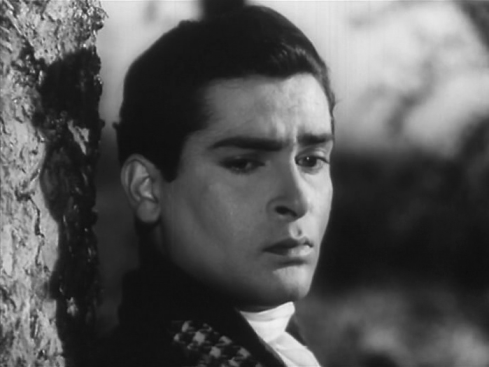
A couple of months back, my sister Swapna was invited to head a quiz team at a pub quiz (Jai Arjun Singh, who was also there, wrote about it here). Telling me about the quiz later, Swapna mentioned that there was one question that even Jai didn’t know. In Aarzoo, which place in Delhi does Rajendra Kumar’s character say he belongs to?

Nobody could answer that question. But the answer is Okhla Village.

… which sort of struck a chord with me, because till we shifted from Delhi to Noida, my husband and I had spent many years living very close to Okhla. And Noida, in case you weren’t aware of this, is actually an acronym for New Okhla Industrial Development Authority. Okhla follows us around. Or we refuse to really move away from Okhla.

This incident reminded me, though, that I have never reviewed Aarzoo on this blog, though I’ve watched the film at least twice. Time to amend that, I decided.

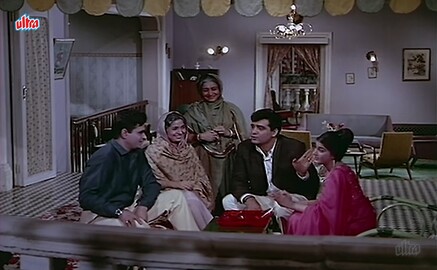
Newly-minted medical graduate Gopal (Rajendra Kumar) and his neighbour Ramesh (Feroze Khan) have been best friends since their childhood. Gopal’s younger sister Sarla (Nazima) and his widowed mother (Achla Sachdev) regard Ramesh pretty much the same as Gopal: a member of the family, a brother/son just as Gopal is.
Continue reading

Amrapali (1966)

Happy birthday, Vyjyanthimala! (it’s either her 90th birthday or her 87th today, it doesn’t seem very clear which, but anyway).

Among the recent books I’ve read is Advait Kottary’s Siddhartha: The Boy Who Became the Buddha, a fictionalized retelling of the story of the Buddha. While Siddhartha is the focal point of the narrative, several other important historical personages appear in the book, among them the nagarvadhu or courtesan of Vaishali, Amrapali. Amrapali is shown to have originally had a relationship with the ruler of Magadha, Bimbisara: so much so that she bears him a son, whom she is later compelled by circumstances to hand over to the Buddha to bring up. Bimbisara’s belligerent and headstrong son and heir, Ajatshatru, though he’s never seen ‘his father’s courtesan’ (as Kottary describes her), detests Amrapali.

… until he, injured in a way with Vaishali, impersonates a Lichhavi (native to Vaishali) soldier in order to escape with his life. Fate brings Ajatshatru and Amrapali together: she, thinking him to be Lichhavi, tends to his wounds and heals him, and they fall in love.

It’s been ages since I watched the Vyjyanthimala-Sunil Dutt Amrapali, and while I remembered some of the core elements, I’d forgotten much of it. As far as I remembered, the film had nothing whatsoever about Amrapali’s relationship with Bimbisara or her having a son with him. To be honest, I’d have been very surprised if that aspect of her life had been shown: it would have been far too bold for Hindi cinema, back then, to have a heroine who could have affairs with both father and son, and bear a child out of wedlock.

So I decided it was time to rewatch Amrapali, which begins in Magadha. Here, the king, Ajatshatru (Sunil Dutt), is in conference with his trusted advisor, friend, and Magadha’s commander-in-chief, Veer (Premnath). Ajatshatru is a hot-headed warmonger, and right now baying for the blood of the democratic Lichhavis, whose land, Vaishali, lies across the river to the north.

Continue reading

Dil Deke Dekho (1959)

Dil Deke Dekho isn’t quite the perfect film I’d like to make it out to be.
(a) The story isn’t exactly original (Nasir Hussain had already used it in Tumsa Nahin Dekha. He also went on to use it in Jab Pyaar Kisi se Hota Hai and Phir Wohi Dil Laaya Hoon, but that can’t be laid at the doorstep of Dil Deke Dekho).
(b) The plot is too complicated, relies too heavily on convenient coincidences, and has some unbelievable – and often unclear – motives.
(c) The lead actress, Asha Parekh (just 16 years old), though pretty as a picture, isn’t a terribly good actress at this stage of her career.

On the other hand: the film stars Shammi Kapoor.

Continue reading