
Happy 100th birthday to one of India’s greatest film makers, Raj Kapoor!
RK was born in Peshawar on December 14th, 1924. What can I say about him that hasn’t already been said or written, and by people much more erudite, well-informed, and more fond of RK’s cinema than I am? Yes; I will admit that I am not the greatest of Raj Kapoor’s fans, but let us keep the whys and the wherefores of that, the debates and the discussions, for another time. As Anu Warrier (of Conversations over Chai, not just a fellow blogger I admire hugely, but also an RK fan) said “I know there are RK films you like!”: and for RK’s birth centenary, I decided it was high time I finally reviewed an RK film that I particularly like.
I have watched Chori Chori several times, and always with great satisfaction. Even though it starred Raj Kapoor (opposite Nargis, moreover), the film is not at all the sort of film RK was known for: this was the light-hearted romp that younger brother Shammi was to go on to make his own. A road trip, a pampered heiress, a romance. Lots of songs, great chemistry.

But, first, what it’s all about.
The story begins at sea, though not too far out. Heiress Kammo (Nargis) is on board her father’s yacht, and her very wealthy father Seth Girdharilal (Gope) is keeping her confined to her cabin, with the door bolted and all his staff on constant guard. Kammo, used to always having her own way, is livid: she’s been smashing things, shouting at the staff, refusing to eat. The arrival of her father in her cabin only serves to annoy Kammo even more, though Girdharilal himself seems completely unfazed.

The reason for this disagreement is a man named Sumant (Pran), whom Kammo is hell-bent on marrying. Seth Girdharilal, on the other hand, regards Sumant as a gold-digger. According to him, Sumant doesn’t love Kammo; it’s Seth Girdharilal’s seventy crores he has his eye on.
There is an argument; Kammo raises hell and tips a food tray over her father’s lap While he’s cleaning up, she escapes, jumps off the boat, and swims to shore, at Madras. There, Kammo (resourceful girl, this) quickly pawns a diamond ring she’s wearing, and buys stuff for herself: saris, a small suitcase, and so on. She changes out of her wet clothes and goes to a public phone booth to call Sumant. But Sumant has gone off to Bangalore to the races, so Kammo too decides to head Bangalore-wards.

While at the phone booth, Kammo had a run-in with a man who seemed to her to be hogging the phone. This is Sagar (Raj Kapoor), a journalist who works for a newspaper named Naya Sansaar; Sagar had been talking to his editor (Raj Mehra) in Bangalore and trying to wheedle him into giving Sagar another chance.

Now Sagar is on his way to Bangalore to meet the editor, and finds himself sitting beside the spoilt, hot-tempered Kammo. They are immediately at daggers drawn and exchange several snide remarks.
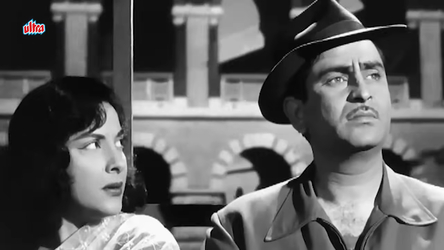
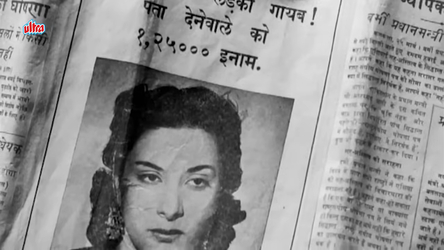
What Kammo has not yet realized is that her father has already put out an ad in the newspapers, announcing a reward of Rs 1.25 lakhs for anybody who can bring him news of his runaway daughter. This ad has been seen by a somewhat penurious autowallah named Bhagwan (Bhagwan), who, along with his wife (Rajasulochana) now decides they must do something to make sure they’re the ones to get that reward money.
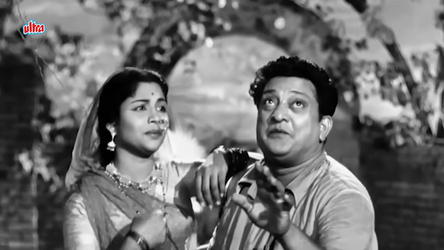
Bhagwan and his wife guess that Kammo is likely to be on the Madras-Bangalore bus (the ad has offered some clues; why Seth Girdharilal has not alerted the police or at least sent some of his minions on the same route is not explained). So this ambitious couple get on to their auto and come to meet the bus when it makes a halt along the way.
While the bus has stopped, Kammo has sashayed off, to sing and dance through the fields nearby, certain that the bus won’t go off without her because she’s told the conductor so. In her absence, Sagar sees Bhagwan and his wife searching for Seth Girdharilal’s daughter—and of course drawing a blank. Disappointed, they leave, dropping the newspaper on the road, where it is picked up by Sagar. And thus it is that Sagar discovers who his feisty co-passenger is.
By the time Kammo (summoned by the honking of the departing bus) comes running to the bus stop, the bus has gone—sent its way by Sagar, who sets about letting Kammo know that he knows who she is. Kammo, already leery of Sagar, suspects that he means to squeal on her and grab the reward money, but Sagar corrects her. No, his intention is quite different. All he wants is the story. This tale of an heiress, running away to her lover, being pursued by bounty-hunting strangers: it’s a good story.
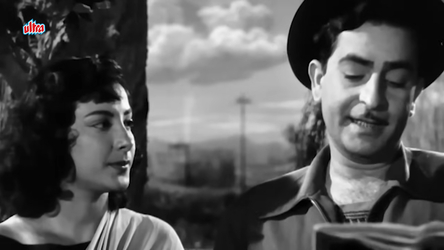
Kammo has little choice, actually. She’s a babe in the woods: so pampered, she has no idea how to get around. More importantly, no clue how she’s going to avoid the potential crowds of 1.25 lakh-seekers. So she throws in her lot with Sagar, and they set off on various adventures on their way to Bangalore.
It is a road trip of four days, and much will happen in that time. Kammo’s cover will be blown, with an aspiring poet (Johnny Walker) discovering who she is.
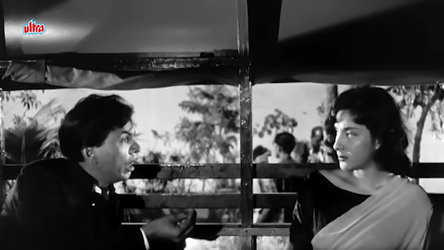
She will see something of life outside the luxurious home she’s known all her life. She’ll find what it is to have nothing to eat except corn cobs, and what it is to have to walk miles, instead of whizzing by in a comfortable car. She will discover that the world doesn’t revolve around her, and that—this probably comes as the biggest surprise for Kammo—that her world no longer revolves around Sumant.
Sumant, meanwhile, has landed up at the home of Seth Girdharilal, and is busy buttering up the man, calling him “Daddy” and being a limpet. Soon, after all, as he tells Sethji in his oily way, he will be calling Sethji Daddy; may as well begin now. Sethji, who is now willing to do anything to have his darling daughter back—and happy—goes reluctantly along.

Based on the 1934 Hollywood romantic comedy It Happened One Night, Chori Chori was an AVM production, scripted by Agha Jani Kashmiri (who also wrote the dialogues for the film) and directed by Anant Thakur. This film proved to be a big hit, and spawned another film that was as big a hit (though whether that was inspired directly from It Happened One Night or from Chori Chori is debatable): the Bangla film Chaowa Paowa, starring Uttam Kumar and Suchitra Sen.
I suppose if one were called upon to celebrate Raj Kapoor’s career, one would probably focus more on the films he directed than the films he merely acted in. After all, those—the films like Awara, Shree 420, and so on—are the ones which defined his thought, his style, his principles in cinema. To a greater or lesser extent, one may also consider films that reflected RK’s cinematic ethos: works that he did not direct, but only acted in, like Anari, Jis Desh Mein Ganga Behti Hai, Teesri Kasam… all films that mirrored the myriad conflicts that RK’s characters seemed to so often embrace.
And then there were the more ‘usual’ films, the sort that could have starred pretty much anyone as the lead actor: films like Ek Dil Sau Afsaane, Dulha-Dulhan, Dil Hi Toh Hai. And Chori Chori: as I mentioned at the start of this review, this was the sort of light-hearted, frothily romantic film that fitted Shammi Kapoor (or even Dev Anand).
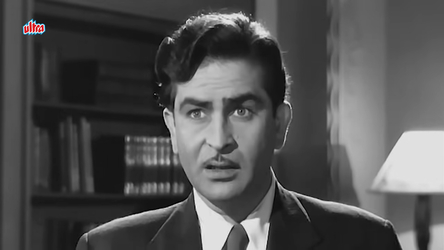
But Raj Kapoor’s Sagar is very much RK’s own, not a cookie cutter ‘hero’: a savvy, resourceful man, somewhat cynical, but also, deep down in his heart, a good man. Principled, kind, likeable. And (a big plus for me, who hates the ‘lovable tramp’ style RK so often adopted in his films): there’s not a trace of those mannerisms here. He’s just a handsome, easy-on-the-eye romantic hero.
What I liked about this film:
The entire package, to be honest: this is one of my favourite fun films. It’s a very good entertainer; not aspiring to convey any messages or make a point about a social ill or anything of the sort. Just a story that sets out to charm, and that it does.
But, to pick out some elements which appealed to me in particular. For one, Agha Jani Kashmiri’s script, which is fast-paced and interesting, not bogged down with needless meandering. The entire script has a lightness about it that isn’t merely restricted to the comic characters: Bhagwan and his wife are there, and there’s Johnny Walker’s character, his wife (Indira Bansal) and a cricket team’s worth of children—but there are other fun elements too, prominent among them the witty repartee that goes on between Sagar and Kammo.
Sagar and Kammo are the hinge on which this film turns, and how good Nargis and RK are as this pair that starts off fighting like cats and dogs, but ends up rather more kindly disposed toward each other. They’re lots of fun, and the chemistry between them is perfect, from the initial sparks that fly to the slow dawning of a realization of something more… not much is said, but the expressions say it all.

In this context, I must also say how much I appreciated the sense of equality that I got here. Though Sagar does say, at one point, that he is the one who ‘set right’ the spoiled Kammo, the fact is not that he ‘tamed the shrew’, but that love softened Kammo—moreover, that love doesn’t make Kammo a doormat the way it makes some other filmi females, like Babita’s frightful Asha in Tumse Achha Kaun Hai. Kammo still gives as good as she gets, and even goes a step beyond.
Then, a special shout-out for the music: the usual RK team of Shailendra and Hasrat, paired with Shankar-Jaikishan, worked their magic for Chori Chori too, and made it one of their very best scores. There’s the glorious romance here of Yeh raat bheegi-bheegi and Aaja sanam madhur chaandni mein hum; the humour of Tum arabon ka her-pher and All line clear; the unfettered joy of Panchhi banoon udti phiroon and the vivacity of Manbhaavan ke ghar jaaye gori. (On which note, also a word of appreciation for the dancing: Sai and Subbu are superb in this song; and there’s an exquisite piece of dancing—without a ‘proper’ song—by Kamala Lakshman, here).
The happiness of it all, the lack of melodrama and of all the other elements that generally pull down most Hindi films of that era, are what make Chori Chori stand out for me. Even when Kammo seems in danger of being caught by some bounty-hunter; even when the misunderstanding and the ensuing separation seem drastic, there’s a certain assurance that it will all turn out well (and it does. The end is the icing on the cake).
Was there anything I didn’t like? No, nothing. For someone who’s not even a Raj Kapoor fan, it’s saying a lot that one of the few Hindi films for which I have such unreserved love is an RK film.
P.S. And, because this film was a remake (and a very faithful one at that) of It Happened One Night, here is my review of that film, including a brief comparison with Chori Chori.
 Dustedoff
Must watch this again – there’s even a colorized version on YouTube! Interestingly AVM, a decade later took the same approach in Tamil with Come September remade as Anbe Vaa, this time with MGR shorn of most of his typical style. And yes, that Kamala Laxman thillaana (sung by ML Vasanthakumari) is a joy to watch and hear.
LikeLiked by 1 person
Yes, I did notice that there’s a colourized version on YouTube. I was a bit leery of watching it, because the few times I’ve seen colourized versions of old Hindi films, I’ve ended up being quite disappointed with the colourization – it tends to look artificial.
Ah, Anbe Vaa. :-) I have been wanting to watch that film, but haven’t been able to get hold of a subtitled version.
LikeLike
Thanks Madhu. Enjoyed reading the review and about RK – didn’t care for him much probably because of his mannerisms in his later films. The story reminds me of Basant with Nutan and Shammi Kapoor. Songs were great. Do you know if the film was also based on the same Hollywood film.
LikeLiked by 1 person
You’re welcome, Nishi – thank you for reading! And yes, part of Basant followed the same plot line (as far as I remember, so did a much later film – a Tanuja-Randhir Kapoor starrer named Humraahi; also, of course, Dil Hai Ki Maanta Nahin). Since neither Chori Chori nor Basant give credit for the story to It Happened One Night, there’s no way of knowing, I guess, where the latter drew its inspiration from. But since Basant goes its own (rather incoherent) way after a while, i think one can safely say that the writer only took inspiration from elsewhere only partway.
LikeLike
I figured Do Ustad had given place to Chori Chori when you mentioned you had watched it recently. :) Yes, this is a fabulous film – all of it. And the songs, oh, the songs!
It always leaves me with a bittersweet feeling when I hear Aaja sanam madhur chaandni mein hum. Because Nargis would leave RK Films after this. In fact, much like Dilip K and Madhubala during Mughal-e-Azam, Raj and Nargis were not even on talking terms during much of the filming.
Thank you for the shout-out. :) The feeling is mutual.
LikeLiked by 1 person
Yes, I figured that since I already knew and loved Chori Chori (and I had never reviewed it), this was a safe bet for an RK post. :-) But Do Ustaad is definitely on the cards for sometime soon – let’s see when.
‘like Dilip K and Madhubala during Mughal-e-Azam, Raj and Nargis were not even on talking terms‘
Which actually made me marvel at the acting skills of both these pairs – not once does the chemistry not seem believable, in both films!
LikeLike
I think the relationship they had once shared, the love was still there. Circumstances had changed in both cases though I think the RK-Nargis split was quite bitter. So, yes, I agree that their acting skills were commendable. And so was their professionalism.
LikeLiked by 1 person
Yes, the professionalism! Even more so if the split was so bitter. It never shows.
LikeLike
IMO,Do Ustad is nowhere as entertaining as Chori Chori. The songs are much weaker and storyline quite generic. Raj Kapoor’s films [even when he only acted and not directed] often had great songs [looks to ‘Phir Subah Hogi’ where Sahir Ludhianvi gave music or ‘Chhalia’ for two examples]; but Do Ustad bucks that trend.
I think it did pair Madhubala with the showman. Raj Kapoor did multiple films with Nargis and Nutan but only Do Ustad comes to find for his pairing with the former.
LikeLiked by 1 person
Ah. I can safely put Do Ustad on the back burner, then!
RK and Madhubala, from what I know, apparently debuted (she as an adult) in the same film, Neelkamal. They worked in several films together, including Dil ki Rani and Chittor Vijay.
LikeLiked by 1 person
oh my god did I read it right you hadn’t reviewed Chori Chori until now anyways this is a wonderful review and I am still dismayed at the fact why are you not in great Raj Kapoor fan? I mean why??😭😭😭
LikeLiked by 1 person
I am still dismayed at the fact why are you not in great Raj Kapoor fan
LoL! Why do you want me to begin counting all the reasons? Let’s leave it at that, that one’s likes and dislikes are one’s own, it’s all very subjective.
LikeLike
This is also one of my favourite Raj Kapoor films along with Teesri Kasam and Awara. But this is the film, which is called an all-round entertainer for me.
Happy 100th birth anniversary to Raj Kapoor and his mythos.
LikeLike
Yes, it’s a complete all-round entertainer! I like Teesri Kasam a lot too, Awara not so much (though I agree it’s good). And I have recently rewatched Jaagte Raho, and realized I liked it even more than the last time I saw it.
LikeLike
Ohh such a lovely review of a lovely film!!! Of all the RK films, this one is my favorite too. Palpable chemistry (from the comments, I came to know they were not on talking terms during filming speak a volume about their acting prowess), lovely music, taut storyline, side plots merging beautifully…what’s not there to like about?
.
LikeLiked by 1 person
Exactly, what’s not to like? Such a good film, this one. :-)
LikeLike
Wonderful film, great music and good screen presence by the lead actors. Interestingly it was Manna De providing playback for RK instead of Mukesh. It worked well though.
I have seen It Happened One Night on several occasions along with this film and loved both of them.
LikeLiked by 1 person
True that. Though RK himself considered Mukesh to be his voice (he said so when heard about Mukesh’s sudden death), can’t imagine anybody but Manna Dey singing ‘Yeh Raat Bhigi Bhigi’.
LikeLiked by 1 person
Yes, I think too that Manna De’s voice really worked for RK here – I didn’t miss Mukesh at all.
Also, I too have just rewatched It Happened One Night, and will be publishing a review of that (with a comparison to Chori Chori) later today.
LikeLike
mukesh was busy working as a leading man RK could not help replacing him with Manna dey as his playback Mukesh realised his mistake and came back as a Singer leaving his acting ambition behind for all times
LikeLiked by 1 person
Chori Chori what a film By the way it was not a RK Films banner film but a Raj Kapoor film Extraordinary songs During my tribute to Filmmaker in the play Mera Naam Rajkapoor at Delhi on 14th Dec 2024 I had included the Kathputli song from Chori Chori performed on stage by two professional dancers If I recall rightly was not Roman Holiday based on the same story ofcourse without the leading pair meeting in the end
LikeLiked by 1 person
By the way it was not a RK Films banner film
Yes, I know – I’ve mentioned at the start of the post that it was an AVM production. I have to confess, I was quite surprised, because I always associate AVM with those extremely melodramatic and over-the-top ‘family dramas’ that invariably starred Shyama as the shrewish bahu who splits up the family!
… and I have to confess I haven’t yet seen Roman Holiday. Someday, I must.
LikeLike
There is no debate. Chawa Pawa was inspired from It happened one Night and Roman Holiday, not Chori Chori. Additionally Chawa Pawa has far more originality in its making and structuring than Chori Chori. Chori Chori, as its very title suggests, lifts multiple scenes from ITON unabashedly. In contrast, CP, barring two scenes, has almost no scenes directly taken from ITON. And its original scenes sparkle.
It is important to note that the Silent, Vintage and Golden Era periods i.e. 1921-1981 (a full sixty years!) were heydays of Bangla cinema, where it cared two hoots for taking inspiration from Hindi films. Like all other Indian industries, it took inspiration from the West. But Hindi, South Or Marathi? Not at all. This is why when over 300 Bangla films were remade across India- including by the “mighty” South and “Almighty” Hindi film industries, Bengal only remade 4 films from other Indian industries in that period. Of these 4, two were Bhabhi (1938) and Sujata (1959), both based on Bangla novels and made by Bangla filmmakers working in Hindi in the form of Himanshu Rai and Bimal Roy respectively. Another was Kabita, a remake of a Tamil film by K.Balachander. Funnily enough, The Tamil film was itself inspired from Ritwick Ghatak’s masterpiece in Meghe Dhaka Tara. As for the 4th one, V. Shantaram decided to dub his Amar Bhoopaali In Bangla. And did so.
But who in his right sense would stop him from doing so? After all it was a great honour that a maker as legendary as V. Shantaram wanted to make a film in Bangla, outside of his native and working tongues of Marathi and Hindi respectively. So, that accounts for the 4th remake/inspiration. Rest, none in those sixty years.
As far as Chori Chori is concerned, I don’t enjoy it. Raj Kapoor’s deadpan comedy makes me dead and Nargis too seems like a fish out of water in comic films. Both are great in smiling-at-tragedy and dramatic roles respectively, but this kind of film isn’t their forte. Dev Anand- Mala Sinha or Dev Anand- Nutan would have been far more suitable for such a film.
Even, the direction is rather placid. The unnecessary comic interludes and an overdose of music too doesn’t help its cause. Gope, an actor of formidable merit, especially comedy, too seems to have lost his mojo by this time, possibly due to poor health. Yes, it has 4 great songs in the form of 3 stunning Manna-Lata duets and one classic Lata solo in Rasik Balma. But the other 3-4 numbers are rather pedestrian.
In all, I am not much fond of Chori Chori, though your review, as usual, is good and enjoyable.
LikeLiked by 1 person
I am glad you at least enjoyed my review! :-) We are all entitled to our own opinions, so I respect your opinion. And I am grateful that you choose to disagree in such a dignified way – I wish some other commenters would learn from you.
Thank you for the interesting insight into the idea of remakes in Bangla. I hadn’t known.
LikeLike