
Some time back, I was standing at the gate of our housing society, waiting for my daughter’s school bus to arrive. A neighbour, the mother of one of my daughter’s classmates, began complaining about the poor standard (according to her) of teaching in the school, which is Christian mission-run. Her contention was that teachers who aren’t qualified, or don’t really excel, are allowed to stay on in the school simply because they’re Christian. “You see them in the school photos,” she said. “All converts, you can see by their faces.”
I pointed out gently that most Christians in India (or actually, across the world) have been converted, at some time or the other, either in their own lifetimes or through their ancestors.
“No, no, that’s not what I mean,” she said. “I mean people who have been given incentives by missionaries to convert. I have lived in South India, I have seen a lot of this.” She must have seen the look on my face, and she hurried to clarify. “You can tell they’re converts, because of their mixed names.”
“I have a mixed name,” I said. Madhulika Liddle.
And then, I think, the penny dropped. So far, she had forgotten, perhaps, that I am Christian.
She blustered. “Of course, of course. But not you. I mean people who look perfectly normal but are Christian.”
“Normal? So Christians are not normal?”
By which time the school bus had arrived and I think both of us were relieved to have an end to what had become an awkward conversation.
But this chat, and the mindset it reveals, brought to my mind two interesting examples of ‘looking perfectly normal but being Christian’ (or whatever; not Hindu, I think, was the implication). [As if our faith is stamped across our features].
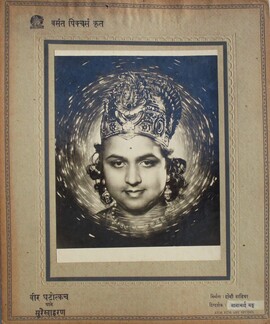
The first is Shahu Modak, the actor who worked in literally dozens of Hindu mythological films, all the way from his debut in the 1932 Shyam Sunder (where, as a child actor, he played little Krishna) to the 1980s. Over the course of this very long career, Shahu Modak acted in some thirty films as Krishna, and many others as Sant Gyaneshwar, Narad, Bharat, etc.
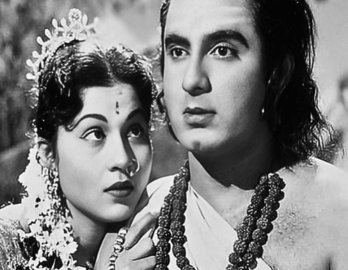
The second is Manhar Desai. Although Desai acted in many mainstream films (even opposite Meena Kumari in Madhosh), it was with mythologicals that he really hit his stride, working in a slew of films (especially opposite Nirupa Roy, another person who was a stalwart of mythologicals). Sati Naagkanya, Sati Anusuya, Naag Mani, Ram Hanuman Yuddh, Janam-Janam ke Phere, Shankar Sati Anusuya, Mahabharat… all had Manhar Desai in them.
The point?
Both Shahu Modak and Manhar Desai were Christians. Shahu Modak was Marathi Christian, and Manhar Desai was from a Gujarati Christian family that moved to Bombay when he was a child.
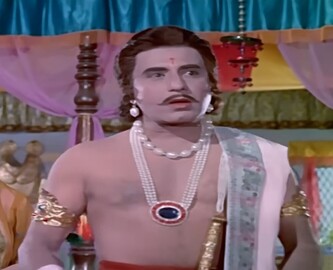
Both looked (as my neighbour would put it) ‘normal’ enough, and had names that were ‘normal’ (not even ‘mixed names’!) enough to have them fit easily into the many roles they played in Hindu mythologicals. As gods, even, ironically enough (or demi-god; the screen grab below is from Mahabharat, in which Manhar Desai played Karna).
Of course, the realm of cinema is all about make-believe; your personal beliefs, your faith, might very well need to be put aside because on screen, you’re acting. The same goes for singers, music directors, lyricists etc: you might write/compose/sing—in essence, act, through your words/music/voice—a faith that isn’t yours. The most oft-quoted example of that is Mann tadpat hari darshan ko aaj (composed by Naushad, with lyrics by Shakeel Badayuni, and sung so feelingly by Rafi), but there are countless others. Asha Bhonsle’s Ya nabi salaam alaika, for example; or dozens of other Muslim devotionals sung by her and Lata (Ae mere maalik mere parvardigaar is one of my favourite devotional songs ever). Or the many, many bhajans sung by Rafi.
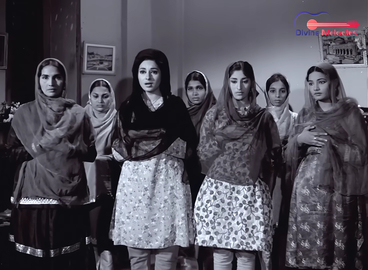
In the old films, it wasn’t just the music, naturally. It was also the films themselves. In a country where the population has been of an overwhelmingly Hindu majority for centuries, it’s hardly surprising that most of our films have also been about Hindus (the Muslim socials fall into their own category). Not necessarily films which are devotional or mythological, even; the average Hindi film has generally featured Hindus. Often, that’s not overtly visible through the film. But every now and then, there might be a scene showing a pooja, or a bhajan—and then who stops to think that the actor isn’t Hindu? Or, in a Muslim social or a Mughal-dynasty (say) film, an actor who isn’t Muslim?
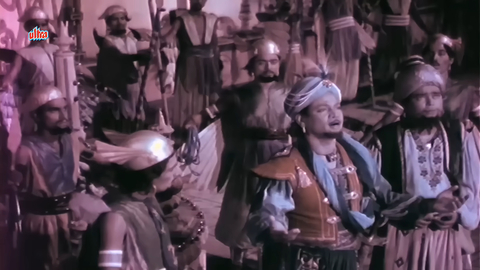
Because that’s what acting is all about, isn’t it? The real persona is shed for the assumed one.
It had to be, because the number of Muslims (especially) who acted in Hindi cinema was—I think—somewhat disproportionate to the numbers in real life. While many of them acted under their real names (Waheeda Rehman, Rehman, Nigar Sultana, Mumtaz, Shakila, Feroz Khan, Nazir Hussain, Suraiya, Agha, Mehmood, etc… too many names to count) there were many who assumed a screen name that was more ‘Hindu’ (if you want to call it that): Dilip Kumar (probably the most famous of them all), Meena Kumari, Madhubala, Shyama, Ajit, Veena, Johnny Walker, Jayant, Jagdeep…
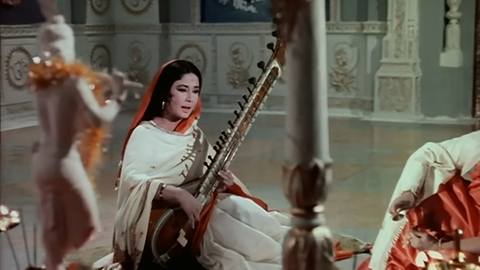
Plus, of course, the many others who were neither Muslim nor Hindu. The Sikhs (Dharmendra, Geeta Bali, Kuldeep Kaur), the Parsis (Sohrab Modi, Daisy and Honey Irani, Jal Khambata), the Jews (Nadira, David, Sulochana/Ruby Myers, Pramila), and—this is where I came in—the Christians. Besides Shahu Modak and Manhar Desai, also Kalpana Karthik, Helen, Smriti Biswas, Sonia Sahni, et al.
Mirroring this multi-faith population of film crew and cast, there was often a nod, onscreen, to a multi-religious society as well. Even if most films featured Hindus, there were people of other faiths thrown in every now and then. True, the Christians, Parsis and Sikhs tended to be embarrassingly stereotyped. Parsis would be caricatures, eccentric to the nth degree. Sikhs would be either stupid, or very belligerent (though Jaagte Raho had a very memorable, canny bunch of Sikhs, even played by Sikhs).
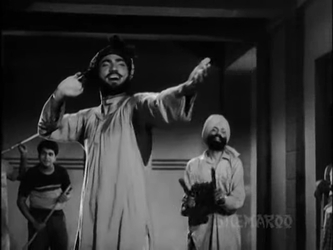
The Christians would either be the goodie-goodie type (Mrs D’Sa of Anari comes to mind), or the buffoon (typically Tuntun in a dress and floppy hat, accompanied by a Sunder/Mukri in an il-fitting suit and cardboard top hat). More often than not, Helen, in one of her umpteen roles as a dancer, would be playing a Rita/Rosie/Lily/Kitty/Jenny/Suzie/whatever—the no-holds-barred, uninhibited Christian who has no qualms about putting herself on display in a public place, and hooking up with the villain.
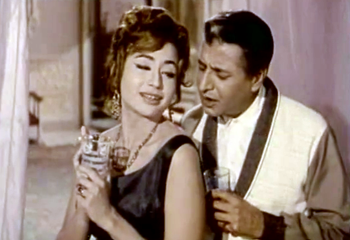
Often, the hero or the heroine would have a very dear friend who was not Hindu. They would stick together through thick and thin, and would even (as in the case of Jayant’s and David’s characters in Mem-Didi) get up to all sorts of not-very-commendable activities together.
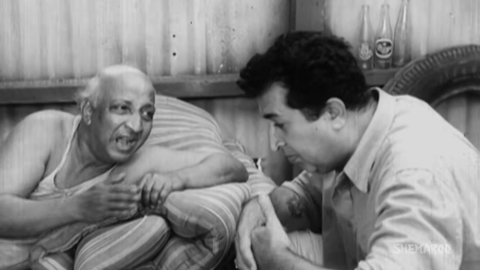
Sometimes, in early films, the entire focus was on Hindu-Muslim unity: Dev Anand’s debut film Hum Ek Hain (1946) and V Shantaram’s Padosi (1941) are both centred round the idea of Hindus and Muslims living harmoniously together. Much later, Yash Chopra’s Dharmputra (1961) made a hard-hitting and wise point about the ills of bigotry.
But let me not turn this into a treatise. This post just stemmed from an incident, and I found myself looking back on one of the many reasons I like Hindi cinema of a certain vintage. It underlined the fact that our constitution declared India a secular country, and it tried to portray a multi-faith society. Sometimes, that attempt went a bit bonkers (Amar Akbar Anthony, while beyond my blog’s timeline, is a case in point), but occasionally—in a Manmohan Krishna singing Tu Hindu banega na Musalmaan banega, for example—it made history.
 Dustedoff
I read this article start to finish in the wordpress notification itself. Invaluable information and brilliant thoughts presented by you Madhulikaji. It’s a gem of an article. You have restricted your timeline to 1970 but as far as secularism is concerned, you can cover Bollywood movies upto the nineties. Even pre-seventies Bollywood did not do justice to the Christian and Parsi communities. However Muslims were not demonized in the movies then. Now the present regime has cast its shadow on the Bollywood and movies are being made which suit its agenda. Secularism has vanished from Hindi movies and bigotry (with hatred) has replaced it. I remember the olden times when even Hindi pulp fiction had a secular tone. We used to read novels under Rajan-Iqbal series and Ram-Rahim series. Now hatred only is being propagated, not only by the politicians but by Bollywood movies also. More and more people are beginning to think like Dilip of Dharmputra (1961) under the influence of continuous religious (cum political) propaganda by our present rulers. Bollywood is also coming up with propaganda movies one after the other. It’s a pathetic state of affairs indeed. I will read this article again.
LikeLiked by 1 person
Thank you so much, Jitendraji – both for the appreciation and for the insights you offer. Yes, indeed: Muslims were never demonized (and actually, even though Christians, Parsis and Sikhs were stereotyped, one never got the impression that the film-maker was showing any sort of hatred for these communities). Now, of course, it’s a different thing altogether. Cinema has become, to a great extent, a vehicle for propaganda. And given the vast number of people who seem to think cinema (like WhatsApp forwards) is based on the truth… it’s dangerous. :-(
LikeLiked by 1 person
Actually, except in a few cases, characters of other religions were shown as good, honest, helpful people, perhaps to help with the integration. And I also remember it was a time when “khadi topi” wearers were allowed to be shown as criminals without the government bludgeoning or bulldozing the producer and director.
LikeLiked by 2 people
Yes, indeed. I honestly can’t think of any old film in which non-Hindus were ever demonized or shown in a bad light. Today, of course, barring a few films, it’s generally quite a different scenario.
LikeLiked by 1 person
A very thoughtful article. Bollywood always gave opportunities to everyone, irrespective of religion. However, it showed a peculiar hesitation in showing the leading pair belonging to different religions! I do not recall such films in the distant (pre 1970) past! Perhaps you can enlighten us, Madam!
LikeLiked by 2 people
Yes, that point occurred to me too, though I didn’t write about it (as it was, I thought I had gone on and on long enough!). The Hindu-Muslim interfaith love, at least, was not something we saw before 1970 (or till even later? I don’t know; the only films that readily come to my mind are from much later, like Veer-Zara or Bombay).
There have been old films with a Hindu male and a Christian woman, though. Howrah Bridge, for example, had Madhubala playing a Christian (Edna), and Helen was Suzie in China Town, opposite one of the characters Shammi Kapoor played (he was called Mike but it emerged later that he had been kidnapped in childhood… so I guess that still makes him Hindu?). And of course there were many films in which minor female characters (often played by Helen) were wooed by the side-hero, so to say. The man a Hindu, she Christian/Anglo-Indian.
Then there’s this song, about the romance between a pandit and an Anglo-Indian:
LikeLiked by 1 person
Raj Kapoor’s Bobby shows an inter faith ( apart from the inter class) love story. But the difference of religion is never highlighted.
LikeLiked by 2 people
Yes. But Nitin’s question was specifically about films from before 1970. Though this thing you point out – about religion not being dwelled upon – is also true of the films I’ve mentioned. For instance, in Howrah Bridge or China Town there is no mention at all of religion, or how it might set two people apart.
LikeLiked by 1 person
It is a sad commentary on our society that a person’s identity is reduced only to their faith – ignoring the person themselves totally. And then false stereotypes are put on each faith. I hve to say this is a recent development – for when I was in school (some decades back) we had class mates from all religions but it was quite irrelevant in how our interactions developed.
People who pigeonhole people based on such random criteria only proves the axiom- When you generalise, it is generally lies!!
LikeLiked by 2 people
Exactly. When I was in school and college, we too had classmates of all religions, and we never even thought twice about it. The only time religion came into the picture was when there would be a religious festival for one faith, and the rest of us would eagerly look forward to whatever goodies were brought to school for us to share!
So well put, that thing about when you generalize, it’s usually lies!
LikeLiked by 1 person
Thank you so, so much for the post. Apart from the beautiful, timeless music, this is one of the reasons I love old cinema so much, even though the plots were thin, riddled with holes, the comedy was at times unbearable, the acting hammy at times. But there seemed to be a soul to it, a social consciousness about the new India that we were dreaming of. That India is gone and I do not know that I will get to see any semblance of it return in my lifetime. It hurts so. There are so many songs that come to mind, but I would like to mention ” Ab koi gulshan na ujde ab watan azaad hai” from Mujhe jeene do. That dreamed of gulshan is now a wasteland, the shamshan that Modi promised in every city and village of India.
LikeLiked by 2 people
I am so glad you liked this post, Roma. Thank you. This was exactly what I wanted to highlight – that while our old films may not have been perfect (all those problems you mention), at least their heart was in the right place. Not like now. But that, I suppose, is a sign of the times: over the past 12 years or so, this country has changed into a frightening, belligerent, arrogant and intolerant space that may take generations to revert to a kinder, more inclusive one. If it does.
LikeLiked by 2 people
Sorry for the emotional post. If you find it too political please feel free to remove the comment. Here’s the link. https://youtu.be/zqPyMRvWWoo?si=6Wl4E2OBBtgCyDKl
LikeLiked by 3 people
No, of course not. In fact, I’ve written a couple of posts that actually do reflect this. Here’s one, written after the Delhi riots of early 2020:
https://madhulikaliddle.com/2020/02/28/songs-for-our-times/
And this one, inspired by Shaheen Bagh:
https://madhulikaliddle.com/2020/03/08/main-chup-nahin-rahoongi-ten-outspoken-woman-songs/
LikeLiked by 2 people
The song “Humne suna tha ek hai Bharat”, from the film Didi.
LikeLiked by 2 people
Yes, lovely song, and such heartwarming lyrics.
LikeLiked by 1 person
“Ye raat bahut rangeen sahi” from the 1964 film Shagun. If you listen to the complete song, the lyrics are so hard hitting.
And coming back to your original theme, has there ever been a better depiction of “Indian” or Hindu womanhood than by Meena Kumari? And I don’t mean only the self sacrificing, weepy type. In film after film she has been the essential ordinary Indian woman, sacrificing, but also with a core of strength. Think Dil apna aur preet paraayi, Dil ek mandir, even, Main chup rahungi.
LikeLiked by 2 people
I have to admit I had forgotten the song from Shagoon, even though I’ve seen the film and thought I remembered all the songs. Thank you for reminding me of this one!
Of all of Meena Kumari’s roles, the one which really sticks with me as a powerful female character is Majhli Didi – I love her in that. Such excellent characterisation, and so well-acted.
LikeLiked by 1 person
Hi….lovely enumeration of the social fabric through the golden era of bollywood. Two movies come to my mind where minority communities are show without any caricatures or stereo types – Khata Meetha and Baton Baton Mein. Thanks.
LikeLiked by 2 people
Thank you, glad you liked this post. And yes, both Khatta Meetha and Baaton Baaton Mein steered clear of stereotypes – I suppose Basu Chatterji was more mature than a lot of other film-makers. Also, perhaps by the late 70s, among a certain class of directors, there was more awareness?
But talking of breaking stereotypes, I must commend one earlier Hindi film that managed to portray Christians quite faithfully: Raat ke Raahi. So refreshing to have Christians who didn’t speak Bambaiyya Hindi!
LikeLiked by 1 person
Thank you for this post – it’s much needed in times like these, though sadly those who need it most would probably never read it.
As you’ve mentioned in one of the comments, films of that time may have stereotyped certain communities, but it wasn’t out of malice or prejudice – and even some of these stereotyped portrayals were sometimes more progressive than most cinema today. A Muslim social like Barsaat Ki Raat, for example, could have a qawwali with lyrics mentioning Meera and Sita, and the idea that “ishq azaad hai, Hindu na Musalman hai ishq; aap hi dharm hai aur aap hi imaan hai ishq” – love is beyond religion, a faith in itself – and no one would bat an eye. Today, if such lyrics managed to get past the Censor Board by some miracle, the audience would probably torch the theatres. Jisse aagah nahi sheikh-o-brahman, indeed.
LikeLiked by 3 people
Thank you – and for quoting those beautiful lines! Also, I must add my two paise here: Kaabe mein raho ya Kashi mein, nisbat toh usi ki zaat se hai. Yes, in today’s day and age, songs like these couldn’t hope to even escape censorship. Actually, come to think of it, how swiftly and completely things have changed in a relatively short period. After all, Chak De! India was only 2007, and that made a pretty profound statement about a Muslim in a Hindu-dominated India (and it had Maula mere lele meri jaan, which was quite a forceful comment on secularism).
And yes, those who really need to read this never will. Or will troll me if they do.
LikeLiked by 2 people
Very timely article, Madhu ji.
Reminds me of an anecdote I once read about the Malayali actor Prem Nazir. He, like Shahu Modak and Manhar Desai, acted in many mythologicals playing many of the Gods from the Hindu pantheon.
It is said that he once visited a well-known producer for a meeting about an upcoming movie. He was asked to wait in the outer hall as the producer was praying in the main drawing room and did not want a Muslim to disturb him.
When the prayer was done and eventually Prem Nazir was let in, he noticed that the picture of Vishnu that the producer was using for the prayer was in fact a picture of Prem Nazir in one of his mythological movies.
Let me add Ragini (of the “Juhi, Juhi Juhi, mere sapnon ki rani” fame) to your list of Muslim actors who took on “Hindu” sounding names.
Regards,
Uday
LikeLiked by 2 people
That’s such an interesting anecdote, Udayji. I have seen a couple of Prem Nazir’s films, but not his mythologicals – I didn’t even know he was a stalwart of Malayalam mythologicals. But what an ironic incident.
I hadn’t realized Ragini was originally Muslim.
LikeLiked by 1 person
To be honest I don’t know how many mythologicals he acted in, but there is at least one where he played the role of Vishnu – Amme Narayana (1984) – IMDb
LikeLiked by 1 person
This is a beautiful and incredibly relevant piece. It’s fascinating how vintage Hindi cinema naturally embraced a shared cultural identity, where an actor’s personal faith never got in the way of the art or how audiences connected with them. Thank you for highlighting Shahu Modak and Manhar Desai—we need reminders of this seamless secular fabric today more than ever.
https://coupon4sure.in/store/bookmyshow-coupon-code/
LikeLike
Thank you so much. Yes, indeed: in today’s times we do need reminders of what we were once capable of (and, mind you, this in the wake of Partition, which one might have thought would have left a lot of people feeling sore about communities other than their own…).
LikeLike
Kya waqt aa gaya hai, which directions are our conversations moving towards. Kuch bhi bol rahe hain log, bagair soche samjhe. Very well written article.
LikeLiked by 1 person
Thank you, Prerna. Aur haan, kya waqt aa gaya hai. Yeh kalyug kab khatam hoga, bhagwaan hi jaane… perhaps not in our lifetimes. :-(
LikeLike
I am so sorry to hear of this incident. It is typical of the narrow-mindedness and ignorance of people. More tragic is the fact, that this is such a trait, that surpasses boundaries, class, religion, creed. Education seems to have made no dent into this. I read your article last week, it hit me so hard, I needed to time to brace myself and find the right words. Not that such belligerence attitude towards a group of people is unknown to me, but everytime it strikes, it leaves me speechless.
That is why I am grateful for the informative article and the comments below it.
Thank you.
LikeLiked by 1 person
Thank you, Harvey. Yes, education (or any other factor – “achhe ghar ke log” is another thing I have heard) makes no difference. The bigotry is so deeply entrenched that nothing can shake it free.
Ironically enough, someone actually made some very snide comments on this post too. But because he had commented for the first time, his comments went into moderation and I deleted them. The people who really need to read posts like this, will never accept that they could be in the wrong.
LikeLike
I’m still trying to find my eyeballs which rolled to the back of my skull somewhere, so I can find my jawbone that hit the floor! That woman had some nerve! I wouldn’t have been so polite, mind you, but then, you’re a nice, civil person, and I’m a witch. :)
This article of yours is not just timely, but so relevant to the times we live in. I have never seen such polarisation until the recent past. When we were kids, religion never came into our ken, except during festivals, where we cheerfully ‘celebrated’ every festival – meaning, we ate all the great food! :)
You write about the secularism in the Hindi film industry, of the devotion that Muslim artists could bring to a Hindu devotional song or vice versa, but a paradox that people don’t care to talk about these days is that many of the ‘Muslim socials’ steeped in the tehzeeb and shaa’iri of the nawabi culture, were often produced/directed and even acted in by Hindus.
LikeLiked by 1 person
I was SO annoyed, Anu! The gall of the woman. But unlike my usual very nice self, this time I snapped back and made it amply clear that I thought she was talking utter bilge. She got the message really quickly. :-)
I totally agree re: how it was back when we were children. One never even thought of ‘us’ and ‘them’, except when it was festival time – I remember Navratri would come around, and Swapna and I would go rushing off along with other girls, invited to homes to be fed and made much of. And when Eid came, our landlord (we were in Srinagar, and he was Muslim) would always send over great big feasts. Of course at Christmas there would be a stream of people – Hindu, Muslim, Sikh – coming over all day long. It still happens, but now I think we’re more aware of differences, more aware that we are above those differences.
And yes, of course there were lots of Hindus making Muslim socials. And starring in them! How many of those films did Rishi Kapoor star in, I wonder? :-)
LikeLike