
I am listening to Poochho na kaise maine rain bitaayi as I write this. I am hearing Manna Dey’s voice, bringing so much emotion, so much frustrated longing into “Ut jale deepak, it mann mera; phir bhi na jaaye mere mann ka andhera”. And I am remembering all the other songs of Manna Dey that I’ve loved over the years. Songs that I grew up with (and, more often than not back then, didn’t know who sang them). Songs that I loved from the very first moment I heard them. Songs that have grown on me. Songs that make Manna Dey immortal, even though he’s no more.
Category Archives: Odds and Ends
Random thoughts on historical films
A couple of weeks back, I reviewed Genghis Khan (1965). Before that I’d reviewed Halaku (1956). In the nearly five years this blog’s been in existence, I’ve watched and reviewed dozens of historical films in various languages—from La Grande Guerra to Zulu, from Taj Mahal and Jahanara to Shahjehan and Humayun. I’ve reviewed films set in the ancient world, in the Middle Ages, in the 19th century.
As you can see, I’m a history buff. And, by extension (since I am also a movie buff), a keen watcher of historical films.

Pran: In Memoriam
You could say Pran played, in a way, an important role in shaping my early film-watching days. My parents tell me that when Majboor (1974) was released, I—then a toddler—completely fell in love with one of its songs. My rendition of Michael daaru peekar danga karta hai (“Michael creates a ruckus after a few drinks”) was a little flawed. I cheerfully (and innocently) sang Michael daadu peekar ganda karta hai (“Grandpa Michael creates a mess after a few drinks”). But I thought the song was fabulous. I thought Michael was a good ‘un. And I thought—as I still do—that Pran (February 12, 1920 – July 12, 2013) was in a class by himself.
Pran, of course, was the quintessential villain. But in a cinema that had as many ‘invariably villains’ as ‘invariably heroes’, Pran stood out. Amongst the Madan Puris, the KN Singhs, the Jeevans, the Prem Chopras (and, to a lesser extent, or later, people like Prem Nath, Ajit, and Rehman), Pran was one of those who just had to appear onscreen for that moment of epiphany: Ah, here’s the villain.

Songs for all times: Celebrating 100 years of Hindi film music
Late last year, an editor from ForbesLife India wrote to me, telling me they’d be doing special ‘100 years of Indian cinema’ editions this year. Would I be interested in contributing an article? That was a no-brainer (or so it seemed), but when I got over my initial excitement and began to think, I realised that:
(a) I know virtually nothing about Indian cinema in general. Hindi cinema, yes; other Indian cinema, almost negligible.
(b) It was too vast a canvas. What would I write?
Much thought later, I offered to write about something I know something about: Hindi film music. What follows is a version of the article that appeared in the April-June 2013 issue of ForbesLife India. Do buy yourself a copy to read the final article—and to read some more interesting writing on a century of Indian cinema.

Book Review: Housefull: The Golden Age of Hindi Cinema
Despite the fact that I love reading as much as I enjoy watching films, I don’t read too much cinema-related writing. Part of the reason is that a lot of what I see in bookstores consists of biographies or autobiographies, and I have a horror of picking up one of those, only to find myself reading the sordid details of people’s personal lives. I’m really not interested in that; what I do like to read is about films themselves, and the professional side of those who make them. (Though I’m happy reading anecdotes like how Madan Mohan persuaded Manna Dey to sing Kaun aaya mere mann ke dwaare, or how Mohammad Rafi got to meet his idol).
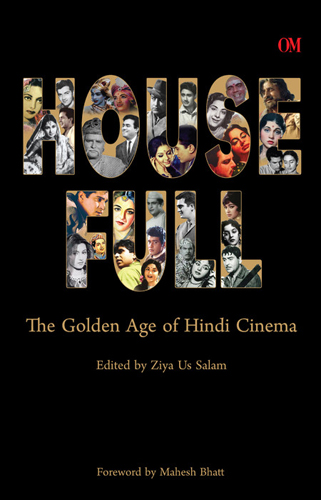
So, when I came across Om Books International’s Housefull: The Golden Age of Hindi Cinema (Ed. Ziya Us Salam) and saw that it was a collection of mini essays about the best films of the 1950s and 60s, I decided this might be right up my street.
Introducing another guitarist: Sammy Daula
Do you recognise this tune? (The clip’s only a few seconds long, so it won’t take much time to listen to it). I’m sure most of you who like old Hindi film music will be able to guess this one.
O P Nayyar’s favourite guitarist was a man named Hazara Singh, but occasionally, he’d let another guitarist play a piece. As in this case. The man who played the guitar here was my father’s cousin, Samuel Naseeruddin ‘Sammy’ Daula.

Chic Chocolate: the Mussoorie Connection?
Where I go, cinema seems to follow.
Well, not unusual, in this day and age, especially not in a country where cinema is so well-loved. But on a recent weekend trip to Mussoorie, I made a discovery that excited me so much, I had to share it.
Mussoorie, as some of you may know, has several filmi connections: actors Tom Alter and Victor Bannerjee are residents, as is the much-loved Ruskin Bond, author of A Flight of Pigeons (on which the 1979 film Junoon was based), as well as of the stories on which The Blue Umbrella and Saat Khoon Maaf were based.
On our last evening in Mussoorie, walking along the Mall, we found the road choked by a crowd. There were cameras, bright lights—and Neil Nitin Mukesh in a striped T-shirt, busy shooting.
Then I discovered, on a visit to Sisters Bazaar in Landour (and having referred to one of Ruskin Bond’s books on Mussoorie and Landour) that the long, low building that once housed the nuns, was later owned by Dev Anand.

In Tribute: ‘Verni’
Those of you who’ve been frequenting this blog for a year or more probably came across this earlier post, on my uncle David Vernon Liddle. Vernie Tau (tau is the Hindi word for a father’s older brother) was my father’s elder brother. He was born on October 12, 1929, and passed away when I was barely 9 years old. I do not remember much of Vernie Tau except for the fact that he was a witty, fun-loving man with (as a cousin of mine puts it) “a terrific sense of humour”. And he was a guitarist who played in some of Hindi cinema’s greatest hits from the early 50s.

Noor – Mrs. Johnny Walker
We’ve mourned the passing of a favourite star, but now—in the yin and yang way of zindagi and maut that Anand would possibly have appreciated—it’s time to celebrate a birthday. Today, July 21st, is the 77th birthday of a very lovely lady who began a career in cinema, appeared in some landmark films, and then bagged her biggest offscreen role: as the wife of possibly India’s best-loved comedian ever. This is Noor, the beautiful Mrs Johnny Walker.

On Rajesh Khanna and the Ephemerality of Life
I saw very few films till I was about ten years old. Till then, my father had been posted in small towns that had rather dreadful cinema halls. Then, in late 1982, we acquired a TV. And suddenly, though there wasn’t a spate of films to see (Doordarshan’s Sunday 5:45 PM film was the highlight of our week), there were some films to see. And, thankfully, I was old enough to understand what was happening onscreen.
One of my earliest recollections of that period is of watching Anand. For me—exposed till then to the usual Hindi film, where the hero always had a love interest, and where there were few (and mostly pretty melodramatic) moments of tragedy—Anand was different.
There was never any doubt that Rajesh Khanna’s character was the hero. He was ebullient, full of life, charming, friendly, yet (in those moments of solitude) sensitive. I kept waiting for a heroine to pop up.

 Dustedoff