When I was raving about Alan Arkin’s bloodcurdling performance as a ruthless killer in Wait Until Dark, memsaab—classic Bollywood aficionado, the inspiration for this blog, and font of knowledge of all things cinema—recommended this film as another Arkin showcase. And, my goodness, what a film. What a fabulously rollicking, hilarious, heart-warming film. I can’t believe I’ve spent so many years on this planet unaware of The Russians Are Coming the Russians Are Coming.
Lata in Ten Moods
When I did the Rafi in Ten Moods post a few months back, Stuartnz suggested I also do a Lata Mangeshkar post sometime. It’s taken a good deal of thought, since—like Rafi—Lata also has such a huge corpus of work, it’s impossible for me to pick my ten favourite songs. This, therefore, is the easy way out. It’s a list of ten songs in ten different moods. Not Lata’s ten best songs, but ten songs that showcase her voice, in every emotion from joy and playfulness to heartbreak and deep sorrow. These are all from pre-70’s films that I’ve seen (Pakeezah is the exception, but I never count that as a 70’s film—for me that’s very 60’s).
A Short Story Published
There was a young man down in the street, labouring away at the kebab stall. From two storeys up, I couldn’t see his face; just his back and arms as he went about his work. He had kneaded the keema and I had watched his shoulders moving, wide and muscular, as he worked the meat. His muslin kurta stretched across a broad back as he chopped onions and mint, pounded masalas, reached out to pour oil into the heavy iron kadhai, and pumped the kerosene stove, arms moving rhythmically back and forth, back and forth.
I drew back, breathing deeply of kebabs and kerosene, roses and sweat. A glorious bit of maleness there. Glorious from a distance of twenty feet, in the gathering gloom of a Ramzan twilight. At close quarters, the attraction would probably fade into nothingness. He probably sniveled. Or had a harelip. Or wasn’t interested in girls anyway.
I opened my eyes and looked up at the clock above my bed. It had once been Ammi’s clock, Ammi’s room. I remembered her standing there, just as I was now, waiting for seven o’clock. Always seven. ‘Ameena, don’t step out of this room when they come. Do you hear me?’ Her voice cracking with stress, her eyes grey like mine, scared and bitter.
Yes, Ammi. I hear you.
I hadn’t gone out of the room; they’d come in when Ammi died. But they rarely came in now, because there was no need. Well trained, that’s what I am, like one of those dancing monkeys I had once seen. The monkey-man, his face pinched and hungry, would jerk the string, flinging it up, and the monkey, perfectly trained, would pirouette in unison…
Those are the opening sentences of my latest short story to be published. One Night’s Work is, as the title suggests, about a night’s work—in a setting both modern and historical: the heart of contemporary Shahjahanabad, the busy, sometimes-sleazy, sometimes-charming (often both at the same time) area that most Dilliwallahs refer to as ‘Old Delhi’. Here, while the faithful get ready for an iftaar during Ramzan, as the markets bustle and heave with excitement, an orphaned girl, trapped in a job she hates, is escorted out on yet another assignment.
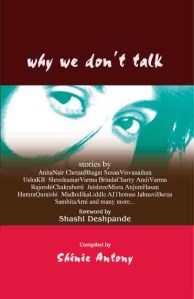
One Night’s Work has been published by Rupa Publications as part of an anthology titled Why We Don’t Talk. Compiled and edited by Shinie Antony, this is a collection of short stories set in contemporary urban India; stories by writers such as Anjum Hasan, Amit Varma, Jahnavi Barua, Rajorshi Chakraborty and Chetan Bhagat, among others. The book was released in Delhi in August, and costs Rs 295. You can ask for it in major bookstores, or buy it online at the Rupa website and at Rediff Shopping (yes, Rediff have got the details mixed up a bit, but the book’s the right one).
Update, two days later: The Times of India has published a brief review of Why We Don’t Talk: A ‘short and sweet’ collection of 27 stories, some by well-known Indian writers. This volume is like a breath of fresh air – poignant, serious, funny, bitter-sweet and quirky. Amit Varma’s ‘Urban Planning’ is a hilarious account of how politicians, media and the police are foxed by the mysterious movement of landmark buildings in Mumbai. Anita Nair’s ‘Trespass’ tells the story of a chance meeting between two women, one of whom is the mistress of the other’s husband. Samhita Arni’s ‘My Great-Grandaunt’ is one of the best of the lot. A great collection with a brilliant mix of stories.
Sunehre Kadam (1966)
This film has the distinction of not being listed on imdb. I’m sure there are other films like that, but the exclusion of Sunehre Kadam came as a surprise to me: it’s not as if it has an obscure cast (not that that is a criterion) or is unknown in other ways—I had heard at least one of the songs before, and I discovered what I would rate as one of Lata Mangeshkar’s most poignant songs.
More on that later; for now, a big thank you to ash, who shared this film with me. I enjoyed it!
Khozhdenie Za Tri Moray (aka Pardesi) (1957)
Frequent readers of this blog have probably realised I have a soft spot for ‘real life’ stories: Gladys Aylward, Dr Kotnis, Changez Khan, Shahjahan: I’m game. Of course, I don’t always end up with films that bear any resemblance to the life of the person in question, but there’s no harm in trying.
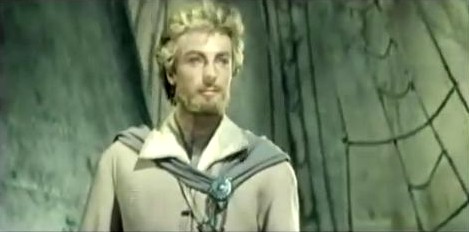
So, another. Afanasy Nikitin was a horse trader from Tver in Russia, who came to India in the late 15th century, having started off from Tver in 1466. His travels took him down the Volga River, through Persia, and then via dhow to India. He is believed to have disembarked in present-day Maharashtra; over the years that followed, he travelled through a large part of peninsular India, including Bidar and Vijaynagar. He died in 1472 in Smolensk, on his way home; his travelogue of India, however, endures: entitled Khozhdenie Za Tri Moray (‘The Journey Beyond Three Seas’), it describes in detail all that Nikitin saw of what was to him a wild, exotic land like nothing he knew.
Classic Bollywood: Ten Unforgettable Scenes
Some months ago, Bawa—to whom I will always be indebted for inspiring me to watch and review films in languages other than English and Hindi—sent me an interesting article. It listed selected scenes that leading film critics pegged as cinema’s most memorable. Bawa’s suggestion: why not do a list like that for Bollywood?
It’s taken time and effort, but this is it: ten scenes from 50’s and 60’s Hindi cinema, which are for me the most memorable—for whatever reason. These are in no particular order, though the scenes that came immediately to my mind (so, I suppose, the most memorable for me) are grouped at the top.
Note: some of these have spoilers.
Gyaarah Hazaar Ladkiyaan (1962)
What is a writer without readers? What is a blogger without people who stop by to read, comment, suggest, recommend, and encourage?
So, in gratitude to everybody who’s been visiting this blog over the months: this month on Dusted Off is dedicated to you. All through September 2010, the posts here will be connected in some way or the other to the readers of Dusted Off. The film reviews will be of films that have been recommended, given, or otherwise suggested by readers; and the lists—those ‘top tens’ I’m so fond of—will be of requests made by readers.
To begin with, this film. When I posted a review of Bhai Bahen a while back, it sparked off a discussion on N Dutta’s music—and reader Ash mentioned Gyaarah Hazaar Ladkiyaan, for which too the score had been composed by Dutta. After we’d indulged in much speculation about the film’s plot (what an intriguing title, right?!), another reader, Shalini, was kind enough to say that she had a copy, and was even more kind enough to share it. Therefore…
The Seahawk (1940)
Another offering for Flynn Week.
It was said, at one time, that if Bette Davis was the queen of Warner Brothers, Errol Flynn was the king. And a king, too, with a lineage that was astounding, to say the least. The Tasmanian-born Flynn spent a few years as a young man in Papua New Guinea holding down jobs as varied (and in some cases illegal) as diamond smuggler, slave recruiter, gold prospector, sheep castrator, and manager of tobacco and coconut plantations, before washing up in the big bad world of cinema. Flynn’s first role was as his own ancestor, Fletcher Christian, a mutineer on the HMS Bounty; two years later, opposite Olivia de Havilland (who was a very distant relative of his), Flynn acted as the pirate Captain Blood—and the king of swashbucklers had arrived.
The Dawn Patrol (1938)
Strangely—considering that Errol Flynn is best known for his swashbuckling roles—the film I most vividly remember of his is this one, an unusual war film. I first watched it years ago as a teenager, and ever since—in spite of having notched up The Prince and the Pauper, Captain Blood, The Adventures of Robin Hood and other blockbuster Flynn hits—this remains my favourite Errol Flynn film. Touching, thought-provoking, and utterly memorable.
Ten of my favourite patriotic filmi songs
I am very proud to be Indian, but I guess in a way that wouldn’t make me terribly popular with some people. I do not agree, for instance, that everything about India is top class, or that everything about the countries we have political, social, economic or other differences with is necessarily evil through and through. I love India, but I do not feel that means I must hate other countries.
But one thing I will concede: nobody does “I love India” songs as well as Bollywood. Of course. We have so many different forms of patriotism onscreen: the soldierly bravery of Haqeeqat; the dignified, subdued yet exceptionally poignant love for country of a native far from home in Kabuliwaala; the militant, do-or-die fervour of Bhagat Singh in Shaheed; the urge to take the country forward into a new age of progress, in Hum Hindustani...
So here are my ten favourite patriotic songs, all from 50’s and 60’s (occasionally 40’s) films that I’ve seen. Happy Independence Day!