Crossfire (1947)

I am a devoted fan of Robert Mitchum, droopy eyes, awesome walk and all. I am also very enthusiastic about film noir (not surprising, since a large portion of Mitchum’s work was noir). Crossfire, made just two years after the end of World War II, focusses on a largely ignored consequence of the war: the sudden demobilisation of soldiers—men who, after years of knowing exactly whom they were supposed to hate, suddenly found themselves with no target for all that festering anger and hatred.
This is a taut, suspenseful film, but also a thought-provoking one, and perhaps a little ahead of its time.

Robert Ryan, Robert Mitchum and Robert Young in Crossfire

Continue reading

Love in Tokyo (1966)

Love in Tokyo was before my time, but I can well imagine what its trailer should’ve been:

Japanese gardens! Asha Parekh in a kimono! Joy Mukherji in a wet shirt! Mehmood as a geisha! Mehmood as an Arab doctor! Mehmood as a nawab! Mehmood as Asit Sen!

And so on and so forth. It probably would’ve mentioned a few other attractions: Pran as a lecherous villain (so what’s new?), Lalita Pawar as a tyrannical matriarch with a soft heart (ditto), surprise revelations, a gold digger without a conscience, and a comic side plot without a shred of sense in it.
In spite of all that lunacy, though, this is an entertaining film with a certain mad charm about it.

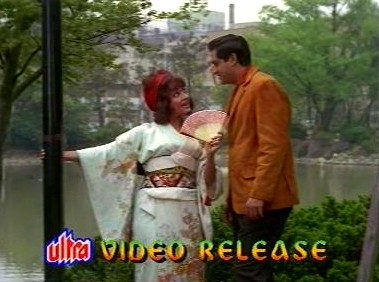
Asha Parekh and Joy Mukherji in Love in Tokyo

Continue reading

The Bells of St Mary’s (1945)

I have a bunch of films waiting at home to be watched, and (uncharacteristically indecisive), I’ve been see-sawing between Wait until Dark, The Maltese Falcon, and It Happened One Night. What I ended up seeing was this: a sweet, poignant, sometimes overly optimistic film with some lovely music and a memorable performance from the matchless Ingrid Bergman.

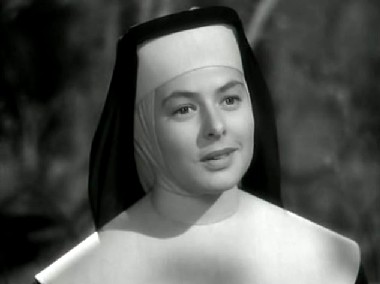
Ingrid Bergman in The Bells of St Mary's

Continue reading

Marine Drive (1955)

Every now and then (recently, with alarming frequency) I come across films that do an about-turn midway through. Either they start off being happy and degenerate into utter despondency; or they are intelligent to start with and then descend into idiocy. Marine Drive is a prime example of a film that manages to become irritatingly nonsensical almost exactly at the half-way mark.

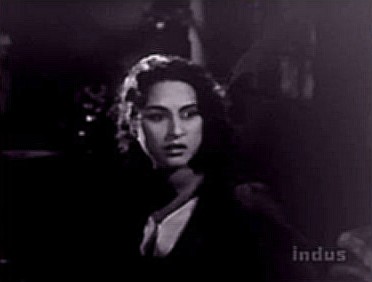
Bina Rai in Marine Drive

Continue reading

Ten of my favourite Madhubala songs

The Hallmark Group recently introduced a limited edition of gold-plated silver ingots representing 25 historic stamps of India. Issued under the authority of India Post, it’s called the Pride of India Collection. The stamps replicated run the gamut of concepts, events and people dear to India: Rabindranath Tagore, kathakali, the Taj Mahal, cricket—and more. And with Bollywood so close to the hearts of so many millions of Indians, there had to be a film star featured: and they couldn’t have chosen better.

Pride of India Collection - Madhubala ingot

[Personally, I think the stamp (released in March 2008) does Madhubala justice; the ingot doesn’t. She looks as if, as P G Wodehouse would put it, she’d been bingeing on starchy foods. The eyes are puffy; the smile is off; and she has a double chin. No, I wouldn’t pay Rs 6,000 for this.]

Continue reading

Twelve O’Clock High (1949)

I was brought up on a diet of Commando Comics, Biggles and Alistair MacLean’s war novels. My greatest wish, when I was ten years old (and rated David Westheimer’s Von Ryan’s Express as the best book ever written), was to see the film version of the book. More about that in a later post, when I’m scraping the barrel for films to review. World War II is an obsession with me (well, almost: it shares space with Westerns, Mughal history, gelato, and a couple of hundred other things). So, a war film, and that too one starring Gregory Peck, was bound to arouse my interest. And am I glad I saw it.

Twelve O’Clock High is a war film that examines the relationships, fears and psychologies of the men who went into battle—and yet it never topples over into melodrama. The action is sparing, the acting excellent, the atmosphere very real.

a bomber lands

Continue reading

Ek Phool Do Maali (1969)

A very frank admission: I am not intellectual. I cannot summon up the brainpower to analyse a film and go deep into the philosophy of it—which is why arty films are completely lost on me. I never, after seeing a film, question it, delve into its profundities, or explore the hidden meaning of so and so scene.

I am therefore proud to announce that I have finally seen a film that has gone a long way in remedying this lamentable situation. Ek Phool Do Maali made me sit up and think. It made me ask a lot of questions. And it made me vow never to assume that just because a film had a cast I generally liked, meant that the film would be good too.

Sanjay Khan, Bobby and Sadhana in Ek Phool Do Maali

Continue reading

The Trouble with Harry (1955)

Looking through my blog archives, I realised that the last Hitchcock film I reviewed, Dial M for Murder, was way back in November 2008. For someone who’s a self-confessed Hitchcock fanatic, this amounts to blasphemy. Service recovery seemed in order.
May I present, therefore, one of my favourite Hitch films: The Trouble with Harry. In true Hitchcock style, it’s full of suspense—but a suspense that’s quirky in the extreme. This is dark humour: farcical, irreverent, and very funny. No, not typical Hitchcock, but one of his best works.

Shirley MacLaine, John Forsythe, Mildred Natwick and Edmund Gwenn in The Trouble with Harry

Continue reading

Raat aur Din (1967)

I’m always on the lookout for old, offbeat Hindi films. Something without the hackneyed romances, the clashes between rich/poor, urban/rural, good/evil, the sudden breaking into song and the neat tying up of all loose ends once the regulation three hours are up. Don’t get me wrong; I have nothing against masala films—some of my favourite old films are masala to the spice-sodden core. But somehow a film like Kanoon, Ittefaq, Anokhi Raat, Kabuliwala or Dekh Kabira Roya, each unusual in its own way, has a certain je ne sais quoi. So does this, Nargis’s last film. There’s something a little hat ke about a film in which the romance is really quite minimal, and the strange light-and-shadow personality of a schizophrenic woman is the main focus of the plot.

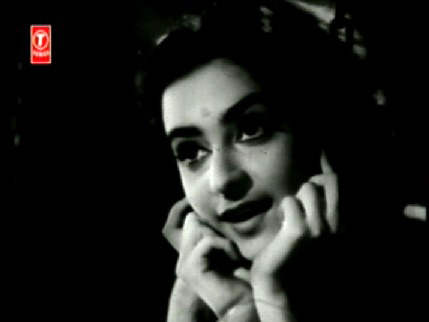
Nargis in Raat aur Din

Continue reading

Send Me No Flowers (1964)

Every now and then, I come across a film that makes me wish there were more like it. This is one of those: full of laughs, very enjoyable and utterly repeatable.
Doris Day and Rock Hudson had already starred in two fabulous romantic comedies—Pillow Talk and Lover Come Back—before they worked together for the last time in Send Me No Flowers. Unlike the two earlier films (which had very similar plots: girl falls for a guy who’s a wolf in sheep’s clothing), this one isn’t a romantic comedy per se; more an out-and-out comedy. But yes, there’s plenty of love and affection, and Hudson and Day look gorgeous together!

Rock Hudson and Doris Day in Send Me No Flowers

Continue reading