
Those who frequent this blog have probably figured out by now that I have a soft spot (a very soft spot) for Muslim socials. So much so that I will watch just about any Muslim social out there, even if it features people who aren’t among my favourites. Even if it has a fairly regressive theme, and even if I end up not agreeing with half the things in the film. So, when I come across a Muslim social that stars some of my favourite actors (Sunil Dutt? Meena Kumari? Rehman? Prithviraj Kapoor? Rajendra Nath? Check, check, check), has lyrics by my favourite lyricist (Sahir Ludhianvi), and had its songs composed by one of my favourite music directors (Madan Mohan—and how appropriate, too, for a film called Ghazal to be scored by the Ghazalon ka Shahzaada): to not watch this would be a crime, I thought.

Restaurant Review: Indigo Deli

One of Mumbai’s best-known and best-loved restaurants is Indigo. I’ve been to Mumbai only a couple of times, but on my last visit to the city, two friends took me out to dinner to Indigo. The food was fabulous, and … Continue reading
Restaurant Review: Carnatic Café

There is no paucity of restaurants that serve South Indian food in Delhi, ranging from top-end (and often expensive) restaurants like Dakshin, which offers probably some of the most authentic cuisines from the Deccan; to the numerous Udupi restaurants which … Continue reading
Restaurant Review: Rosang Cafe

By some odd coincidence, this is the third consecutive week that I’ve had a weekend lunch at a restaurant that had first started off in Hauz Khas Village. Yeti proved that a change in location could actually work for the … Continue reading
Ten of my favourite Sunil Dutt songs
A couple of months back, amidst a discussion on one of my posts, fellow writer (and fellow Sahir Ludhianvi fan) Karthika Nair and I got involved—as we are apt to do—in talking about Sunil Dutt (who, coincidentally, has appeared in a number of songs written by Sahir). I realized then that I’d never compiled a list of my favourite Sunil Dutt songs. This, despite the fact that he is one of my favourite actors.

Little-known tombs: Atgah Khan’s Tomb

I’ve recently concluded a series of occasional mini-articles on little-known secular historical monuments in Delhi. Looking around for ideas for another series, I realized that some of my favourite historical monuments in Delhi are tombs. Yes, that might sound slightly … Continue reading
Restaurant Review: Elma’s Brasserie

Like Yeti, Elma’s was a place I was first introduced to in Hauz Khas Village. The Elma’s in Hauz Khas was (I haven’t been there for nearly a year—possibly more) a good tea place: a nice selection of teas, lovely … Continue reading
Only the Valiant (1951)
Someone once told me “I don’t watch Westerns and war movies. Too much blood and gore, too little character development, and no message to take home. Nothing but guts and glory.”
True, if (and this is a very big, very emphatic if) the only war films or Westerns you’ve ever seen are the straightforward action types (and even among those, old films tend to be far less gory than their newer counterparts—modern Westerns and war films like The Thin Red Line, Saving Private Ryan, True Grit, etc are, on the whole, far more graphic than their predecessors). But there’s nothing to stop a film—irrespective of genre—from also being well-written, from having good characterisation and character development, and from being something more than a battle of “let’s see who’s braver”. Some of the best films—in fact, even the films that I’ve found affirming virtues like humanity, peace, equality, and so on—I’ve seen have been war films or Westerns: Paths of Glory, La Grande Guerra, The Searchers…
My point being, there are films out there that may seem, at first glance, deceptively run-of-the-mill genre film. Then, at closer inspection, they turn out to be something more.

Restaurant Review: Yeti – The Himalayan Kitchen
A friend had introduced us to Yeti a couple of years back. Yeti, then, was a small, somewhat cramped little restaurant in Hauz Khas. We went there for lunch with our friend, liked what we ate, told ourselves we’d be back—but never actually got around to returning, just because the logistics were all stacked against another trip. Hauz Khas has become notoriously crowded over the past few years; parking is a pain; and it is, anyway, not all that close to where we stay.
It was therefore with great joy that we greeted the news that Yeti had now opened in Greater Kailash too—less than half an hour from our home, and with ample parking space. Come Sunday, we decided we had to go check it out to see if it was as good as the Hauz Khas one.
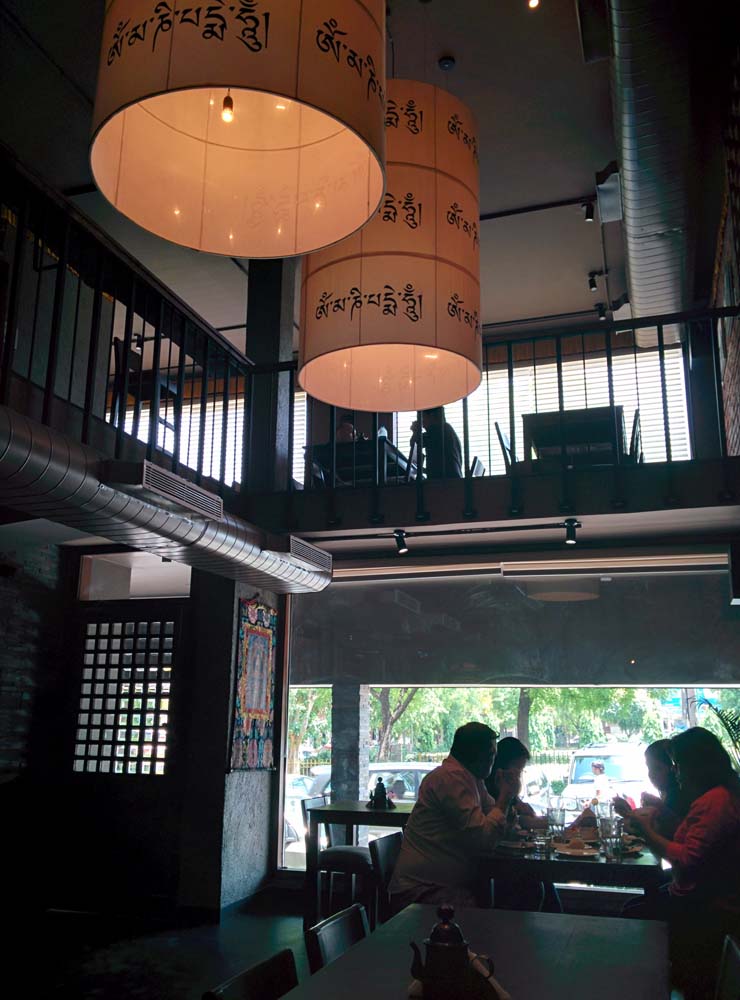
Inside Yeti.
Heritage and Street Food: A Walk Through Nizamuddin Basti
I’ve been on countless heritage walks around Delhi, and some of them have ended with going off to a Chaina Ram or a Karim’s or a shop in Parathewali Gali to fortify oneself before heading back home. But I’ve never … Continue reading
 Dustedoff