I’ve seen this film – a ‘raja-rani’ film, like Rustom-e-Hind – several times, but the most memorable viewing of it was at my parents’ home a couple of years ago.
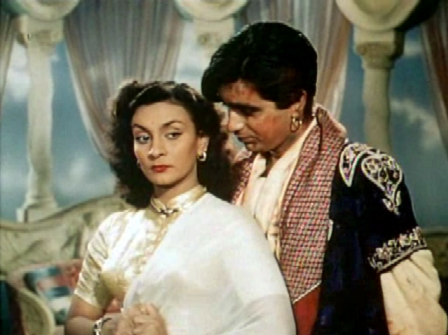

I’ve seen this film – a ‘raja-rani’ film, like Rustom-e-Hind – several times, but the most memorable viewing of it was at my parents’ home a couple of years ago.
Mumtaz, as I mentioned in my last post, was one of the best things that happened to Mere Sanam. She may not have had much screen time in the film, but she certainly left her mark – more than she’d been doing in the B-grade films she’d mostly appeared in till then.
Rustom-e-Hind, made in the same year as Mere Sanam, is an example of that type of film. It’s basically a Dara Singh showcase – so there’s lots of showing off of wrestling – but Mumtaz gets to smile prettily and flutter her eyelashes, if nothing else.
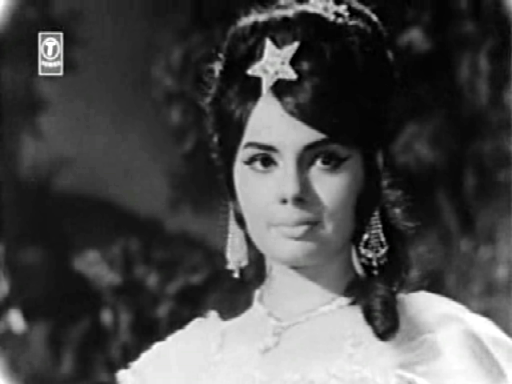
Nasir Hussain may have made his Tumsa Nahin Dekha story into four separate – and equally successful – films, but did that induce others to be original? On the contrary. Narinder Bedi, at least, probably seemed to think that what worked for Nasir Hussain might well work for him. Therefore, Mere Sanam, which has a storyline similar in many ways to Tumsa Nahin Dekha. (Both films also have fantastic music by OP Nayyar, by the way).
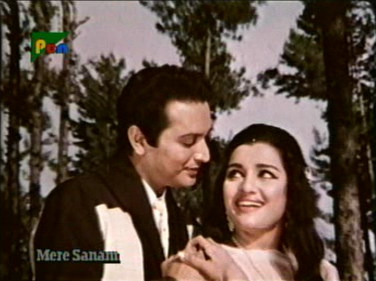
If Rajkumar is the trademark ‘Shammi Kapoor at his peak’ film, then Tumsa Nahin Dekha is an equally – if not more – important film, because this is the one that made Shammi Kapoor into the icon he was by the mid-60s. Till Nasir Hussain got Shammi Kapoor to shave off his moustache and act as the devil-may-care hero of this film, Shammi was (as my father puts it), “Just another actor with a thin moustache and the usual roles. Nothing exceptional.” Tumsa Nahin Dekha gave him the opportunity to transform from the half-hearted, unexceptional sort-of-hero into a Shammi Kapoor who became almost an institution in himself.

With the launch date of The Eighth Guest & Other Muzaffar Jang Mysteries just around the corner (August 19th, 2011), here’s something to whet your appetite: the book trailer.
Here it is, in normal resolution:
And in high definition:
Enjoy!
Buy the book online at: Landmark | Flipkart | Crossword | IndiaPlaza
My blog has featured Shammi Kapoor now and then – with reviews of some of his films, in my list of classic Hindi cinema’s handsomest men (which he topped, by a very long margin), and in various lists of songs.
Yesterday morning, when I woke up and logged on to the Internet, the first news headline I saw was that Shammi Kapoor had passed away. I have never been so affected by the passing away of one of the many stars of the past who have died in the recent past… but the news of Shammi Kapoor’s death brought tears to my eyes. I have a lump in my throat even as I type this.
I had not really intended to write this review now. I am in the midst of a blog project in which each post links to the previous and the next posts in some way or the other. But I could not ignore the passing of my favourite actor. I would never forgive myself for that. So, while this post does have a connection to the last (Humayun was a ‘raja-rani’ – ‘king-and-queen’ – film; so is Rajkumar), it is, first and foremost, a tribute to the brightest, most joyous and most entertaining star of the 60s. A sun that will never set.

One of the main characters in Prince of Foxes was a man who actually existed in history: Cesare Borgia (1475 (?) – 1507 AD). This post is about a film that features one of Cesare Borgia’s contemporaries, a man born halfway across the world, seven or eight years after Cesare Borgia was born. A man as ambitious as Borgia, and a man who had as marked an impact on the history of India as Cesare Borgia did on Italy. This was Babur, the founder of the Mughal dynasty – without which we wouldn’t have had the Taj Mahal, Fatehpur Sikri, murgh musallam, and who knows how many Hindi films.
Humayun is (as the name suggests) more about Babur’s son and successor Humayun (who, coincidentally, was born almost exactly a year after Cesare Borgia died – Borgia died on March 12, 1507; Humayun was born on March 7, 1508). But the film begins with Babur (Shah Nawaz) invading India, so Babur does play quite an important role in the scheme of things.
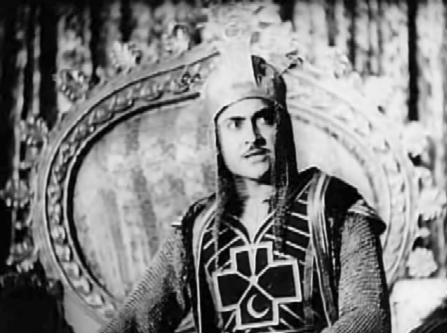
The last film I reviewed, Kohinoor, was part swashbuckler, part romance and part political intrigue. So is Prince of Foxes (though this has none of the comedy that makes Kohinoor such an endearing film). Interestingly, though, that isn’t the only thing common between these two films. They also have one scene in common. It’s a fairly critical scene in the film, where the hero has been imprisoned and is dragged forward, chained and beaten, in an assembly presided over by the villain – who sentences the hero to death. A bystander, one with ample reason to resent the hero, steps forward and disputes the death sentence – simply because it’ll bring the hero’s life to a blessed, quick end. Why not prolong his agony instead? This bystander proposes a gruesome way to do it (the same way in both Kohinoor and Prince of Foxes), and offers to do it. With the exact same results in both films.
I did not supply the details in Kohinoor, and I won’t let the cat out of the bag here. Suffice to say: if you like swashbuckling historicals, this is one Hollywood film you should put on your list.
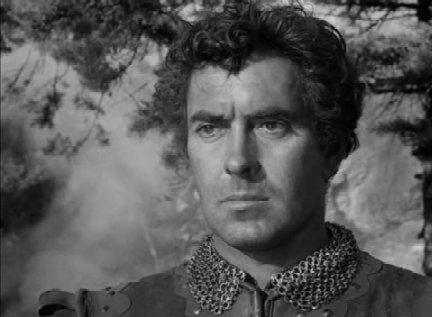
Der Tiger von Eschnapur and Das Indische Grabmal were, as Anu called them, ‘raja-rani’ (‘king-and-queen’) films, no matter how warped they may have been as examples of that genre. In line with my last post, therefore, here’s another film: also raja-rani, also set in the India of maharajas, evil plotters wanting to make a grab at a throne that’s not legitimately theirs, and a pretty lady at the heart of it all. Kohinoor, however, is a blessedly long way from Fritz Lang’s Indian epic. This film’s a rollicking farce mostly all through, with plenty of good songs, a great cast, and some superb comedy sequences.

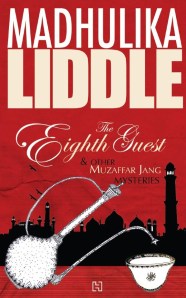 A number of readers have been asking me when the next Muzaffar Jang book – the sequel to The Englishman’s Cameo – will be out. So here it is.
Muzaffar Jang features again, in this series of mystery stories, nearly all of them set in Shahjahanabad, the Dilli of Shahjahan’s last years as the Mughal Emperor. As the blurb on the back of the book puts it:
“It is the year 1656. Muzaffar Jang, that rare creature in Shahjahan’s Dilli, an aristocrat with friends in low places, is recovering from injuries sustained during his recent adventures involving two mysterious Englishmen and some reprehensible activities against the Imperial Exchequer.
Muzaffar’s bruised shoulder has yet to heal when he finds himself catapulted into a series of mysteries: An elephant in the Royal Elephant Stables goes berserk and kills its mahout – or does it? A scholarly nobleman – but, oh, such a pompous bore – is left a very puzzling legacy by his father. An artist at the imperial atelier is found murdered next to one of his works.
Muzaffar must pit his wits against treacherous noblemen and scheming traders, greedy villagers and lovelorn men – and women.
But who knows? Before the year is out, Muzaffar may just meet his match…”
I am especially fond of writing short stories, so this collection is one I’ve particularly enjoyed putting together – and they’re stories I hope you will like. The book will be formally released in Delhi, at the India Habitat Centre, on August 19, 2011 – but you can pre-order now on any of these online bookstores:
Landmark | Flipkart | Crossword | IndiaPlaza
And yes, there’s even an early review already published, on this blog.
Enjoy!
 Dustedoff