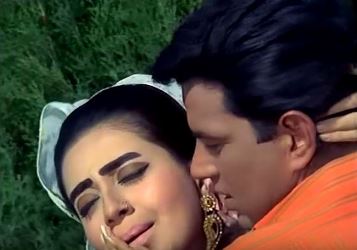
Tumse Achha Kaun Hai (1969)

Lalita Pawar plays an ageing and very wealthy woman who employs a man (played by Shammi Kapoor) to reform her granddaughters, who are getting too wild for her liking. The man, poor and in desperate need of money to pay for the treatment of an ailing family member, takes up the offer, even though it will require him to pretend to be someone he’s not. In the process, he ends up falling in love with one of the granddaughters—much to the annoyance of the indignant grandmother.

This was the gist of the story of Professor (1962), though with one qualification: Shammi Kapoor’s Preetam in that film is initially hired just as a tutor for the younger brothers of the granddaughters; it’s only a little later that he’s also given the task of tutoring the young women. It was, as I’ve said on more than one occasion—and of course in my review of the film—a delightfully entertaining film, romantic and fun and with absolutely fabulous music.

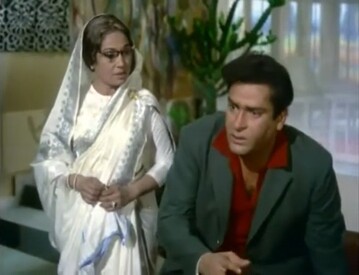
Seven years later, Shammi Kapoor acted in another film with a somewhat similar plot. Here, in Tumse Achha Kaun Hai, he is Ashok, a musician; and Lalita Pawar plays Sarojini Devi, the very wealthy woman who approaches him with a proposition: that he take on the task of setting to rights her granddaughters, all three of whom (she feels) are a disgrace to Sarojini Devi.
Continue reading

Doli (1969)

The Hindi film industry has always been an upholder of patriarchy. Its male stars attract ridiculously high prices in comparison to their female colleagues, and have disproportionately longer careers than them (plus a much longer time as leads). Sexism is rampant, ranging all the way from sexual discrimination to violence. And, though more women directors, scriptwriters, lyricists etc are around now, it’s still pretty much a male-dominated industry.

Hardly surprising, then, that most of our films tend to look at things (at best) from a male point of view. At worst, they uphold patriarchy in its most virulent forms, reducing women to a cypher, expected to devote their lives to the service of men. Ever-forgiving Sati Savitris, wrapped in saris and simpering prettily every time their lord and master deigns to be kind. Or unkind, it doesn’t matter; he is still her devta.

Doli is one such film, steeped in patriarchy and regressive in the extreme.

It begins in a college, where Amar (Rajesh Khanna) and Prem (Prem Chopra) have just graduated. Amar is the star athlete, Prem the star pupil who has topped the college and won a scholarship for higher studies in America. Later, in their dorm, both Prem and Amar receive letters from home, informing them that their weddings have been fixed. On the same day, in the same town, Nasik. Neither of them is happy about this, but Prem, having known already that a match had been found for him, is rather more resigned.

Continue reading

Raaz (1967)

For many years now, I’ve been fascinated by what I call the ‘supernatural’ subgenre of Indian suspense films. Offhand, I can’t recall too many [any?] non-Indian films that used a supposedly supernatural theme to veil what was a definitely corporeal, criminal deed. Yeh Raat Phir Na Aayegi, Mahal, Woh Kaun Thi?, Bees Saal Baad, Poonam ki Raat, Anita—all of these (and plenty more) used tropes such as spooky songs, ‘ghosts’ (invariably women in white), mysteriously creaking doors, swinging lampshades and seemingly haunted havelis, all forming part of a grand plan to convince someone that they were surrounded by bhoots when in reality they were surrounded by crooks.

Raaz is one of those films. And yet not.

Continue reading

Kab? Kyon? Aur Kahaan? (1970)

If you’ve been reading this blog for a while, you’ve probably realized by now that I’m a sucker for suspense films. And that I have a soft spot for Dharmendra. And Helen. And Pran. Bring all of those together, and I’m pretty much willing to give it a try. Kab? Kyon? Aur Kahaan? is a film I’d watched many years ago, and liked, so I decided it was time for a rewatch [especially since I’d forgotten pretty much everything of it except for one very taut and tense section]. As it turned out, this was one of those films that make me realize how much more forgiving I was in my younger days. I’d forgotten, for instance, how Babita’s eyebrows managed to give Dharmendra’s a run for their money in the bushiness department.

Babita and Dharmendra in Kab? Kyon? Aur Kahaan?

Continue reading