Subarnarekha (1965)

Today is the 100th birth anniversary of one of India’s greatest film directors, Ritwik Ghatak: he was born in Dhaka on November 4, 1925.
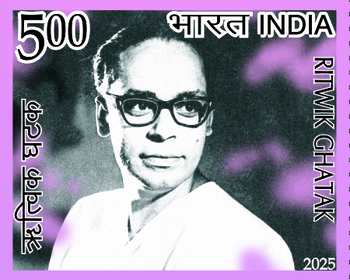
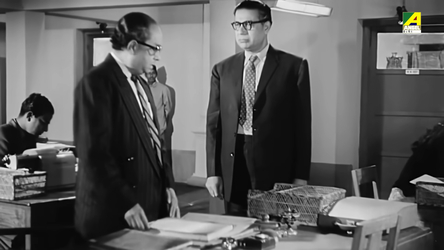
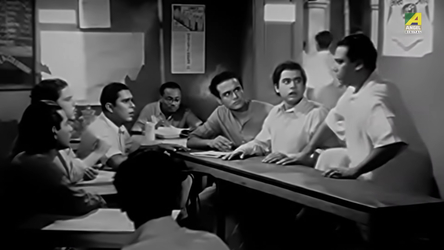
I have to confess I’ve not seen very much of Ghatak’s work, mostly from an innate tendency to shrink from ‘sad movies’. I did watch Meghe Dhaka Taara some years back (and admired it, though it was, as expected, tragic). For his birth centenary, I wanted to review another of his films, and this one popped up in the searches. It immediately drew my attention, for several reasons. For one, it stars Madhabi Mukherjee, one of my favourite actresses. For another, it also starred Abhi Bhattacharya, a familiar face from Hindi cinema, and one I’ve always liked. At least, I reasoned, if I had to watch a sad film (at a time when I’m so busy and stressed, I’d rather watch mindless fluff)… at least there would be people onscreen I enjoy watching.

Continue reading
Ekti Raat (1956)

This, actually, was not the film review I was intending to post this week. But then, over the weekend gone by, I met Moon Moon Sen, and I was reminded (of course I would be!) of her mother, Suchitra Sen.

I was in Dehradun on October 11 and 12, attending an arts and literature festival. The guest of honour was Moon Moon Sen, still beautiful, and with a serene calmness to her that was—as someone mentioned—very ‘peaceful’ (to which Ms Sen replied that she has a horrible temper!) Moon Moon Sen was mostly involved in graciously felicitating those who participated in panel discussions and so on; I was thrilled to have her place a scarf around my neck. But the last session of the festival was a conversation with her, and it was very interesting. She answered questions about herself, of course, but also about her mother (“always, ‘Madam’, never ‘Mrs Sen’ or ‘Suchitra’” she recalled). Not just a star, but a mother (“I only knew her as Mummy”), and one whom young Moon Moon was obviously very protective about: she said she shielded her mother when Suchitra Sen had to make her way through a crowd. She had no qualms even about punching anyone who tried to get fresh with her Mummy.

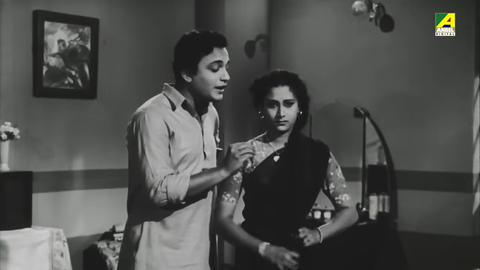
I remembered, then, that I had a Suchitra Sen film review ready to be published. Here it is, a light-hearted comedy, directed by Chitta Bose, based on a story by Balaichand Mukherjee ‘Banaphool’ and with a screenplay by Nipendrakrishna Chatterjee.

The story begins in the Calcutta home of Shushubhon Dutta (Uttam Kumar) and his wife Anita (Sabita Chatterjee), who have been married a few months. The two are constantly bickering, and we see them in the middle of an argument even as the film starts. Anita is hot-tempered, Shushubhon likes to needle her.

Continue reading

Kabuliwala (1957)

This is a film I’ve been meaning to watch for a long time now—ever since someone told me that the 1961 Balraj Sahni Kabuliwala (in Hindi) wasn’t a patch on the Bengali version, directed by Tapan Sinha and starring Chhabi Biswas as the eponymous Afghan. I was reminded of it again last year when, for Tapan Sinha’s birth centenary celebrations, Anu (from Conversations over Chai) wrote this wonderful review of the film.

Then, some time back, I began reading 100 Indian Stories (edited by AJ Thomas, published by Aleph Book Company, 2025)—and one of the very first stories in the collection was Rabindranath Tagore’s classic The Kabuliwala.

I figured it was about time I watched Tapan Sinha’s take on the story.

The story begins with scenes (no dialogue, only somewhat sonorous singing in what seems to be Pashto) in rural Afghanistan. Peaks loom high above the valley, a train of camels moves rhythmically along a narrow mountain, and we see Rahmat (Chhabi Biswas) hard at work, but taking out time now and then to play with his little daughter, whom he’s obviously deeply devoted to.

Continue reading

A two-film Tapan Sinha article

… not on this blog, but here, on Learning and Creativity’s Silhouette e-magazine.

Highly acclaimed director Tapan Sinha was born on 2nd October, 1924, in Kolkata, and at the height of his career, was considered one of a quartet of top Bengali directors, along with Satyajit Ray, Mrinal Sen, and Ritwik Ghatak. He was to make some very fine Hindi films too (including Ek Doctor ki Maut and Sagina—the latter a remake of his own Bengali work, Sagina Mahato), but it was in the realm of Bengali cinema that Tapan Sinha made a special mark, with poignant, insightful films like Kabuliwala (which, by the way, Anu from Conversations Over Chai has written about, exquisitely, here).

Khaniker Atithi, made by Tapan Sinha in 1956, was remade by him 16 years later in Hindi as Zindagi Zindagi. The two films are basically the same story, but it’s the details that make all the difference. You get a glimpse of how Sinha’s mind worked, how he tailored his film to suit two different eras, two sets of audiences with probably very different expectations from cinema.

The editors at Silhouette had asked me to contribute a piece on any of Tapan Sinha’s films for their Tapan Sinha centenary celebrations, and I’m grateful to them for giving me this opportunity: I got to see two very interesting films, always a thing of joy.

Click here to read the article.  

Deya Neya (1963)

In English, ‘Give and Take’.

I read a review of this Uttam Kumar-Tanuja starrer many years ago, and, ever since, I’ve been wanting to watch Deya Neya. All this time, I had never been able to get a subtitled version of it, but now there’s one (thank you, Angel), and I wasted no time in watching it.

The story begins in Lucknow, where Proshanto Roy (Uttam Kumar) lives with his parents: his very successful and wealthy industrialist father BK Roy (Kamal Mitra) and doting mother (Chhaya Devi). Mr Roy has Proshanto working at the office, doing accounts; but Proshanto is never to be found at work, and it riles his father up no end.

Continue reading

Barjatri (1951)

Aka The Wedding Procession, though Hindi speakers will probably be able to relate to a more exact approximation of what barjatri means: baraati. The people who, at a wedding, accompany the bridegroom to the venue, invariably in great pomp and to be made much of. This delightfully funny film centres around a group of young men whose story begins just before all of them are to travel, as baraatis, for their friend’s wedding.

One of these is Ganesh ‘Gansha’ (Kali Bannerjee), who lives in his uncle’s home, and is unemployed. Uncle (?) has been pushing Ganesh to find a job, but Ganesh couldn’t be bothered. He would rather spend time sitting with his pals, chatting and smoking, all of them generally enjoying themselves.

Continue reading

Book Review: Amitava Nag’s ‘Soumitra Chatterjee: His Life in Cinema and Beyond’

For someone who didn’t know of Soumitra Chatterjee till fairly late in life, I fell under the actor’s spell pretty fast. Initially (as I mentioned in this review of another Soumitra Chatterjee biography) seeing him in Charulata, I liked him well enough to want to explore more of his work. I watched him then in various other films, and always, so far, with admiration. His versatility, the way he manages to mould himself to believably depict such different characters: exemplary acting.

So when another Soumitra Chatterjee biography—Amitava Nag’s Soumitra Chatterjee: His Life in Cinema and Beyond (Speaking Tiger Books, 2023)—came to me to read, I wasn’t averse to the idea. Perhaps Nag would have something different to say about the subject?

Continue reading

Aparajito (1956)

Aka The Unvanquished.

After the success of Pather Panchali, Satyajit Ray—who had never intended to make a sequel to the film—was encouraged to take the story of Apurba ‘Apu’ Ray forward, a story that emerged in Aparajito.

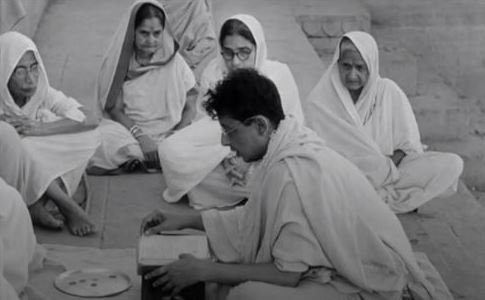
This instalment of the story of Apu begins a few years after the last scene of Pather Panchali. Apu (now Pinaki Sen Gupta) has now moved to Banaras, with his priest father Hori (Kanu Bannerjee) and mother Sarbojaya (Karuna Bannerjee). Hori goes to the riverside every day to deliver sermons to a group of Bengalis, most of them widows. He makes enough money for the little family to be just about comfortable, no more.

Continue reading

Pather Panchali (1955)

What can one write about a film about which so much has already been written? Dare one even attempt a review?

But since I did watch Pather Panchali  (‘Song of the Little Road’) recently,  and since it is such an iconic film, a review is in order.

Satyajit Ray’s debut film has been hailed as one of the hundred greatest films ever made, but its making was fraught with difficulty for Ray. Funds were hard to come by, since investors were unwilling to put their money into a film that had no major stars, no songs (though Ravi Shankar did compose the background music for Pather Panchali, a score which forms an important part of the film), and was so bleakly real. Pather Panchali eventually ended up being funded by the government of West Bengal, and took three years to make.

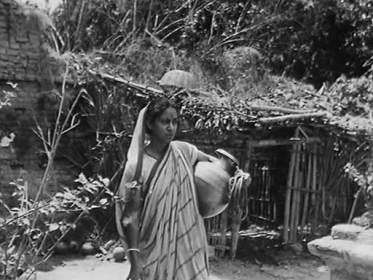
Based on the 1929 novel of the same name by Bibhutibhushan Bandyopadhyay, Pather Panchali begins in a small, sweet way which nevertheless manages to establish the main theme of the story: the poverty of Hori (Kanu Bannerjee) and his little family. Hori is a priest, a learned man, but he is constantly trying to make ends meet. He is not at home in this scene, where his wife Sarbojaya (Karuna Bannerjee) is doing her chores. Hori’s cousin, the elderly widow Indir Thakrun (Chunibala Devi, an octogenarian veteran actress whom Ray coaxed out of retirement to do this, her last role) also stays with the family.

Continue reading

Lukochuri (1958)

This film has been on my watchlist for a long time—many people, over the years, have recommended it to me as a good Bengali comedy—so when, on my ‘double roles’ post someone mentioned it, I decided it was high time I watched Lukochuri (‘Stealth’). I was a little sceptical; Kishore Kumar tends to go over the top when doing comedy, to the extent that I find him positively irritating in films like Half Ticket, Jhumroo, Naughty Boy, etc. But a Bengali film, I thought, might have a more sophisticated sense of humour? One could only hope.

The story starts in Jabalpur, where Kumar Chaudhury ‘Buddhoo’ (Kishore Kumar) is getting ready to leave for Bombay. Buddhoo works for a company which has transferred him to Bombay, and Buddhoo is bidding farewell to his father (Moni Chatterjee) and his Pishima (?), his father’s sister, who lives with them.

Continue reading