Lata Jagtiani’s Thank You, Guru Dutt! was released a few months back, to mark Guru Dutt’s birth centenary year. This is a book that follows on the heels of several other (well-acclaimed) books about Guru Dutt, his life and cinema: Nasreen Munni Kabir’s Guru Dutt: A Life in Cinema; Yasser Usman’s Guru Dutt: An Unfinished Story; and Ten Years with Guru Dutt: Abrar Alvi’s Journey, by Sathya Saran, among others. I will admit that I haven’t read any of the aforementioned books, so for me Jagtiani’s book was a first, in that sense.
Continue readingTag Archives: biography
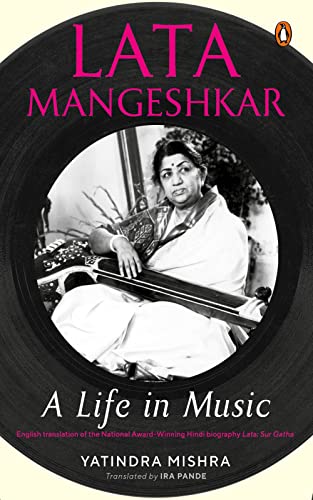
Book Review: Yatindra Mishra’s ‘Lata Mangeshkar: A Life in Music’
Over a period of about four years, from 2010 to 2014, Lata Mangeshkar was interviewed by the biographer Yatindra Mishra, the interviews coming together in the form of a Hindi book, Lata: Sur Gatha. The biography won a National Award, and was published in its English translation (Lata Mangeshkar: A Life in Music, translated by Ira Pande) earlier this year.
Continue readingBook Review: Amitava Nag’s ‘Soumitra Chatterjee: His Life in Cinema and Beyond’
For someone who didn’t know of Soumitra Chatterjee till fairly late in life, I fell under the actor’s spell pretty fast. Initially (as I mentioned in this review of another Soumitra Chatterjee biography) seeing him in Charulata, I liked him well enough to want to explore more of his work. I watched him then in various other films, and always, so far, with admiration. His versatility, the way he manages to mould himself to believably depict such different characters: exemplary acting.
So when another Soumitra Chatterjee biography—Amitava Nag’s Soumitra Chatterjee: His Life in Cinema and Beyond (Speaking Tiger Books, 2023)—came to me to read, I wasn’t averse to the idea. Perhaps Nag would have something different to say about the subject?
Continue readingBook Review: Nabendu Ghosh’s Dadamoni: The Life and Times of Ashok Kumar
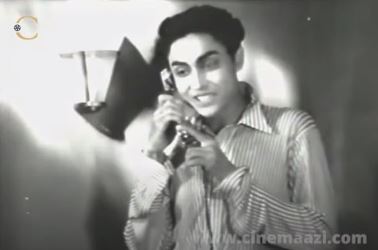
The 1936 Hindi film Jeevan Naiyya begins with a telephone conversation. An engaged couple, very much in love with each other, whispers sweet nothings on the phone. It’s all a bit awkward, and the young man in particular comes across as distinctly uncomfortable with all this koochie-kooing. This is not quite the mellifluous, effortless romance of a Jalte hain jiske liye, but it is, in its own way, a landmark scene. Because this is the very first onscreen appearance of a young actor who went on to become one of Hindi cinema’s biggest stars: Ashok Kumar Ganguly, better known simply as Ashok Kumar.
Continue readingBook Review: Vinod Mehta’s ‘Meena Kumari: The Classic Biography’
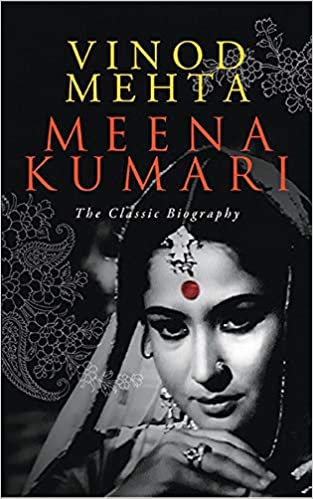
On 31st March, 1972, a Good Friday, Meena Kumari died, after a long and painful battle with cirrhosis of the liver. She had been admitted to St Elizabeth’s Nursing Home in Bombay on 28th March, and died three days later surrounded by the people who had played an important part in her life, both personal and professional. Her sisters Khursheed and Madhu; her estranged husband Kamal Amrohi; and various luminaries of the film world, including Begum Para and Kammo, from whose house the Aab-e-Zamzam (holy water from Mecca) was fetched to be spooned into Meena Kumari’s mouth as she was dying.
Over the next few days and weeks and months, Meena Kumari’s name dominated Hindi film news. Her magnum opus, Pakeezah, had just been released, having been 15 years in the making; Meena Kumari’s death served to make the film a success: thousands went to watch Pakeezah simply as a way of paying tribute to the much-loved actress. Praise was lavished on ‘India’s greatest tragedienne’ and there was much speculation about who, really, was responsible for her lifelong misery, and the alcoholism that had finally taken her life. People who had worked with her—co-actors, directors, and others—paid homage.
And Vinod Mehta, based on the success of a book he’d already written (not a biography) was asked if he would be up to writing Meena Kumari’s biography.
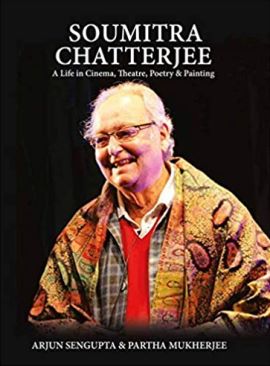
Continue readingBook Review: Arjun Sengupta and Partha Mukherjee’s ‘Soumitra Chatterjee: A Life in Cinema, Theatre, Poetry & Painting’
The first Soumitra Chatterjee film I saw was Charulata (1964). I had known of Soumitra Chatterjee before, had known even of his stature in Bengali cinema; but this film was my introduction to him. And what an introduction it proved to be.
Even now, several years down the line, I cannot claim to have done justice to Soumitra Chatterjee’s filmography, not even to his most famous phase of the fourteen films he did with Satyajit Ray. I have seen some films, of course, including Aranyer Din Ratri, Samapti (the third part of the Teen Kanya trilogy of short films), Kapurush and Sonar Kella from among Ray’s works, and a few by other directors, such as Barnali (which I watched a few weeks back, when Chatterjee passed away). My relative lack of familiarity with Chatterjee’s work made me a little nervous about reading his biography: I wondered if I would be able to understand all the nuances, whether it would not be too much for a Chatterjee-ignoramus like me.
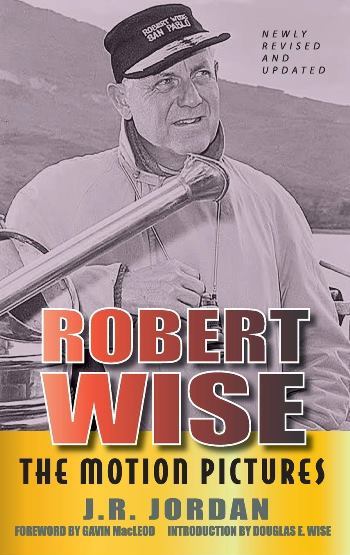
Book Review: JR Jordan’s ‘Robert Wise: The Motion Pictures’
Some weeks back, I received an e-mail from someone named Joe Jordan, who wanted to know if (since I had reviewed The Desert Rats), I would like to have a copy of his book about the film director Robert Wise.
I rarely turn down an offer of a book, unless it’s something that I absolutely know will not be my cup of tea. But a book about classic cinema? I said thank you to Joe, and waited for my copy of Robert Wise: The Motion Pictures.
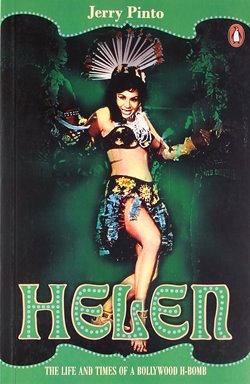
Book Review: Jerry Pinto’s ‘Helen: The Life and Times of a Bollywood H-Bomb’
I won’t go so far as to say that Helen was the first Hindi film actress I remember seeing (that would be Shakila, since CID was the first Hindi film I remember watching). But I distinctly remember being about 10 years old, watching Chitrahaar, and being very excited because an old favourite of mine, a song I had till then only heard and never seen, was going to come on (in Chitrahaar, there would always be a sort of intertitle between songs, a single frame in which the name of the next song, the film it was from, and the names of the music director, the lyricist, and the singer(s) would be listed).
This song was Mera naam Chin Chin Choo, and my feet were already tapping when it began. All that frenetic movement, those men in sailor suits dancing about. The energy, so electric that it even seemed to transmit itself to the musicians. The infectiousness of it all.
And Helen.
Book Review: HQ Chowdhury’s ‘Incomparable Sachin Dev Burman’
Book Review: Anirudha Bhattacharjee and Balaji Vittal’s ‘S D Burman: The Prince Musician’
When I began this blog, it was with the intention of reviewing films, and doing the occasional song list. I had never read a book on cinema, and had no real interest in doing so, either: my perception of the genre, so to say, was a world of sleaze: biographies laying bare lives about which I did not want to know the sordid details.
I am happy to say that, over the years, I’ve been proven wrong. I’ve read several biographies, of film personalities all the way from Balraj Sahni to Fearless Nadia, Mohammad Rafi to Kidar Sharma, Asha Bhonsle to Rajesh Khanna to Nasir Husain—and most have proven entertaining, informative, and definitely non-sleazy. A hat tip is due to biographers like Akshay Manwani, Sidharth Bhatia, Gautam Chintamani, and Jai Arjun Singh.
… and to Anirudha Bhattacharjee and Balaji Vittal, whose biography of RD Burman was the main reason I wanted to read this, their biography of Pancham’s illustrious (and, in my opinion, even greater than his son) father, S D Burman. S D Burman: The Prince Musician (Tranquebar, Westland Publications Private Limited, 2018; 344 pages; ₹799; ISBN 9789387578180) is an exhaustive detailing of the career of S D Burman, beginning from his days as a singer in Calcutta, till his death—while still far from having hung up his boots—in 1975.