Happy birthday, Manmohan Krishna.
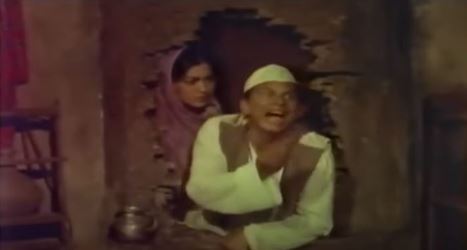
Today is the birth centenary of one of Hindi cinema’s best-known and most-loved character actors, the very versatile Manmohan Krishna of the beetling brows and the prominently curved lips, who could assay pretty much any kind of role film makers cared to throw his way. Usually slotted as the avuncular older gentleman—the now blind former taxi driver of Dil Tera Deewaana, the philosophical mendicant of Railway Platform, the saintly Abdul Rasheed of Dhool ka Phool, who brings up a foundling to be neither Hindu nor Musalmaan, but a human being—Manmohan Krishna did show, in the rare film where he was given a chance to act a rather less predictable character, that he was perfectly capable of that as well. He could be the evil Lalu Ustad in Sadhna; the wolf in sheep’s clothing in Bees Saal Baad, and the imperious daddy, disapproving of forbidden love, in many films.
Tag Archives: film review
An Inspector Calls (1954)
…at the home of the wealthy and respectable Birling family, just as they finish dinner.
The Birlings have been dining with a guest: Gerald Croft (Brian Worth) has just got engaged to the daughter of the house, Sheila Birling (Eileen Moore). Gerald has got her a wonderful ring, and there’s been much love and affection and congratulations being showered all around.
Continue readingNastik (1954)
A hundred years ago, on January 27, 1922, in Golconda (Hyderabad) was born Hamid Ali Khan, known to thousands of Hindi film viewers (and, even thousands more who have perhaps never watched any of his films) as Ajit. The man of ‘saara shahar mujhe loin ke naam se jaanta hai’. The iconic villain, suave and eerily soft-spoken though at the same time very oily and dangerous, of films like Zanjeer, Yaadon ki Baaraat, and Kalicharan. The baas of Raabert and Lilly (who was constantly being told not to be silly).
But long before he became the stuff of really bad jokes, before he attained the stature of one of Hindi cinema’s greatest onscreen villains, Ajit was a hero. Coming to Bombay in the face of parental opposition (having first sold his college books to finance the trip), Ajit had to struggle a lot to find work in the cinema industry. He began as an extra, and worked in several films until being noticed by the Gujarati-Hindi director Nanabhai Bhatt (Mahesh Bhatt’s father) who not only gave him the screen name Ajit, but also launched him in a leading role. Across the 50s and 60s, Ajit acted in a slew of films, both as leading man (Nastik, Dholak, Baradari, Marine Drive, Tower House, Opera House, etc) as well as in major supporting roles (of special note here are Naya Daur and Mughal-e-Azam, in both of which he appeared alongside Dilip Kumar).
Continue readingTo Sir, With Love (1967)
RIP, Sidney Poitier.
When I heard the news of Sidney Poitier’s death (on January 6th, 2022), one of the first thoughts that came to me was: what a sad coincidence, that the last English-language film I’d reviewed on this blog was one of his (The Bedford Incident). Then, the realization that, in so many years of blogging, while I’ve watched and/or reviewed several films of Poitier’s (including the wonderful Lilies of the Field, for which he won an Academy Award; The Long Ships; The Defiant Ones), I’ve never seen a few of his most iconic films, such as In The Heat of the Night, Guess Who’s Coming to Dinner, and A Raisin in The Sun.
I will watch those sometime, sooner or later; but for now, to commemorate the life and career of one of my favourite actors, I decided to rewatch a film I haven’t seen in several decades. The film that’s probably the one with which most Indians (at least) associate Poitier, about a school teacher who manages to change the lives of the disturbed and insecure students he has to teach.
Continue readingPalki (1967)
I have watched so many Hindi films from the 50s and 60s that now I am always on the lookout for ‘new’ old films that I haven’t watched. And if someone tells me a film isn’t half bad, I’m more than willing to give it a try. So, when blog reader Manuela mentioned Palki, and wrote this about it: “It’s 100% melodrama, and viewers who regard melodrama as sentimental candy floss for the uneducated will probably hate it. But if you consider melodrama as a legit form of storytelling, it’s very enjoyable.”… I bookmarked the film for watching there and then.
The film is set in Lucknow, to which we are introduced by way of a song. Poor but brilliant shaayar Naseem (Rajendra Kumar) serenades the city by singing Ae shahr-e-Lucknow tujhe mera salaam hai at a mushaira. Naseem is the toast of the town, and is soon to be feted at a mushaira hosted by a Nawab (Rehman). That will be a fine recognition of Naseem’s talent, says a friend, When he hears of this, Naseem’s neighbour and friend Sultan (Johnny Walker) agrees.
Continue readingThe Bedford Incident (1965)
In my younger days, I used to watch a lot of war films: not the newer, more gory and violent ones, but the older, not so graphic type. My favourites were adventure films like Where Eagles Dare, though somewhere down the line I also developed a liking for more nuanced films, films like Battleground or Paths of Glory or La Grande Guerra, which showed the harsh reality of war, of the horror it is to go into battle, to fight a war plotted out by people sitting in a conference room far away…
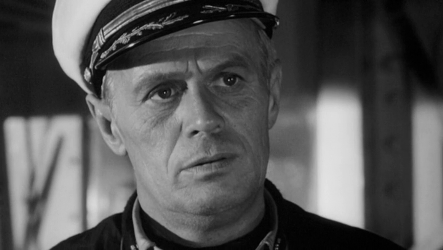
The Bedford Incident is different. The people sitting in a distant conference room are there all right, but the real problem here seems to be not them, but the man who commands the USS Bedford. Captain Eric Finlander (Richard Widmark) is a hard, embittered man who gives no quarter.
Continue readingAakhri Dao (1958)
This was one film where I had a tough time making up my mind: should I review it? Should I not? It’s not a great film, but it’s not absolutely abysmal either. And it has a luminously lovely Nutan, plus some superb songs (courtesy Madan Mohan and Majrooh Sultanpuri) to compensate for other drawbacks in the film. It’s also a film about a murder (as macabre as that may sound, always something that catches my attention).
If for nothing else, as an example of a film that could have been pretty good but ends up a damp squib, this, I decided, was worth reviewing.
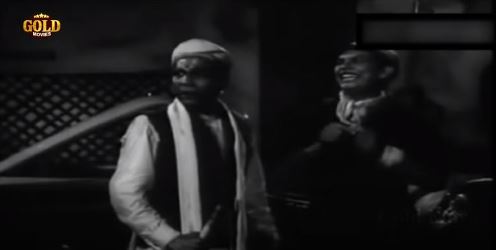
The story centres round Raj Kumar Saxena ‘Raju’ (Shekhar), a mechanic who works in a garage, and lives in a tiny room above the garage along with his friend and colleague Popat (Johnny Walker). Popat has been having a chat with a wealthy customer, Muthuswami Chetiyar (Mirajkar) and is keen on getting Muthuswami to invest in a garage for Popat. The incentive Popat offers is a match for Muthuswami’s daughter: Raju, he says, will be a fine bridegroom. Because he guesses Muthuswami will not be eager to marry his daughter to a mechanic, Popat takes care not to let on that the groom he has in mind is that figure hunched over a car at the other end of the garage…
Continue readingAuntie Mame (1958)
“Life is a banquet and most poor suckers are starving to death!” says the eponymous Auntie Mame (Rosalind Russell) on more than one occasion in this delightful film about an eccentric woman who is obliged to look after her orphaned nephew. Mame Dennis, indeed, is not one of the ‘poor suckers’ she so derides; this is a woman who lives life to the full (and a little beyond), grabbing happiness with both hands and not giving a damn, mostly, for what the world thinks.
Continue readingKalapi (1966)
A Gujarati film starring Sanjeev Kumar.
I am always keen to watch regional films starring people I’m familiar with from Hindi cinema. With (say) Bengali cinema, it’s not too difficult—so many Bengalis (Sharmila Tagore, Kishore Kumar, Biswajeet, Suchitra Sen, Mala Sinha, etc) were big names in Hindi cinema, and managed to do quite a bit of work in Bengali films too, many of which are subtitled. With Punjabi (which I understand enough of to be able to get the gist without having to rely on subtitles) it’s also satisfying, because Punjabi cinema seems to be pretty much completely populated by the same names one keeps running into in Hindi cinema: Nishi Kohli, IS Johar, Balraj Sahni, Prithviraj Kapoor, Indira Billi…
But to come to this: I stumbled upon Kalapi completely by accident, and immediately bookmarked it. Because a subtitled version is available on YouTube, here (though I must warn you, the subtitles are pretty bad), and because of Sanjeev Kumar, one of the greatest actors of Hindi cinema. Also, I am on an eternal quest to find old regional language films that are subtitled, and since I’d never watched a Gujarati film before, this would be a first for my blog.
Continue readingApradhi Kaun (1957)
The world of Hindi cinema is peppered with names that anyone familiar with the industry (at least the industry of the 50s and 60s) can quickly slot into categories. Star. Villain. Comedian. Character actor. There are many, many names that automatically fall into (almost exclusively) one of these categories. Those that have shifted from one category to another—like Pran, for instance, once the quintessential villain but in later years the more interesting ‘good man’, or Ajit and Premnath, both initially hero and later villain—have again usually not done too many shifts.
Abhi Bhattacharya is one of those relatively rare individuals who seem to have appeared in a wide variety of roles, a wide variety of films. He was the idealistic school teacher of Jagriti, the ‘other man’ of Anuradha. The kind-hearted, principled example of the bhadralok in films like Amar Prem, and the straying older brother of Dev Anand in Love Marriage. He played Krishna and Arjun and Vishnu (the latter in a slew of mythologicals). He even played the villain, in the Vinod Khanna-Yogita Bali starrer, Memsaab.
This year marks the birth centenary of Abhi Bhattacharya (as far as I’ve been able to find out, he was born in 1921, though I’ve not been able to discover exactly when in 1921). To commemorate his career, I wanted to watch a Bhattacharya film, but a dilemma presented itself: which one? Hindi or Bengali? (since Bhattacharya had what seems to have been a very successful career in Bengali cinema as well). Eventually, I homed in on this film, a rare whodunit in Hindi cinema that’s pretty well made too.
Continue reading