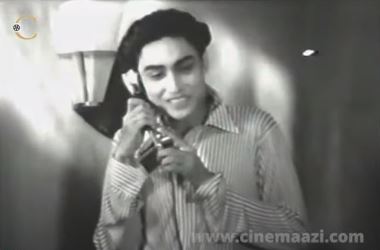
Our recent trip to Nainital prompted me (actually, even before we left on our trip) to read Gulshan Nanda’s novel Kati Patang. Gulshan Nanda, for those who may be unfamiliar with his work, wasn’t just a hugely successful writer of Hindi social-romantic popular fiction, but also a script writer for Hindi cinema: he wrote the scripts (many of them based on his own novels) of blockbusters like Saawan ki Ghata, Khilona, Kati Patang, and Jheel ke Us Paar. This insightful article about Nanda’s writing, as well as its adaptation to the big screen, is worth a read.
Continue readingTag Archives: film review
Detective Story (1951)
Today, June 26, 2022, marks the birth centenary of one of my favourite Hollywood actresses, the beautiful and very versatile Eleanor Parker. Born in Cedarville, Ohio, on June 26, 1922, Eleanor Parker had decided fairly early on that she wanted to become an actress; but despite being noticed and invited for screen tests several times, she turned them down in order to focus on stage performances, preferring to gather experience onstage before getting into films. Finally entering Hollywood with a debut role in Busses Roar (1942), Eleanor went on to work in a very wide and varied range of films over the next nearly 50 years.
Most people associate Eleanor Parker with her role in The Sound of Music: but the elegant, beautiful, scheming but eventually gracious Baroness was only a minor role in what was a blockbuster hit of a film (which, I think, was the main reason for Eleanor’s popularity in it). You only have to watch Eleanor Parker in films where she had bigger, meatier roles—as the wild gypsy in Scaramouche, or the woman who finds herself imprisoned in Caged, or the feisty and funny Mary Stuart Cherne, out to get her man in Many Rivers to Cross—to realize that she was so much more versatile than many of her contemporaries. Of course, she could (and did) swing the standard arm candy roles, as in The Naked Jungle or Escape from Fort Bravo, but she could also do justice to roles that required some hardcore acting skills.
Continue readingAnna Karenina (1948)
I have very, very vague memories of watching a Russian version of Anna Karenina years ago—it had been telecast on Doordarshan, with subtitles, and I, probably barely a teenager back then, understood very little of it.
But last year, having finally got around to reading Tolstoy’s novel, I decided I should find a cinematic adaptation to watch. Just to see how a screenwriter might interpret this pretty sprawling work (not as sprawling as War and Peace, but still). I read, in several places, that at least as far as English-language cinema is concerned, the 1935 Anna Karenina, starring Greta Garbo, was considered the best version there is. Despite much searching online, I couldn’t find a copy of it (the ones that were there were dubbed in other languages), but I did find this one, made thirteen years later and starring Vivien Leigh as Anna.
Continue readingLukochuri (1958)
This film has been on my watchlist for a long time—many people, over the years, have recommended it to me as a good Bengali comedy—so when, on my ‘double roles’ post someone mentioned it, I decided it was high time I watched Lukochuri (‘Stealth’). I was a little sceptical; Kishore Kumar tends to go over the top when doing comedy, to the extent that I find him positively irritating in films like Half Ticket, Jhumroo, Naughty Boy, etc. But a Bengali film, I thought, might have a more sophisticated sense of humour? One could only hope.
The story starts in Jabalpur, where Kumar Chaudhury ‘Buddhoo’ (Kishore Kumar) is getting ready to leave for Bombay. Buddhoo works for a company which has transferred him to Bombay, and Buddhoo is bidding farewell to his father (Moni Chatterjee) and his Pishima (?), his father’s sister, who lives with them.
Continue readingPehla Aadmi (1950)
Today is the birth centenary of one of Hindi cinema’s most familiar character actors, the very well-known Nasir Hussain (or Nazir Hussain, or Nazir Hussein, or Nazir/Nasir Husein, whatever; Hindi cinema credits are famous for being inconsistent). Not the same man as the film maker of the same name, but an important personality in his own right. Born in Usia (Uttar Pradesh) on May 15, 1922, Nasir Hussain came to cinema in a roundabout sort of way. Having worked briefly in the railways (where his father too was employed), Nasir had ended up joining the British Army, and was posted overseas—in Malaya—during World War II. Taken captive, he was freed and subsequently went oj to join Subhash Chandra Bose’s Indian National Army, the INA.
After his INA experience, Hussain could not find an alternate career and wound up doing bit parts in theatre. From here, a chance meeting with Bimal Roy finally brought him into cinema. Their very first film together (they were to go on to make several more films, with Nasir Hussain in front of the camera and Roy behind, such as Parakh, Do Bigha Zameen, and Devdas) was this one: Pehla Aadmi, in which Nasir Hussain was not just an actor, but also assistant to the director—as well as the writer of the story and the dialogues.
Continue readingWahan (1937)
Aka Beyond the Horizon.
When I began this blog, it was with the intention of indulging in my love for old cinema. While that has remained the main objective of my writing here, I’ve added to it a desire to make this a means of documenting old cinema (especially Hindi cinema) too. Not all old cinema, since that would be too mammoth a task for one person to take up; but films that I think are worth documenting, in particular if they seem to be otherwise obscure now. Films that are landmarks in Hindi cinema history; films that were somewhat different, perhaps, from the usual.
Or, as in this case, films that allow us a glimpse of familiar faces that we know from another, later, period. Leela Chitnis, the perennially poverty-stricken and very distressed mother of 60s cinema, stars in Wahan as an Aryan princess, and Ulhas, the well-known character actor of the 50s and 60s, appears in his debut role as her fiancé.
Do Phool (1958)
I have watched hundreds of Hindi films. Many of these I’ve reviewed here on this blog, and for many of those, I’ve had readers mention that so-and-so film was actually a remake of so-and-so Hollywood film, or was inspired from this novel or that play. In some, of course, I’ve been able to spot a source immediately: the grand mansion being run as a hotel by its manager who then forces the owner to pretend to be a guest is lifted from Come September and used—without any credit for the original idea—in both Kashmir ki Kali and Mere Sanam. Adalat is a remake of Madame X; Aradhana of To Each His Own; Gumnaam of And Then There Were None… all uncredited. And umpteen others.
This is something I find very irritating. The amount of work that goes into coming up with a good plot is substantial, and if you’re acknowledging that by thinking it worthy of being copied, then you should certainly think it worthy enough to pay for. But by calmly hogging all the credit and assuming that Indian audiences won’t cotton on to this plagiarism, and Hollywood (or foreign writers), too far from the world of Hindi cinema, will be oblivious.
Anyway, that’s a long, convoluted and messy topic, which I should probably leave for later. For now, the reason why all of that came to my mind: because this film does give credit where it’s due. Not, unfortunately, to the writer of the book (Johanna Spyri), but at least to the book itself.
Continue readingThree Men in a Boat (1956)
Today is World Book Day, so it seemed appropriate to post something related to books: a review of a film based on one of my favourite books.
I must have read Jerome K Jerome’s Three Men in a Boat when I was in my early teens. A not-quite-story of three men who go down the Thames in a boat, along with their dog. Many descriptions of the countryside, of sights to see and places to visit. Several reminiscences of various events and incidents that aren’t even part of this trip. No romances (and yes, I must admit to having been a fairly typical teenage girl in being quite addicted to romances). Three Men in a Boat, seen only from that limited point of view, would not have sounded like a novel that would appeal to me.
But it did. And how. I laughed my way through all the adventures, the madness, the utterly hilarious trip that this was. Jerome K Jerome (who, by the way, was amazingly versatile, writing very well in various genres, including horror) brought to Three Men in a Boat a humour that I find irresistible. He’s very witty, of course, but what makes that humour even more brilliant for me is the fact that it’s so relatable. The circumstances, the incidents, the dialogues: all could have happened to one of us; what makes Jerome so hilarious is that he manages to exaggerate the nuttiness just that wee bit that turns it utterly hilarious. Something as simple as what happens when two men try to put up a tent in pouring rain; or when they get together to pack for a trip…
How would that translate into a film? I have always been a little sceptical, since much of the humour of Three Men in a Boat lies in Jerome’s language, in the brilliant way he looks at everyday incidents through that deliciously witty lens of his. The story itself is bare of a plot of any sort.
Continue readingThe Man Who Knew Too Much (1956)
I knew something connected to Doris Day long before I had even heard of her. When I was about six years old, my mother used to sing Que sera sera to me, and that song became such a favourite of mine that I ended up writing down the lyrics (misspelt, I admit: Kay sera sera is what I recall having written) and belting them out, night and day.
It was only many years later that I finally watched Alfred Hitchcock’s The Man Who Knew Too Much, and got to see Doris Day sing that song onscreen, in a tense, nail-biting climax that both highlighted Doris Day’s singing ability as well as her acting prowess. By the time I watched this film, I had already seen Doris in other, more light-hearted roles, the sort of films (mostly musicals or screwball comedies, including the delightful ones which she did with good friend Rock Hudson) where she lit up the screen with the sheer joy of her presence. I had heard Wham! sing “… You make the sun shine brighter than Doris Day…” I had listened to plenty of songs Doris Day had sung, and I had fallen in love with the vivacity and good humour Doris seemed to radiate.
Continue readingSadhu aur Shaitan (1968)
Cinema looking at itself is not an uncommon feature; there have been several notable films, both in India (Kaagaz ke Phool, Sone ki Chidiya) as well as abroad (Cinema Paradiso, 8½, The Bad and the Beautiful, etc), which are about cinema and film-making. But this film, relatively obscure, really should be part of the annals, simply because of its sheer devotion to Hindi cinema. Not because it’s about film-making, not because there is even (as in Solvaan Saal), a single scene on the sets of a film. But because it celebrates Hindi cinema in so many ways, on so many levels.
Sadhu aur Shaitan begins by introducing us to the eponymous ‘sadhu’ of the story: Sadhuram (Om Prakash), a widower who lives with his two children Ganesh (Master Shahid) and Munni (Baby Fauzia), and the maid Ramdeyi (Dulari) who looks after home and the children. Sadhuram is a somewhat excessively ‘good and righteous’ man, the living image of piety (all a little over the top as far as I’m concerned, but at least he isn’t stuffy about his righteousness).
Continue reading