Ten of my favourite Nalini Jaywant songs

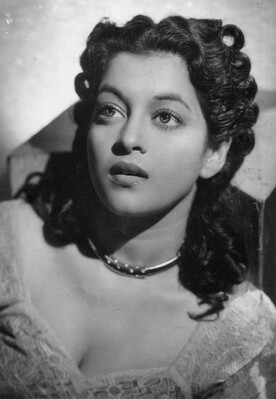
Nalini Jaywant is one of those actresses about whom I’ve changed my opinion over the course of my watching of her films. I remember, as a child (which includes my early teens, which was a peak period when it came to Hindi film viewing), not especially liking her. I was a callow youngster, and as shallow as I was callow. To me women like Madhubala or Meena Kumari were the ultimate in beauty: Nalini Jaywant, with her heavy-lidded eyes and her pouting mouth, didn’t strike me as beautiful. Also, even if I put aside the purely superficial aspect of her looks, there was the fact that I didn’t think her a good actress. I found her voice affected and thin, nothing to write home about.

Thank goodness I grew up. Grew up, widened my horizons, and realized that there are different kinds of beauty. Realized, too, that one shouldn’t pass judgment on the worth of an actor without having watched a wide-ish spectrum of their work. Nalini Jaywant, when I had watched Munimji, seemed just another effervescent filmi female, no more than arm candy; it was through Shikast and Kaala Paani, through Hum Sab Chor Hain and Railway Platform (and many more), that I discovered just how versatile she could be. Goofy, flirtatious, tragic, long-suffering, feisty… Nalini Jaywant aced so many roles, brought so many of her characters vividly to life.
Continue reading

Somewhat Cross-dressed Women ‘Romancing’ Women in Performances: Ten Songs

The title of this post will probably require some explanation before I launch into the list itself.

Several years back, I did a post on female duets. Commenting on that, fellow blogger and blog reader Carla wondered about the rationale or thought behind songs like Reshmi salwar kurta jaali ka, where a dance performance featuring two women dancers has one woman dressed as a man, supposedly romancing the other (who’s dressed as a woman). I had no explanation to offer, and over the years, while I’ve mulled over this plenty of times, I’ve still not figured out why this became popular.

You know the type of song: there’s a fairly conventional love song, often teasing and playful, being sung—and the two people onscreen, while both women, are dressed as man and woman. The woman dressed as a man isn’t (unlike Geeta Bali in Rangeen Raatein), however, actually pretending to be a man: it’s very obvious that she is a woman, and that she’s supposed to be a woman (even the playback singer is a woman).

Continue reading

Ten of my favourite C Ramachandra songs

…specifically, songs which he composed, not just songs he sang (since C Ramachandra also lent his voice to some of his best songs).

Chitalkar Ramachandra was born 97 years ago—on January 12, 1918, in the town of Puntamba in Maharashtra. Although he’d studied music, it was as an actor that C Ramachandra joined the film industry—he debuted in a lead role in a film called Nagananda. This didn’t continue for long, though; he eventually shifted to composing songs, first for Tamil cinema, and then for Hindi. And he came like a breath of fresh air to Hindi film music: in a period dominated by classical tunes composed by the likes of Naushad, Anil Biswas and Pankaj Mullick, C Ramachandra had the guts to bring in music with distinctly Western rhythms, what with hits like Aana meri jaan Sunday ke Sunday and Mere piya gaye Rangoon. And he was brilliantly versatile: as the following selection will (hopefully) show, he could compose just about everything from peppy club songs to lullabies to ghazals (if one can expect a particular style of music for a ghazal) and lilting love songs.

Chitalkar Ramachandra, b January 12 Continue reading

Ten of my favourite ‘inspired’ songs

I’d been toying with the idea of this list for a while, and memsaab’s recent post on Bhoot Bungla reminded me of it, what with Aao twist karein and its very obvious resemblance to Come on let’s twist again.

I am—and my family and friends know this by now—absolutely and completely enamoured of old Hindi film music. Especially of the 50’s and 60’s. What singers we had! What lyricists! What music directors! What inspiration! The songs were often derived, in small part or large, from a wide range of sources: folk music, classical ragas, Western music, even the rhythmic hoofbeats of a cantering horse. Sometimes the inspiration wasn’t too obvious, or the end result was such a change from the original, it was hard not to give credit to the music director. Other songs were shameless ‘lifts’ from originals.
So here goes: my favourite ‘inspired’ songs, all from 50’s and 60’s films that I’ve seen. And to make the scope more manageable for myself: tunes that were originally Western. These are in no particular order.

Continue reading