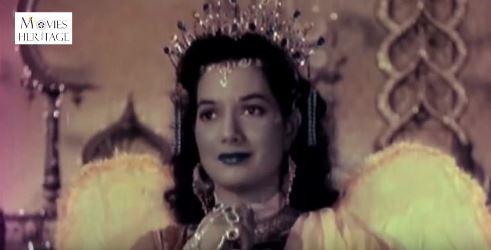
Chaar Darvesh (1964)

YouTube suggested this film to me, and for a few days, I was torn. Should I watch it (Feroz Khan is not a favourite of mine, though I don’t find him as irritating as some others), or should I not? Sayeeda Khan, after all, is someone I’ve wanted to watch, mostly because I was intrigued—she was married to film director/producer Brij Sadanah, and was murdered by him on their son’s eleventh birthday party (Sadanah also shot and killed their daughter, before committing suicide). Yes, macabre (not to mention tragic), but that’s how it is.

Eventually, it was the music—by the very talented but vastly underrated GS Kohli—that tipped the scales in favour of my watching Chaar Darvesh. Kohli, who did a lot of work as assistant to OP Nayyar (and it shows, in the rhythms and styles of much of his work), composed music on his own for several B-grade films, of which among the best-known are Shikari (1963; easily his magnum opus, with one great song after another) and Chaar Darvesh. Even if just for the music, I wanted to watch this film.

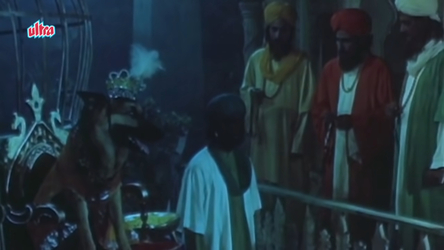
The story is set in some fictitious fantasy kingdom somewhere in the Middle East. At a shrine, three bearded darveshes, clad in flowing robes, have gathered to pray for boons. One is seeking a treasure [that sounds a little shallow, for a darvesh]; another is searching for his sweetheart, who’s gone missing.

These three men have learnt, though, that their wishes will only be granted once they have been joined by a fourth darvesh… who, thank heavens, arrives soon after. This is Qamar (Feroz Khan in blackface), and he proceeds to tell them his tale of woe and to explain how he happens to have turned so black.
Continue reading

Lal-e-Yaman (1933)

Aka Parviz-Parizaad.

I had heard of Lal-e-Yaman (literally, ‘Rubies of Yemen’, though why it’s so named, I couldn’t tell) before, but it wasn’t until I read Manek Premchand’s Director’s Chair: Hindi Cinema’s Golden Age some weeks back that I was reminded of it: it appeared in JBH Wadia’s filmography, being the first film he produced and directed, along with his brother Homi Wadia. Premchand described Lal-e-Yaman as an ‘Arabian Nights kind of adventure’, and that piqued my interest.

The story is not explicitly set in Yemen, though it’s probably someplace in the Middle East. The King (Jal Khambatta) of a kingdom has recently remarried after having been widowed. He has a ten-year old son, Parviz (?) from his first wife; now the second wife (Mohini) is sitting beside him when a dervish arrives. This man prophesies that the new queen will wreak havoc, that the king will be much plagued because of her.

Continue reading

Zabak (1961)

Zabak is a film I’ve been wanting to watch for a while, mostly for Shyama. I like Shyama a lot, and as far as I know, this is one of the rare colour films in which she acted as a lead. Plus, given my penchant for raja-rani films, I thought this might be worth a try.

Zabak (Mahipal) is the son of a healer and hamaam owner named Hassan Shah Isfahani (?). Hassan Shah is much acclaimed as a man who knows his medicine, and everybody around, from the Haakim (the Lord) of Isfahan to the man in the street, comes to him for relief from a variety of ailments. Zabak is a happy-go-lucky sort, spending his time joking around town, and romancing Zainab (Shyama), the daughter of the Lord of Isfahan.

Continue reading

Hatim Tai (1956)

RIP, Shakila.

Yes, this post is a little late as a tribute to one of Hindi cinema’s loveliest actresses—Shakila passed away, aged 82, on September 21—but that was because I was travelling. I heard the news, was saddened and upset, and vowed that as soon as I got back, I’d post something about Shakila. Not a songs list, because I’d already done that. A review of one of her more popular films, then, I decided.

Continue reading

Book Review: Dorothee Wenner’s ‘Fearless Nadia: The True Story of Bollywood’s Original Stunt Queen’

I don’t recall exactly when I realized who the Hunterwali really was. Myth, fictional character, movie character: I had no idea, but—even as a child—I had vague memories of references to a feisty woman who went about cracking a whip (thus, ‘Hunterwali’—the ‘woman with the whip’). A particularly fearless, sharp-tongued woman would jokingly be referred to as Hunterwali, and I always thought it was a generic appellation. Not something derived from cinema, at any rate.

This, mind you, well into the 80s.

Then, somewhere down the line, I discovered the truth: that Hunterwali was a blockbuster hit film from the 30s, starring an actress named Fearless Nadia. The visual—I think it was a grainy photo in an old magazine or newspaper—was enough to explode all my ideas of what old Hindi film heroines (till then, for me, always sari-clad and melodramatic) were supposed to be. This one wore shorts and a clingy top. Her boots were no-nonsense ones, she wielded a whip and she generally looked super badass.

And she was blonde.

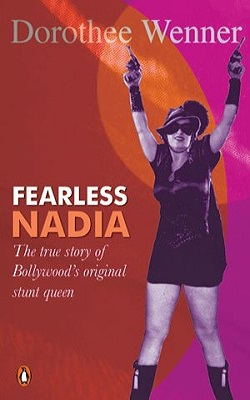
Dorothee Wenner's biography of Fearless Nadia

Continue reading