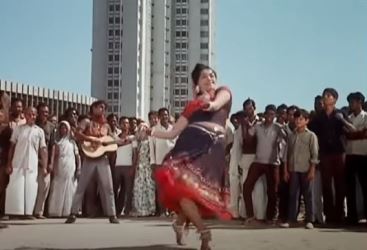
Aar-Paar (1954)

I saw this on the big screen, on August 10, 2025.

Given that getting to see a Hindi film as old as this on the big screen, as a proper commercial release (re-release, in this case), is a very rare treat, it needs to be put up front.

To mark the birth centenary of Guru Dutt, the National Films Division Corporation of India (NFDC) and the National Film Archive of India (NFAI) collaborated to restore and re-release several of Guru Dutt’s films. These were shown at PVR and Cinépolis cinema halls across India on August 8th through to 10th. Left to myself, I would happily have seen all the films that were being screened; but duty calls. August 9th was rakshabandhan, and we had family coming over for lunch. I was busy all through the previous day cleaning and cooking and generally preparing, and then again through half of the next day. But, once our guests had eaten, I scurried off cinema-wards to watch Sahib Biwi aur Ghulam. The following day, I managed to watch Aar-Paar.

Continue reading

Book Review: Nabendu Ghosh’s Dadamoni: The Life and Times of Ashok Kumar

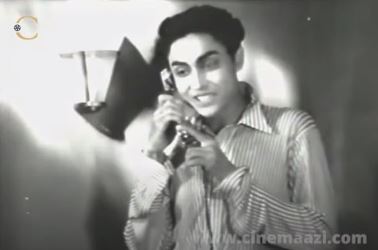
The 1936 Hindi film Jeevan Naiyya begins with a telephone conversation. An engaged couple, very much in love with each other, whispers sweet nothings on the phone. It’s all a bit awkward, and the young man in particular comes across as distinctly uncomfortable with all this koochie-kooing. This is not quite the mellifluous, effortless romance of a Jalte hain jiske liye, but it is, in its own way, a landmark scene. Because this is the very first onscreen appearance of a young actor who went on to become one of Hindi cinema’s biggest stars: Ashok Kumar Ganguly, better known simply as Ashok Kumar.

Continue reading

Chanda aur Bijli (1969)

Chanda aur Bijli is one of those films I’ve known about for a long time—because of a family anecdote that is centred around a song from this film. My sister, a toddler when Chanda aur Bijli was released, quickly fell in love with Bijli hoon main toh bijli. Her version of it, though, was somewhat different (and suggests a mind that dwelt rather heavily on food):

Bijli hoon main toh bijli
Bun khaake jab bhi nikli
Logon ke dil mein machhli
(And here she’d add a little line completely off her own bat: ‘Wohi machhli jo Baby ne khaayi thhi!’)

For those who don’t understand Hindi, that means:

Lightning; I am lightning,
When I went out after eating a bun,
There was a fish in people’s hearts
That same fish that Baby ate!

The original, of course, is a rather more predictable Hindi film song:

Bijli hoon main toh bijli
Bal khaake jab bhi nikli
Logon ke dil mein machli

(Lightning; I am lightning,
Every time I went out, tripping along,
I made people’s hearts trip)

Continue reading