Chhoomantar (1956)

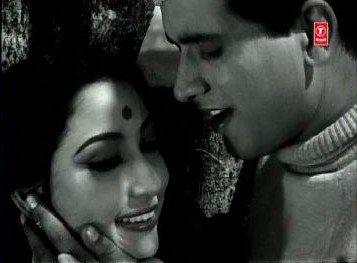
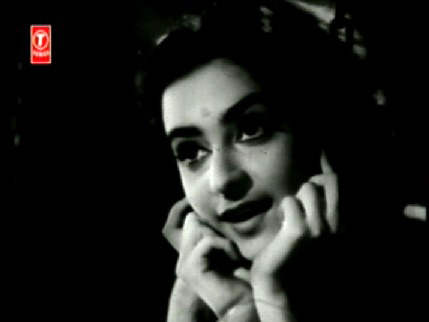
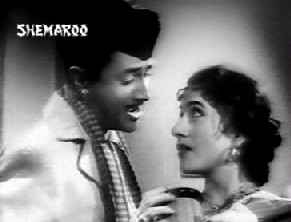
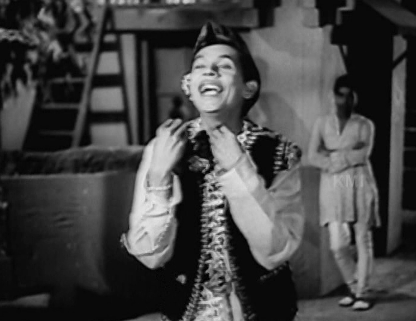
Unlike Madhumati and Aar Paar, where he was just a supporting actor (though, in my opinion, his contribution to both films far surpassed the actual screen time of the characters he played), in Chhoomantar Johhny Walker is not just the funny man, but also the hero. He gets to sing and dance (the latter even in drag!). He gets to woo a pretty heroine, be brother to another lovely lady, and he gets to kick some serious ass.
Continue reading

Kanoon (1960)

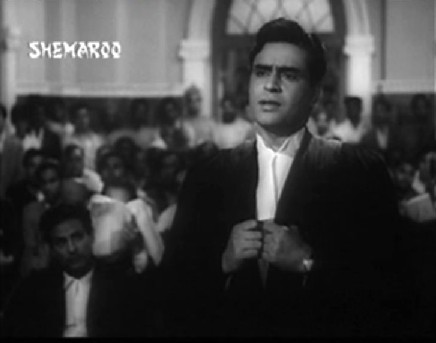
9 years before he made the superb suspense thriller Ittefaq, B R Chopra produced and directed this film. It too starred Nanda (though not in as pivotal a role as in Ittefaq). It too didn’t have a single song—though it did have a ballet performance. And, like Ittefaq, it hinged on a murder.
But Kanoon wasn’t by any means a precursor to Ittefaq. Ittefaq is mainstream murder mystery; Kanoon straddles with consummate skill the line between crime detection and social issues. It’s an excellent, unusual and gripping film that merits viewing.

Continue reading

Pyaar Kiye Jaa (1966)

I’d planned to watch (and review) something quite different this week, but when Beth announced Shashi Fest, I couldn’t resist the temptation to participate. That resolve was strengthened when I realised that in a year and a half of blogging about cinema, I’ve never once reviewed a Shashi Kapoor starrer. For shame! This, therefore: a farcical and fun film that never lets itself slip into seriousness. It features some of Hindi comedy’s greatest stalwarts, has superb music, and—of course—stars Shashi Kapoor, showing how good he is at comedy.

Continue reading

Rail ka Dibba (1953)

I’m doing something I’ve never done on this blog before. I’m offering a free gift for anyone who cares for it: a VCD, once viewed, of Rail ka Dibba. I’ll ship it anywhere in India and you won’t need to pay a paisa for it.
Now, why I’m doing this. First, the preliminaries: it’s a Friends VCD, and we all know what that means. Their logo takes up much of the screen. The print is bad, the sound quality even worse. And their evil villain editor seems to have chewed up frames, scenes, dialogues—everything—in an attempt to fit the film onto two CDs. And though it’s not a really bad film, Rail ka Dibba left me feeling pretty certain that I won’t be watching it again. Anybody who wants it is welcome to it.

Continue reading

Hariyali aur Raasta (1962)

My guardian angel in charge of film viewing seems to think I’m in serious need of improvement. Which is probably why I’m finding myself subjected to a series of films centred round the difference between good women and bad women. That Touch of Mink tried to touch on it in a humorous way; Bhabhi was more blunt (are sledge hammers blunt?); and Hariyali aur Raasta, though not quite as in-your-face as Bhabhi, had very much the same message: good women choose honour, family and home over all else.

Manoj Kumar and Mala Sinha in Hariyali aur Raasta

Continue reading

Bhabhi (1957)

I made such a mistake doing a Westward the Women post for International Women’s Day. Granted, it’s a good film, and highly recommended—but does it really teach a woman anything substantial? Knowing how to harness a mule or drive a wagon isn’t all there is to life. So here’s compensation: a film replete with lessons for women (and men, too). There are do’s and don’ts for just about any situation in life, including—though never stated—filmmaking.

Pandari Bai in Bhabhi

Continue reading

Shaadi (1962)

Shaadi isn’t one of the better films I’ve seen in recent times. In fact, it had some definitely irritating moments, and it called for more suspension of disbelief than is generally expected in Hindi films. On the other hand, it had quite a cast: Saira Banu, Manoj Kumar, Dharmendra, Indrani Mukherjee, Balraj Sahni, Om Prakash, Manorama, and others. Even more interestingly, it was Saira Banu’s second film and one of Dharmendra’s first few films. Overall bearable, especially since I didn’t have anything better to do.

Saira Banu in Shaadi

Continue reading

Jaali Note (1960)

Having watched countless Hindi films, I’ve reached the conclusion that the bulk of 50’s and 60’s cinema wouldn’t have been possible without a few stock plot elements. One of these is Divine Intervention (DI); another’s the Mysterious Motive (MM); and yet another—a popular one, this—is Just For A Song (JFAS), when the whole point of a plot element is to bring in a song.

Shakti Samanta’s Jaali Note is replete with DI, MM and JFAS. I don’t really mind this in films, as long as there’s more. Unfortunately, this is where Jaali Note falls flat on its face; there is almost nothing else. Madhubala, looking lovely, and Dev Anand disguised in a thin moustache, but that’s it.

Dev Anand and Madhubala in Jaali Note

Continue reading