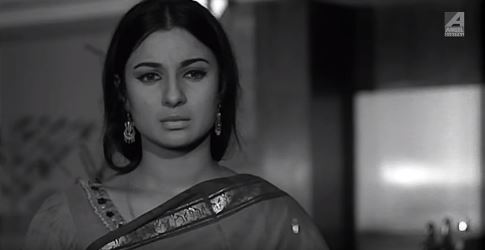
Ekti Raat (1956)

This, actually, was not the film review I was intending to post this week. But then, over the weekend gone by, I met Moon Moon Sen, and I was reminded (of course I would be!) of her mother, Suchitra Sen.

I was in Dehradun on October 11 and 12, attending an arts and literature festival. The guest of honour was Moon Moon Sen, still beautiful, and with a serene calmness to her that was—as someone mentioned—very ‘peaceful’ (to which Ms Sen replied that she has a horrible temper!) Moon Moon Sen was mostly involved in graciously felicitating those who participated in panel discussions and so on; I was thrilled to have her place a scarf around my neck. But the last session of the festival was a conversation with her, and it was very interesting. She answered questions about herself, of course, but also about her mother (“always, ‘Madam’, never ‘Mrs Sen’ or ‘Suchitra’” she recalled). Not just a star, but a mother (“I only knew her as Mummy”), and one whom young Moon Moon was obviously very protective about: she said she shielded her mother when Suchitra Sen had to make her way through a crowd. She had no qualms even about punching anyone who tried to get fresh with her Mummy.

I remembered, then, that I had a Suchitra Sen film review ready to be published. Here it is, a light-hearted comedy, directed by Chitta Bose, based on a story by Balaichand Mukherjee ‘Banaphool’ and with a screenplay by Nipendrakrishna Chatterjee.

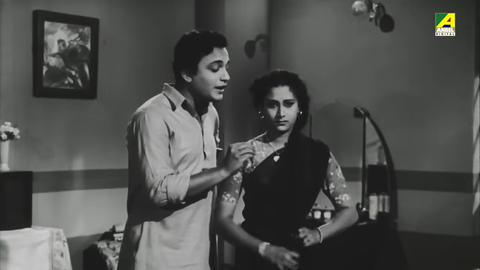
The story begins in the Calcutta home of Shushubhon Dutta (Uttam Kumar) and his wife Anita (Sabita Chatterjee), who have been married a few months. The two are constantly bickering, and we see them in the middle of an argument even as the film starts. Anita is hot-tempered, Shushubhon likes to needle her.
Continue reading

Deya Neya (1963)

In English, ‘Give and Take’.

I read a review of this Uttam Kumar-Tanuja starrer many years ago, and, ever since, I’ve been wanting to watch Deya Neya. All this time, I had never been able to get a subtitled version of it, but now there’s one (thank you, Angel), and I wasted no time in watching it.

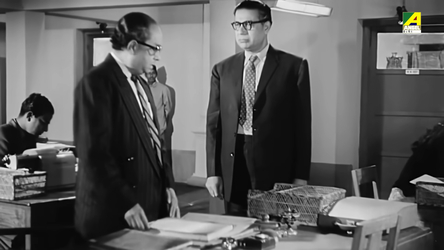
The story begins in Lucknow, where Proshanto Roy (Uttam Kumar) lives with his parents: his very successful and wealthy industrialist father BK Roy (Kamal Mitra) and doting mother (Chhaya Devi). Mr Roy has Proshanto working at the office, doing accounts; but Proshanto is never to be found at work, and it riles his father up no end.

Continue reading

Pehla Aadmi (1950)

Today is the birth centenary of one of Hindi cinema’s most familiar character actors, the very well-known Nasir Hussain (or Nazir Hussain, or Nazir Hussein, or Nazir/Nasir Husein, whatever; Hindi cinema credits are famous for being inconsistent). Not the same man as the film maker of the same name, but an important personality in his own right. Born in Usia (Uttar Pradesh) on May 15, 1922, Nasir Hussain came to cinema in a roundabout sort of way. Having worked briefly in the railways (where his father too was employed), Nasir had ended up joining the British Army, and was posted overseas—in Malaya—during World War II. Taken captive, he was freed and subsequently went oj to join Subhash Chandra Bose’s Indian National Army, the INA.

After his INA experience, Hussain could not find an alternate career and wound up doing bit parts in theatre. From here, a chance meeting with Bimal Roy finally brought him into cinema. Their very first film together (they were to go on to make several more films, with Nasir Hussain in front of the camera and Roy behind, such as Parakh, Do Bigha Zameen, and Devdas) was this one: Pehla Aadmi, in which Nasir Hussain was not just an actor, but also assistant to the director—as well as the writer of the story and the dialogues.

Continue reading

Rajkumari (1970)

Here is the answer to the question I set a couple of days back. What do Aapke kamre mein koi rehta hai, Yeh jawaani hai deewaani, Pyaar deewaana hota hai and Yeh kya hua have in common, I had asked (besides the obvious: that Kishore had sung all four, and RD Burman had composed all four). Some people got the answer correct, and some came close to guessing. Yes, these songs were all copied by Burman from tunes he had composed for one film. That was a Bengali film named Rajkumari, released in 1970.

Rajkumari, starring Tanuja as the eponymous princess, is a film I came across thanks to friend and erstwhile fellow blogger, Harvey. Some weeks back, Harvey shared a link to one of the songs of Rajkumari (more about these songs, later). I liked it so much that I made up my mind I had to see it. And it turned out to be quite entertaining.

Continue reading

Sagarika (1956)

Every now and then, when I’ve reviewed a Hindi film (Mamta, Sahib Bibi aur Ghulam, Kabuliwaalah, Khamoshi) or even mentioned one (Devdas, Chori Chori), someone or the other has popped up and either informed me (or reminded me) that this film was originally made in Bengali.

It was a little different with Sagarika. This film nobody told me about. I happened to be trawling IMDB checking out the synopses of all of Suchitra Sen and Uttam Kumar’s films, and realized—even as I read the plot of Sagarika—that this was exactly the same story as one of my favourite Hindi films, Bimal Roy’s lovely Prem Patra. Could I resist the temptation to watch it? No.

Uttam Kumar and Suchitra Sen in Sagarika Continue reading

Deep Jwele Jaai (1959)

It’s sad that, over the past year or so, barely a month has passed without my having to post a tribute to yet another film personality who’s passed on. Last month, with Eleanor Parker, Joan Fontaine and Peter O’Toole passing away within days of each other, I thought it couldn’t get worse. And I hoped that 2014 would be better.

But, alas. We say goodbye to yet another luminary of the film world. This time, the beautiful and very talented (not to mention wildly popular) Suchitra Sen (April 6, 1931-January 17, 2014), who made a mark in Hindi cinema even in the few films she acted in (Bombai ka Babu, Devdas, Mamta and Aandhi being the best-known), but ruled Bengali cinema.

Suchitra Sen Continue reading