The Odd Couple (1968)

RIP, Neil Simon.

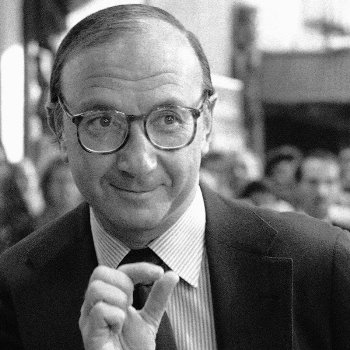
I read about the death of Neil Simon, playwright and scriptwriter (among other roles—including producer and director) on August 26th, admittedly with some level of blankness. The name sounded familiar (or was I simply mixing him up with Neil Diamond?) but I couldn’t, without help, associate Neil Simon with any film.

Continue reading

La Femme du Boulanger (1938)

Or, in English, The Baker’s Wife.

Recently, across a period of about three months, I’ve had to watch a slew of films from across the world (for an article I needed to research). While making my way through films from the US, Brazil, Spain, France, Mexico, Japan, China, Taiwan, Vietnam… and of course, closer home, Hindi cinema—it came home to me rather forcibly just how much of a gap there often is (and has been, for many years) between Hollywood and much of the rest of the world.

The Hays Code, applied to Hollywood productions between 1930 and 1968, imposed restrictions on the scenes shown—the sex, the violence, etc—as well as the language, the themes, the messages and more. But even later, after the Hays Code was no longer applicable, I’ve realized how much more tame Hollywood is when compared to other cinema (for instance, from France, Spain, or Mexico, to name just three countries, recently-watched films of which were far removed from what Hollywood would make). Hollywood’s risqué is often tame for Europe. (And Indian cinema, across regions, seems to faithfully follow Hollywood in this matter, though it’s much tamer even than Hollywood).

Anyway, on to one of the films that highlighted this point for me. La Femme du Boulanger is a French film about a middle-aged baker who sets up a bakery and patisserie in a sleepy village in the French countryside, along with his pretty wife to help him out—and within a couple of days, the wife has run off with a local buck. In Hollywood, this would have been probably treated quite seriously; in France, it becomes more a comedy than anything else. All anybody is really worried about is that their baker has gone off his desire to bake, so they’re not getting bread any more…

Continue reading

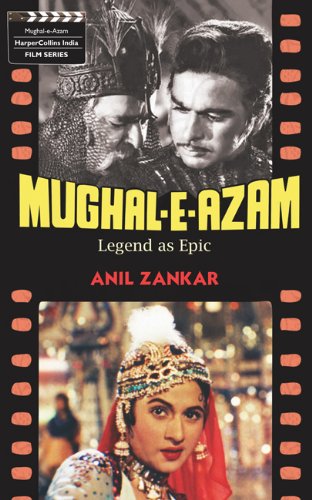
Book Review: Anil Zankar’s ‘Mughal-e-Azam: Legend as Epic’

In the nearly ten years this blog has been in existence, I’ve reviewed hundreds of films. Including many, many Hindi films. Some have been big hits, others so obscure that even fairly faithful followers of my blog, seeing the name of the film in their RSS feed, have probably decided my review didn’t even merit a visit.

But there are also the (to some) glaring omissions. Every now and then, someone wonders why I’ve never got around to reviewing some of the most iconic Hindi films of the pre-70s period. Mother India. Guide. Pyaasa. Devdas. To them I say that I fear I will not have anything to say that somebody or the other hasn’t already said, and probably in a far better and more informed way than I could.

Among the films about which I’m asked, again and again, is Mughal-e-Azam.

This one is a somewhat more puzzling omission from my list of reviews, given that I am deeply interested in Mughal history, I am very fond of Madhubala, and that the film really does have near-cult status. So much so that it was even the first full-length film anywhere in the world to be digitally coloured for a theatrical re-release (in 2004). But what would be the point of me writing about Mughal-e-Azam? Almost anybody who’d be interested enough in the film to read my review of it would almost certainly have already seen the film, and chances are, would know not just the story, but would have decided and definite views about much of the rest of the film, too: the characters, the songs, the dialogue, the historicity (or lack of it).

All of this, too, was in my mind when I began reading Anil Zankar’s Mughal-e-Azam: Legend as Epic (Harper Collins Publishers India, 2013; 200 pages; Rs 250). I was intrigued: what would Zankar have to say about a film so well-known?

Continue reading

Nishaan (1965)

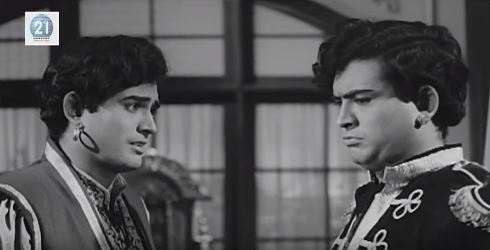
When I watched the 1949 Nishaan last week on Youtube, the topmost recommendation in the side panel was what was billed as another copy of the same film. Just for the heck of it, I clicked on the link, and arrived at a completely different film: Nishaan, yes; but a Nishaan made 16 years after the 1949 one, and a Nishaan too which is important for one major reason: it marks Sanjeev Kumar’s debut in a lead role (and that too a double role).

Sanjeev Kumar had already played small parts in two films—Hum Hindustani and Aao Pyaar Karein, but this film, with ‘Introducing Sanjeev Kumar’, was his first big role(s). He didn’t soar to success immediately, and most of his films over the next couple of years were fairly forgettable (as Nishaan is, to some extent). But despite the general unimpressiveness of this film, what stands out is the very natural acting of its leading man.

Continue reading

Nishaan (1949)

I came to this film by way of a song (that happens with unsettling frequency to me).

Five years ago, when Shamshad Begum passed away and I was researching a song list featuring her voice, I came across Jaiyo jaiyo sipahiya bazaar, and was blown away. Not just by Shamshad Begum’s ability to sing in multiple languages, but by the general appearance of the song. There was apparently something fun going on here. So I made a mental note that if I came across Nishaan on Youtube, I’d watch it.

Well, I did. And, in a refreshing change from a lot of those films I’ve seen because of songs, this one turned out to be pretty good. It’s a classic raja-rani film, with feuding families, a really black-hearted villain, twin brothers as heroes, and an enterprising heroine.

Continue reading