Book Review: Manek Premchand’s ‘Director’s Chair: Hindi Cinema’s Golden Age’

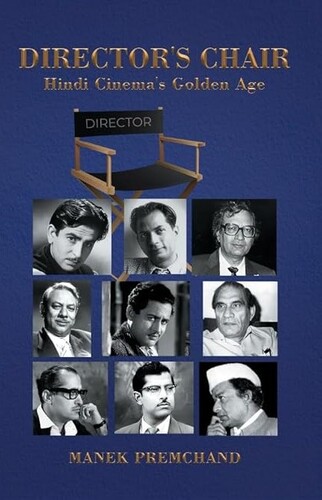
Amongst all the many books on Hindi cinema I’ve read over the years, most have been about actors, or (rather more occasionally) composers, singers, or even lyricists. Biographies, autobiographies, analytical insights into their work. Meena Kumari, Balraj Sahni, Asha Bhonsle, Rajesh Khanna, Ashok Kumar, SD Burman, Majrooh Sultanpuri, Sahir Ludhianvi, Helen, Lata Mangeshkar, Dev Anand, and many others. By contrast with these, I can count on the tips of my fingers the number of books I’ve read about directors. Hrishikesh Mukherjee (by Jai Arjun Singh), Basu Chatterji (by Anirudha Bhattacharjee) and Nasir Hussain (by Akshay Manwani); even an autobiography by Kidar Sharma. But other than that?  Not too many. Or none that I’ve read (though, I will admit, I am yet to read both Nasreen Munni Kabir’s and Sathya Saran’s books on Guru Dutt).

I was keen, therefore, to read Manek Premchand’s ‘Director’s Chair: Hindi Cinema’s Golden Age’ when its publisher, Blue Pencil Publishing, offered to send me a complimentary copy. I am of the firm belief that a director plays a huge role in making a film what it is: yes, everybody plays their part, but how so many disparate elements are brought together, how the sum becomes greater than its parts, is up to the director.
Continue reading

Talat Mahmood: Ten Solos, Ten Composers

Today is the birth centenary of the ‘King of the Ghazal’, the inimitable Talat Mahmood. Talat was born on February 24, 1924 in Lucknow, and it was in Lucknow itself that he obtained his initial training in music: at the Marris College of Music, where he learnt classical Hindustani music from Pandit SCR Bhatt. By the age of sixteen, Talat was singing the ghazals of Urdu’s foremost poets for All India Radio Lucknow, and was soon taken on by HMV as well. His first introduction to cinema came through the film industry in Calcutta, where he not only sang songs (under the name ‘Tapan Kumar’), but also acted in several films. In 1949, at the age of twenty-five, Talat moved to Bombay, and the rest, of course, is history: he went on to become one of Hindi cinema’s most distinctive voices, and his songs—romantic, filled with pathos, tender, soulful—still live on.

Continue reading

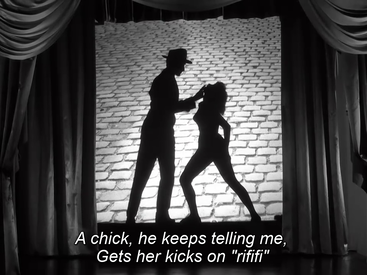
Rififi (1955)

Fact 1: In the 1956 Hindi film CID, there was a song (composed by OP Nayyar, lyrics by Majrooh Sultanpuri) which went Jaata kahaan hai deewaane… kuchh tere dil mein fiffi, kuchh mere dil mein fiffi. The censor board pounced on the song, accusing that ‘fiffi’ word of being obscene. Sultanpuri, Nayyar, and the director Raj Khosla insisted that it was a meaningless word, just put in as a filler to help marry the tune to the lyrics. The censor board refused to change its stance, and the song remained out of the film. In the 2015 film Bombay Velvet, the song was resurrected and sung by Suman Sridhar.

Fact 2: In the 1955 French film (note the year: 1955, a year before CID) Rififi, there’s the title song, sung (and performed onscreen too) by Magali Noël. Though the French word rififi (which is military slang) can be roughly translated as ‘rough and tumble’, referring mostly to the macho strutting of toughs of the like of this film’s main characters, the song’s lyrics give it a differently nuanced spin. Innuendo, through and through.

Continue reading

Yaadein (1964)

In its category for Fewest actors in a narrative film, the Guinness Book of World Records begins the list with this:

“Excluding monologues, the only narrative films with a single cast member have been Yaadein (India, 1964), written, directed and produced by Sunil Dutt (India), who was also its only actor….”

(Only two other films are listed in this category; one is the 2002 French-American production Lettre; the other is the 2004 Kannada film Shanthi).

I have known about Yaadein for a long time now; it was aired on Doordarshan when I was a child, and I remember my parents watching it. I wasn’t allowed, because this is one of those rare Hindi films from that era which had an A certificate. I do recall, though, my parents telling me that it was a unique film, with only Sunil Dutt in it.

Continue reading

The LO Goes to the Little Rann of Kutch

We ushered in the New Year this time in Ahmedabad (see my blog posts, on Historic Ahmedabad and on more around Ahmedabad). But Ahmedabad, really, was just on the way—for a place I’d been looking forward to visiting for a while now: the Little Rann of Kutch, which is home to the Wild Ass Sanctuary, India’s largest wildlife sanctuary.

The Little Rann of Kutch is just about 95 km from Ahmedabad along a very good highway, so it can take less than two hours to cover the distance. We had booked a cottage at a resort (in the village of Dasada) named Rann Riders by Kaafila, and had arranged for them to have us picked up from Ahmedabad. Given that we are interested in history, we opted to take a longer route to get to Dasada: through Patan and Modhera, which are home to some of Gujarat’s most iconic historical structures.

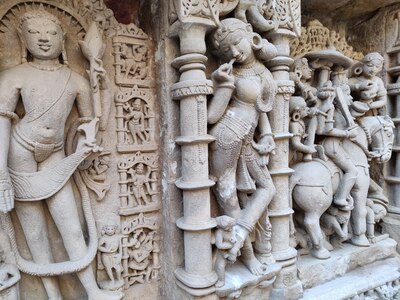
Rani ni Vaav, Patan
Section of carvings at Rani ni Vaav
Continue reading