
When Dharmendra passed away earlier this year, it struck me that while I have watched many of his films—from both before and after 1970, the cut-off year for my blog—I have reviewed relatively few. I decided, therefore, to make amends. By watching, for instance, Aaye Din Bahaar Ke and Aaya Saawan Jhoomke. Here’s another one, teaming Dharmendra with one of his more frequent co-stars, Sharmila Tagore.
The story begins on a road where Sunil (?) is walking along with his father, Hari Ram (?). Daddy, walking in the middle of the road [? Why? Also, you know what’s going to happen when a character walks in the middle of the road], is hit by a car, and the next we see, he’s dying in hospital, with Sunil, Sunil’s younger sister, and their mother (Achla Sachdev) looking gloomily on while a policeman tries to get Daddy’s final testimony. Daddy manages to gasp out an accusation: Seth Vishwanath has murdered him; the car accident was no accident. He dies, and the cop goes off to arrest Sethji.
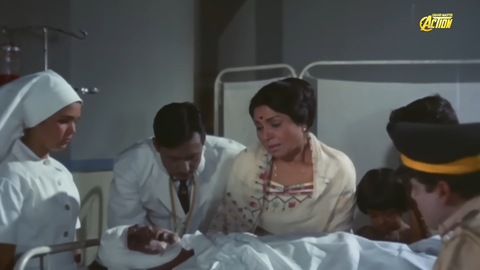
Sethji (?) has either had a tip-off or is realistic enough to guess what’s coming. He has a hurried conversation with his friend and confidant Ajit (Rehman). All his business, as well as his little daughter Anita, he hands over into Ajit’s care. There is one other instruction: on no account must Ajit allow Sethji’s estranged (and pregnant) wife anywhere near Anita. Ajit promises.
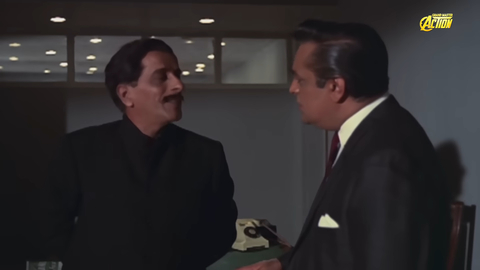
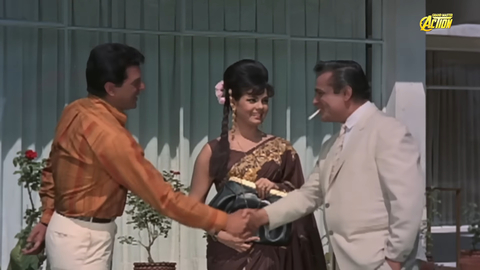
Years later, Ajit is not only looking after the business interests of Anita (now Sharmila Tagore) but is also trying to get her interested in him [given that he took charge of her when she was a child, and that he was her father’s friend and probably old enough to be her father, this is icky]. He spares no opportunity to flirt with Anita, but she gives him the cold shoulder or tries to deflect his attentions.
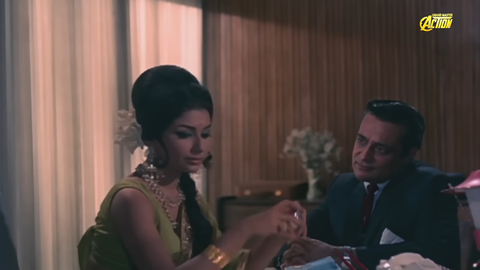
… especially as she has fallen in love with Sunil (now Dharmendra). The first time Sunil sees Anita is at the studio of an artist friend of his, Bharti (?), for whom she is modelling. Sunil catches one glimpse of her and is bowled over. In whispers, he asks Bharti who she is, and Bharti says, dismissively, that she’s a model whom he picked up somewhere for this particular artwork. Sunil assumes she’s poor, and before leaving, slips Anita a five rupee note.
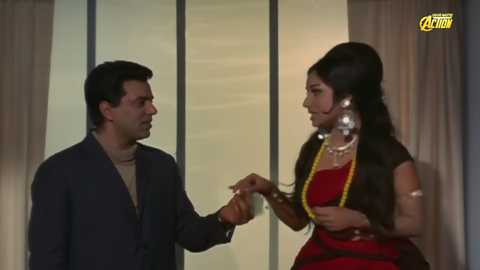
When he’s gone, Anita laughs over the incident with Bharti and warns him not tell Sunil the truth about her: that she’s an heiress. Let him believe I’m poor, she says: I’ll have some fun at his expense. Later, when Anita has begun dating Sunil, she admits to her friend and companion, Meena (Mumtaz), that she feels even more deeply about Sunil because his love is sincere. Because he thinks she’s poor, he is not—like the many other men who fawn over her—after her money.
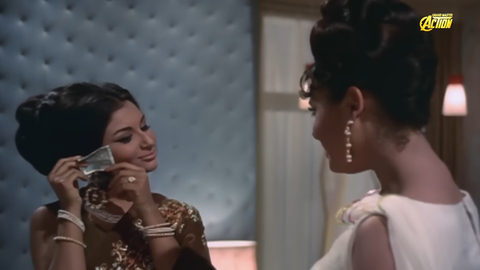
But for now, she’s not going to be telling Sunil who she really is.
It’s not easy, though, to carry on a charade of this sort when you’re dating someone. Anita ends up spinning a series of lies to keep Sunil in the dark: that she works as a maid in a wealthy household, and all her fine sarees and heavy jewellery are hand-me-downs or borrowed from her generous mistress. One day when Sunil insists on escorting Anita to her home (she says she lives in the garage of this palatial mansion), Anita is forced to pretend that Meena—who emerges just then—is her mistress.
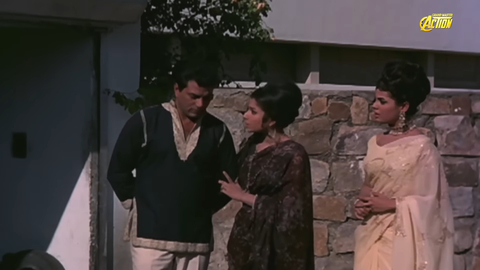
Meena plays along, to the extent that some days later, when Sunil and Ajit both arrive at the mansion simultaneously (and she knows that Ajit will be furious if he discovers that Anita is dating Sunil), she tells Sunil surreptitiously that Ajit is her fiancé; and she tells Ajit (also surreptitiously) that Sunil is her fiancé. Why on earth? Why not invent a completely unromantic reason for each man to be at the mansion?
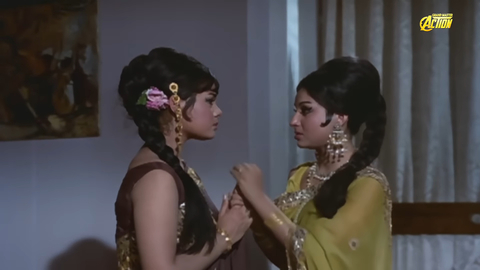
One day, Anita inadvertently listens in on a conversation and discovers that Meena is not quite the innocent and loyal friend she had imagined: she is a plant. No, not a green-leaved one, but a spy for Ajit. Ajit was the one who had introduced her to Anita, and all this while she has been keeping an eye on Anita. And reporting back to Ajit. Anita is very hurt about Meena’s betrayal [such hypocrisy, from someone who is doing all she can to keep Sunil in the dark about who she really is]. She confronts Meena, Meena breaks down and is remorseful—and they kiss and make up, with Meena promising to give Ajit a taste of his own medicine.
In the meantime, Anita has also met Sunil’s mother and his sister Mohini (Snehlata). Both of them are very eager to have Anita as daughter-in-law/sister-in-law ASAP.
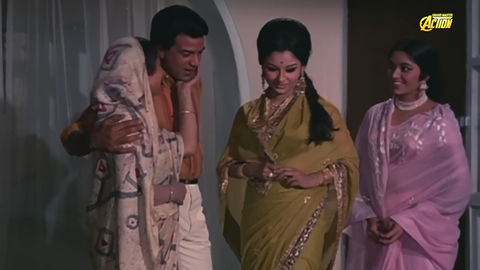
Also in the meantime, another person has appeared on the scene: Ramesh (Santosh Kumar?) is a very old and very good friend of Anita’s, so when he arrives in India from a stint abroad, she goes to the airport to receive him—and there bumps into Sunil and his family. It turns out [this has to be the unlikeliest coincidence of all] Ramesh is Mohini’s fiancé. Um. Given that Ramesh is such a good friend of Anita’s, why hasn’t he yet told her of his engagement?
With Ramesh in town, Anita decides to host a party. Sunil, of course, is invited, to Meenaji’s party. There, however, he bumps into his boss (Brahm Bhardwaj), who wants to know how Sunil happens to know the wealthiest heiress in town… and, to cut a long story short, the cat is out of the bag. Sunil realizes he’s been duped, and is livid.
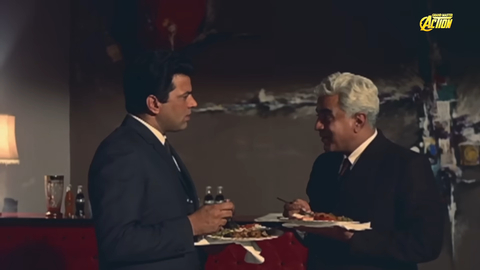
What now happens is a whole series of hissy fits and I’m-going-to-have-my-revenge stuff as Sunil seethes, Anita simpers and tries to woo him back with coy smiles, and Meena comes up with the most woolly-headed ideas to charm Sunil back to Anita’s side. All of them backfire, and it is seriously beginning to look as if the Anita-Sunil romance is a thing of the past.
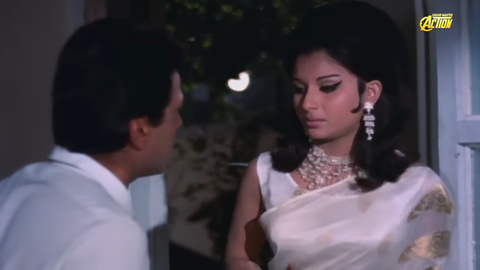
But there’s more. Remember Anita’s father’s instruction about his pregnant wife? That woman is still alive. And so is the child she bore.
If you’d rather not watch the film (and I would strongly advise against watching it), just let me know and I will tell you what happens next.
What I liked about this film:
The music, by Laxmikant-Pyarelal, with lyrics by Majrooh Sultanpuri. Every single song in Mere Humdum Mere Dost is a classic, from the title song to Chalo sajna jahaan tak ghata chale to Allah yeh ada kaisi hai in haseenon ki, to Chhalkaaye jaam to Hui shaam unka khayaal aa gaya. Humein toh ho gaya hai pyaar may not be as well-known as the other songs, but it’s still a good one, and one of the rare Lata ‘cabaret’ style songs.
And, the beauty of Sharmila Tagore and Dharmendra. And of Mumtaz, too, who is cute as a button.
What I didn’t like (hold on to your seats; this is a long list)
The sheer lack of logic through much of it. Why would you think that a girl, just because she’s a model, is automatically dirt-poor? Why would a girl so poor she lives in a garage and wears her mistress’s hand-me-downs have all the time in the world to gallivant about rather than be working? (Also, if her mistress is so very generous, why does poor Anita live in the garage?)
Then, the utterly inappropriate title of this film. Your dearest friend, your kindred spirit, your soulmate: is a person you trust, a person you confide in. Not someone you believe the worst of (and this happens again and again, both on Sunil’s part and on Anita’s). Both Anita and Sunil, too, are emotionally rather immature, and seem to think romance consists of singing nice songs. Their love story is basically one string of songs and misunderstandings, the latter mostly stemming from bad ideas.
Instead of telling him at the outset that she let him believe her poor because she suspects all men of chasing her for her wealth, Anita chooses to try and coax Sunil out of his fury by pulling a fast one on him and staging an engagement, basically ‘trapping’ him into a formal bond. And when that only serves to get him even more angry, she happily acquiesces to Meena’s harebrained idea: snuggle up to Ramesh to get Sunil jealous so that he comes right back to Anita. Guess where that goes.
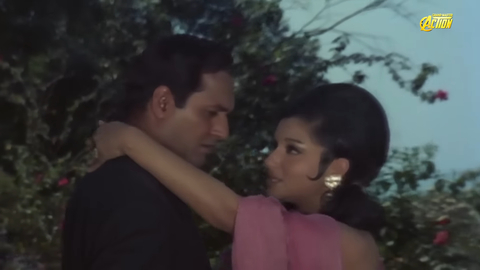
Then, the icky age-gap-but-still-trying. There’s Ajit, who took over as Anita’s guardian when she was a child but is pursuing her. There is also Sunil’s idiotic pal Dhand (Om Prakash, in one of his more annoying roles), who has a grown-up daughter but spends a good deal of his time trying to flirt with Meena. Ugh.
Also, the slip-ups and plot holes and total lack of attention to detail. For example, why does Bharti sign his paintings ‘S. Kumar’? [because S. Kumar is credited with the paintings in the film; in which case why not give the painter character a name that began with S? Not rocket science]. Also, who is the little kid Sunil and Mohini’s mother is seen tending to in a very motherly sort of way? Since Mohini and Sunil are both unmarried, this is obviously not a grandchild. And since it has at least been fifteen years since Hari Ram died, and the kid is definitely only about four or five years old… samajhne waale samajh gaye hain, as they say.
Director Amar Kumar (who also wrote the screenplay) was the man who directed the sensitive Garam Coat; who’d have thought?
Basically, despite the good cast, the excellent music, and the big names in the crew (Hrishikesh Mukherjee as editor, Rajinder Singh Bedi as dialogue writer), this one’s a dud. Do not watch.
I think I need to watch another Dharmendra-Sharmila film to get over this one. Perhaps Anupama.
 Dustedoff
I was thinking about watching this just the other day. I can’t remember if I’ve ever watched it so thought maybe I should. I definitely won’t be now, better to just watch the songs and leave it at that. I have just watched Aaya Sawan Jhoom Ke and watched Aaye Din Bahar Ke a couple of months ago. They have the usual formula, everything going well before it all starts to go wrong but I still enjoyed them. I love all the Aaya Sawan Jhoom Ke songs.
LikeLiked by 1 person
I think all these films of Dharmendra actually had pretty good music – and they were visually appealing. The rest… better left undiscussed! Aaye Din Bahaar Ke and Aaya Saawan Jhoomke were entertaining enough (though they had flaws), but this one is just too flawed and silly to be enjoyable.
LikeLiked by 1 person
I’m curious – what happens next? I have my own guesses and would like to see if they’re accurate (:
LikeLiked by 1 person
LoL! Don’t even attempt trying to figure it out, because it’s so convoluted and so random.
Basically, Sunil and Anita get together after she sings a song – but then Sunil’s mother discovers that Anita’s father was the one who killed her husband, so she refuses to let Sunil marry her.
And Anita discovers that her mother (Nighar Sultana, looking rather raddled) is alive and well, and that she had given birth to a baby, who is… Meena. Initially, the mother refuses to admit she is Anita’s mother, but this gets sorted out after disaster strikes the family: Sethji, who has been in jail all this while, is finally released and is heading home on the train, accompanied by Ajit. On the way, Ajit murders him (perhaps because he’s got so used to enjoying Sethji’s wealth and doesn’t want to let go of it?)
But – as in Agatha Christie’s 4.50 From Paddington – a woman (Ruby Myers/Sulochana) in a passing train sees the whole incident from the train window. There is some silly delay in bringing Ajit to justice because the woman’s husband refuses to let her testify because she might get into trouble blah blah but Sunil helps him see the light. :-)
And that’s it. Ajit goes to jail, everybody is reunited, and all is bliss.
LikeLiked by 2 people
Oh, Madhu, I was rather taken aback when I saw which film you had chosen to review… but I giggled at your asides and nodded my head in agreement to every point you made in the ‘don’t like’ section. I wish you’d eviscerated it more!
Gosh, this is such a silly movie and I remember thinking (when I first watched it on DD) that all this lying and scheming had better have some repercussions. But no, sau khoon mu’aaf! Because they are pretty people doing not-so-pretty things, I guess. Can’t believe the names associated with this film, and I don’t mean just Dharam/Sharmila. I mean, I’ve seen some cockamamie films in my time and shaken my head at the illogical goings-on and plot holes ad nauseum, but this one takes the cake, the bakery and the cherry on top, doesn’t it? What a waste of all that talent and the absolutely gorgeous score. (Which gives me a great idea for a post…)
LikeLiked by 2 people
Anu, I remembered that it was a bad film – but I had forgotten just how bad! Oh, God. So inane. What on earth were they doing here? Why did none of these people, with so much talent (and I’m not even talking of the cast, which is excellent – but Hrishikesh Mukherjee? Rajinder Singh Bedi?) not tell the producer/director that this needed serious editing of the script itself?
What a waste of all that talent and the absolutely gorgeous score. (Which gives me a great idea for a post…)
Horrible movies with great scores? I hope so – and I’m already looking forward to whatever you have planned, even if it’s not that!)
LikeLiked by 1 person
Bingo! : -)
LikeLiked by 1 person
Yay! I am looking forward to that, Anu. My brain is already whirring with all the films I would put on that list. :-)
LikeLike
I had seen this movie on Doordarshan decades back. Your assessment is perfect and your narration is amusing. Let me tell you one thing Madhulikaji. Dharmendra and Sharmila Tagore share their birthday (8th December). In addition to Anupama, they have worked together in gems like Devar and Satyakam also. Once again compliments for the good review.
LikeLiked by 1 person
Thank you for reminding me about the fact that they shared a birthday. I knew that, but had forgotten it. And yes, of course they worked in some very good films together. My memories of both Satyakam and Devar are hazy, but I do remember that I liked Satyakam more. :-)
Thank you for the appreciation, Jitendraji. I’m glad you enjoyed this post.
LikeLiked by 1 person
When I started reading my first thought was, “Oh, again a father is being killed in a Dharmendra film!” Then I thought, “This is going on the path of Anari (1959). Then I absolutely lost interest in the characters of the movie, who were behaving like some teenagers in a sitcom. The loss of interest was reserved only for the characters, your writing was as ever lovely. It made me laugh. Thank you for you article, dear Madhu.
LikeLiked by 1 person
characters of the movie, who were behaving like some teenagers in a sitcom.
So true! They were, indeed – totally brainless. The only thing about films like this (barring the good music and the eye candy) is that they make for amusing reviews.
LikeLike
Interesting read, Madhuji.
I agree with both you and Anuji that it was a rank bad film.
But it proved to be a milestone in Dharmendra’s career in a way. After eight years of struggling to make a mark as a serious actor, he acted in six movies in 1968, four of which were flops, including Mere Humdum Mere Dost.
On the other hand, that year’s number one film was Aankhen, which was a thriller. And Dharmendra almost never looked back. Dharam Garam of the “Kutte, Main Tera Khoon Pee Jaaonga” was born.
I am saying “almost”, because Hrishikesh Mukherji and Gulzar occasionally cast him in interesting roles.
Similar case with Jeetendra who started in Shantaram movies and evolved into “Mr Jumping Jack” until Gulzar cast him in movies like Khushboo and Kinara.
Regards,
Uday
LikeLiked by 1 person
Yes, indeed – it was with Aankhen that Dharmendra finally went into action hero mode. I somehow associate his gentler roles only with films like Anupama, Devar and Satyakam, but it is true even of quite a few of these social melodrama sort of films: any fighting etc was pretty incidental, and it was basically a lot of weepiness.
LikeLiked by 1 person
Lovely review as well. I find the song ‘Chhalkayein jaam quite difficult to watch.’ And yes, I’ve almost never understood the need to go on telling lie after lie instead of just bite the bullet and tell the truth.
LikeLike
I totally agree with you about both points. Chhalkaaye jaam is better heard than watched – it does make me feel pretty uncomfortable too. And why go on lying? And turning cartwheels to maintain those lies? Far better to tell the truth and face up to whatever comes your way.
LikeLike