
Aka Golconda ka Qaidi: a film made both in Hindi as well as English, though I’ve only seen the English version, not the Hindi, which I couldn’t find anywhere, despite much searching.
Prem Nath directed and starred in Prisoner of Golconda, which also starred his wife Bina Rai and his younger brother Rajendra Nath (whose debut this was, going by the film’s credits). I don’t remember now how I happened to stumble upon the film on YouTube, but I was immediately intrigued; Indian films in English from that era always have that effect on me. What’s more, on a web page, I saw it mentioned (as it turned out, incorrectly) that Prisoner of Golconda was a fantasy. This, I decided, was a film that might merit watching, since the last Prem Nath-starrer fantasy I saw, Aab-e-Hayat, was a thorough entertainer.
But no, Prisoner of Golconda is no fantasy at all. This is a patriotic film, a story set in the early 1940s, and Prem Shankar (Prem Nath) is a police officer, an ASP, who comes to the rescue of a besieged police station where the local officer, Zorawar Singh (Hiralal) has found himself surrounded by a crowd of irate locals. These people, full of anger for the high-handed ways of the British government (and, naturally enough, seeing in the police the embodiment of that colonial government) have been on the rampage. They have already set fire to a post office and are now getting ready to destroy the police station as well.
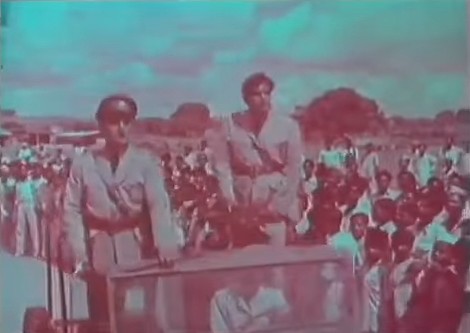
In these circumstances, Prem arrives on the scene and instead of using force to dispel the protestors, uses logic: would Gandhiji, whom they have been invoking all along, approve of their violent behaviour? Let Gandhiji and Pandit Nehru and all those other leaders whom they respect emerge from jail, and then follow where they lead. Not with blood on their hands.
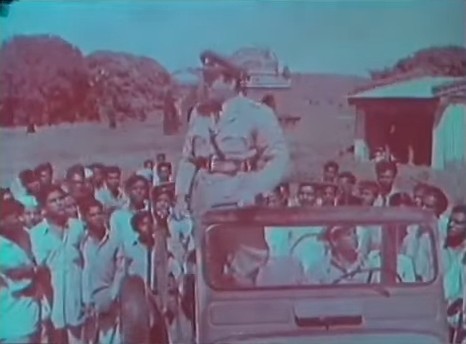
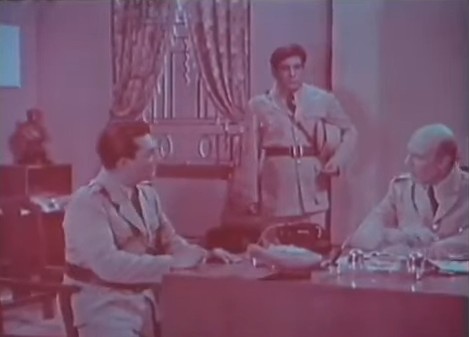
The crowd disperses, and Zorawar Singh, though momentarily relieved, is also very affronted. Prem elbowed in on his territory; this is Zorawar Singh’s jurisdiction, not Prem’s. Prem shrugs it off, but Zorawar Singh is so incensed, he goes to his boss, the Inspector General (Michael Shea? I’m not sure). He complains that Prem spoke to the crowd of Gandhi etc: he is a traitor. The boss is suitably furious, and decides that matters must not get out of hand.
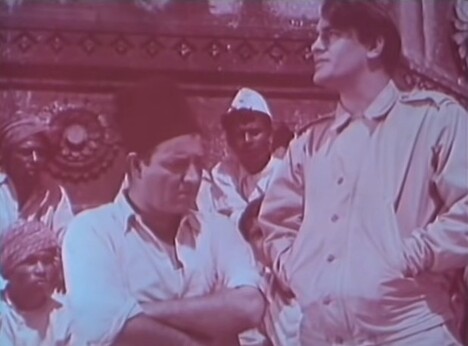
In the meantime, Prem has been talking to the ring-leaders of the crowd he had addressed—and they happen to be two people he knows very well. One is his younger brother Jindar (Rajendra Nath, looking very young and lanky and earnest); the other is Jindar’s friend Ashfaque (Agha). They are two hot-headed young bloods, both eager to do whatever it takes to get rid of the British. But Prem, as before, soothes them and preaches satyagraha.
However, Prem soon finds himself out of a job. Zorawar Singh’s complaints have had their effect; the IG summons Prem, and he is dismissed for his anti-establishment views. Prem freely admits that he is patriotic and wants India’s independence; but insists that that doesn’t get in the way of him doing his job. The boss doesn’t listen to him.
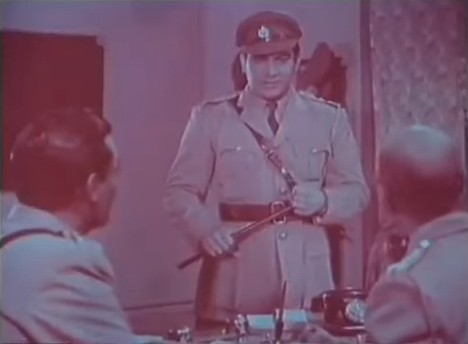
Prem goes home and breaks the news to his mother (Shobhna Samarth). He tells her that he will now serve Mother India. Ma is horrified: like Jindar, Prem too has “gone crazy”. And, anyway, she reminds him, what of Krishna, whom Prem is supposed to be getting married to, very soon?
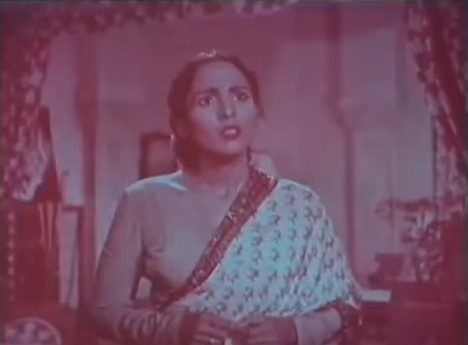
Prem goes to explain to Krishna ‘Kittu’ (Bina Rai), and though she is initially shocked and distressed to discover that her fiancé has lost his job and has decided to join the freedom movement, she assures him that she will wait for him. Prem promises her that they will get married on the day India becomes independent.
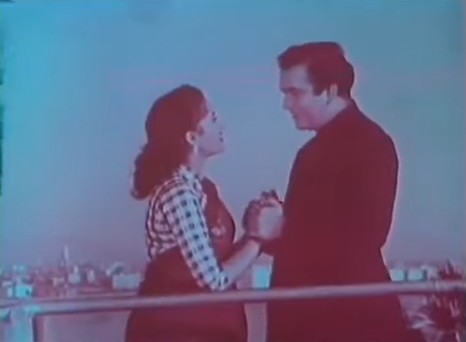
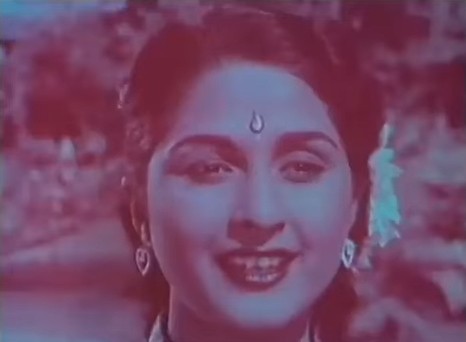
… and then he goes off to join Jindar and Ashfaque and their group, who seem to spend all their time loafing about in some ruins and shouting Inquilab zindabad. That appears to be the sum total of their freedom-fighting.
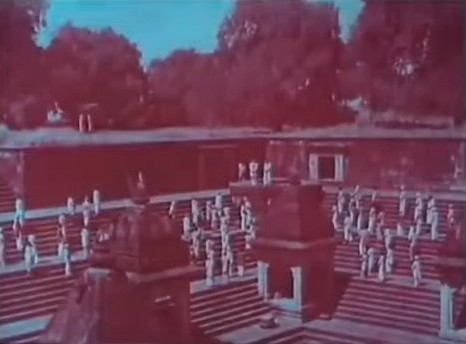
Of course, all this rebelliousness will not go unnoticed for long, especially since Zorawar Singh is still smarting from the humiliation of Prem’s ‘rescue’. He heads the police move to put down this particular group of freedom-fighters. They chase the group all across town, and finally manage to lure Prem by attacking his mother. Prem goes to Ma’s rescue, and gets there just in time to have her die in his arms.
This is the moment Zorawar Singh has been waiting for. Prem is finally caught, and is imprisoned in the Golconda Fort. That’s how he ends up as the Prisoner of Golconda.
This was, actually, an odd sort of film. Why did Prem Nath think he could find a market for it in English-speaking countries? I’m not sure too many non-Indians would feel the sense of patriotism Prisoner of Golconda seeks to convey (and that too without a tenth of the grandeur, panorama, historicity and just general all-round storytelling that marked, say, The Tiger and The Flame). True, this is a shortish film (just over an hour long), and it does not have the songs that Western audiences may have found intrusive, but still: I don’t think this would have really worked if it was released in the West. The YouTube video where I watched this has a caption that says it’s unreleased, but whether that refers to release worldwide or not, I have no idea.
What I liked about this film:
What I didn’t like:
Random thoughts about this film:
Honestly, that is what I do have to say about Prisoner of Golconda. Just some observations, nothing particularly didn’t like, or even liked.
Let’s start with the story, by Prem Nath’s father, Rai Bahadur Kartar Nath Malhotra. Rai Bahadur Sahib had been an IG of Police (and we stayed in the house he and his family had occupied in Rewa), so I can see why Prem Shankar in this film is a cop, and so on… It is not, however, a fantastic story. It’s a little lacklustre, there’s a lot of patriotic bombast and sloganeering, but not very much else until the last fifteen minutes or so when something momentous happens in the Prem-Kittu romance.
The diction is something that has always intrigued me when I’ve come across one of these films made in English but with an Indian cast. Prem Nath came across as pretty fluent (I was not surprised by this) as did Rajendra Nath, though because he was so overwrought through most of the film, it was a little difficult to understand him at times. Bina Rai, though she has a small role, was good, her diction clear and quite natural. The one person who amused me was Agha: nothing wrong with his diction, but his dialogue, his actions, everything were pretty much the sort of character he played in countless Hindi films: nutty, uninhibited, unintimidated by anyone and anything. He was fun, but I do wonder how many Westerners watching this film might have thought so (and the very idea of such a comic character, in a film with an otherwise ‘serious’ tone? Would that have seemed out of place?)
Spoiler alert:
One interesting element here reminded me of the Nargis-Karan Dewan starrer Lahore: during communal riots (in this case, in the lead-up to Independence), Kittu’s home is attacked and she is raped. Shortly after, Prem escapes from the fort-prison with the help of Jindar and Ashfaque; by the time August 15th is imminent, Prem has found a now heavily pregnant Kittu in a refugee camp. She goes on calling herself ‘unworthy of him’, but Prem brushes all that aside. He still loves her, he will still marry her.
I was pleased about this. It not only showed a sensitive acknowledgement of the sort of trauma women had to undergo, it also encouraged the same sensitivity in men.
… and then, a pregnancy suddenly gone haywire, and Kittu dies on the verge of being married.
What? Did you chicken out of showing your ‘tainted’ heroine happily married, Mr Malhotra?
Spoiler ends.
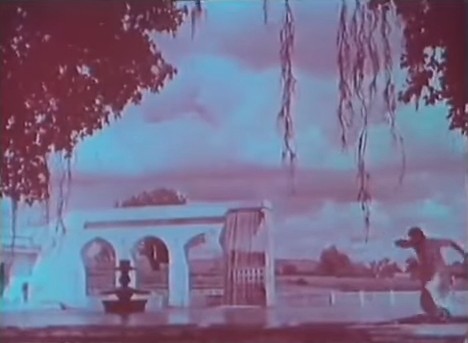
But yes, one thing I liked very much here: the fact that Prisoner of Golconda was filmed in Aurangabad, and you get to see a lot of the city’s monuments, from Panchakki:
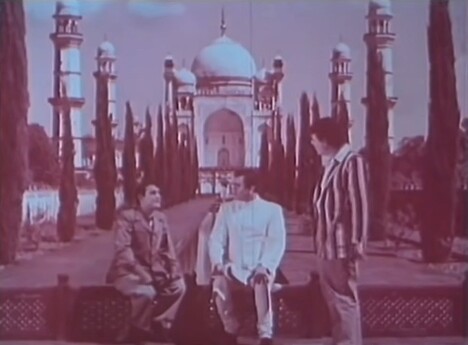
To Bibi ka Maqbara:
To Daulatabad Fort, masquerading as Golconda Fort:
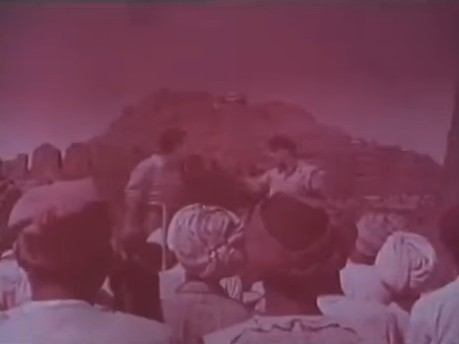
Since I had visited Aurangabad—and all these sites—just a few months back, this aspect of the film appealed to me. I only wish the film wasn’t in that frightful reddish tone of Geva Color. Plain and simple black-and-white would’ve been so much nicer.
Interestingly, the Hindi version of the film, Golconda ka Qaidi, had some nice songs, with music by DD (Datta Davjekar) and Jagannath, lyrics by Anjaan and Prakash Sathi. They’re there in audio-only versions on YouTube, with some very catchy tunes; I really enjoyed Uthaake sar chalo jawaan and Hanso na bahaaron tumhe kya pata, among others. Prisoner of Golconda credits the music directors and lyricists, but does not have the songs.


What an interesting movie!
I would never have thought that Premnath would have produced, directed and starred in an English movie. I was also wondering why he would produce an English movie. Maybe it was not produced for western audiences but for an English-speaking Indian audience. English as spoken in the movie is very much proper Indian-English. I had to tune my ears to the idiom to understand it. That is why think that it didn’t find any distributors.
Thank you, dear Madhu, for introducing us to this film and your post. It was interesting.
LikeLiked by 1 person
That’s an interesting point, Harvey, that his intended audience might have been an English-speaking Indian one; that might have worked, given the tone and subject of the film. But in that case, I would also have thought that he would have retained the songs, even if they were in Hindi – because, from what I understand, lots of people who otherwise didn’t understand Hindi would still appreciate Hindi songs. And the songs in this film were good so I can well imagine audiences in (say) Southern states coming to watch the film primarily for the songs.
LikeLike
Thanks for the review, Madhuji.
I did not know about this movie, but I must watch it now. I assumed from the title that it was indeed a fantasy movie, but glad that it is actually based on the freedom movement, even if it was not a historically accurate depiction.
Since I have my own nostalgia for Golconda (the real fort, not the Daulatabad fort), I will definitely look for this movie.
Thanks once again for the pointer.
Regards,
Uday
LikeLiked by 1 person
Thank you for reading, and for commenting, Udayji. Yes, do watch – the Golconda angle (even if it’s actually Daulatabad!) is quite prominent in the film. BTW, talking of Golconda – have you seen the Manhar Desai-Nighar Sultana film Hyderabad ki Naazneen? Another film which references Hyderabad, but actually has nothing to do with it!
LikeLike
Golconda ka Qaidi has long been on my wishlist. I had no idea there was an English version available. I remember reading an interview of Premnath where he mentioned that this movie was about the INA and the censors foud it objectionable and cut it so much that the film became totally muddled and unfocussed. Is the INA part in the English version too?
LikeLiked by 1 person
Thank you for adding to this, Neeru. There is nothing in the film about the INA, so I’m really wondering where that went… and why the censors found it objectionable (because Nazir Hussain’s Pehla Aadmi was about his experiences with the INA). But perhaps the depiction/execution of the INA theme in Golconda was iffy? I don’t know.
LikeLike
I had heard of this film but haven’t watched it. From what you say, it does sound like it’s been heavily truncated, and not just the songs. I don’t think I will be watching it so reading your excellent review will have to do. :)
LikeLiked by 1 person
Yes, I took this one for the team! :-D As Greta used to say on her blog: I watch obscure movies so you don’t have to.
LikeLike
I did some research into this film, and apparently, the English version never did have a theatrical release. The YouTube version was uploaded by Premnath’s son in 1921.
LikeLiked by 1 person
The film’s caption did say that it was unreleased. I wonder whether he’d made it in English in the hope that he would be able to release it overseas, or whether the plan had been to release it for English-speaking audiences in India…
Also, 2021, I think? ;-)
LikeLike
🤦🏻♀️2021! I doubt if even Premnath was born in 1921!
From what I read, he didn’t find distributors for the English version. His earlier production, Shagufa, had failed and theatre owners were leery of an ‘English’ film finding a market. So it remained in the cans.
LikeLiked by 1 person
I guess I’m a sucker for punishment, because the first thing I did after I read your comment was to go look for Shagufa, to see if it was perhaps available online. It isn’t, so probably for the best!
Also, Anu, Happy Onam to you and yours.
LikeLike
I don’t think you should martyr yourself! :) Not even so you can get a good review out of it.
LikeLiked by 1 person
:-D Especially since I do have a bunch of (hopefully good) films waiting to be watched.
LikeLike